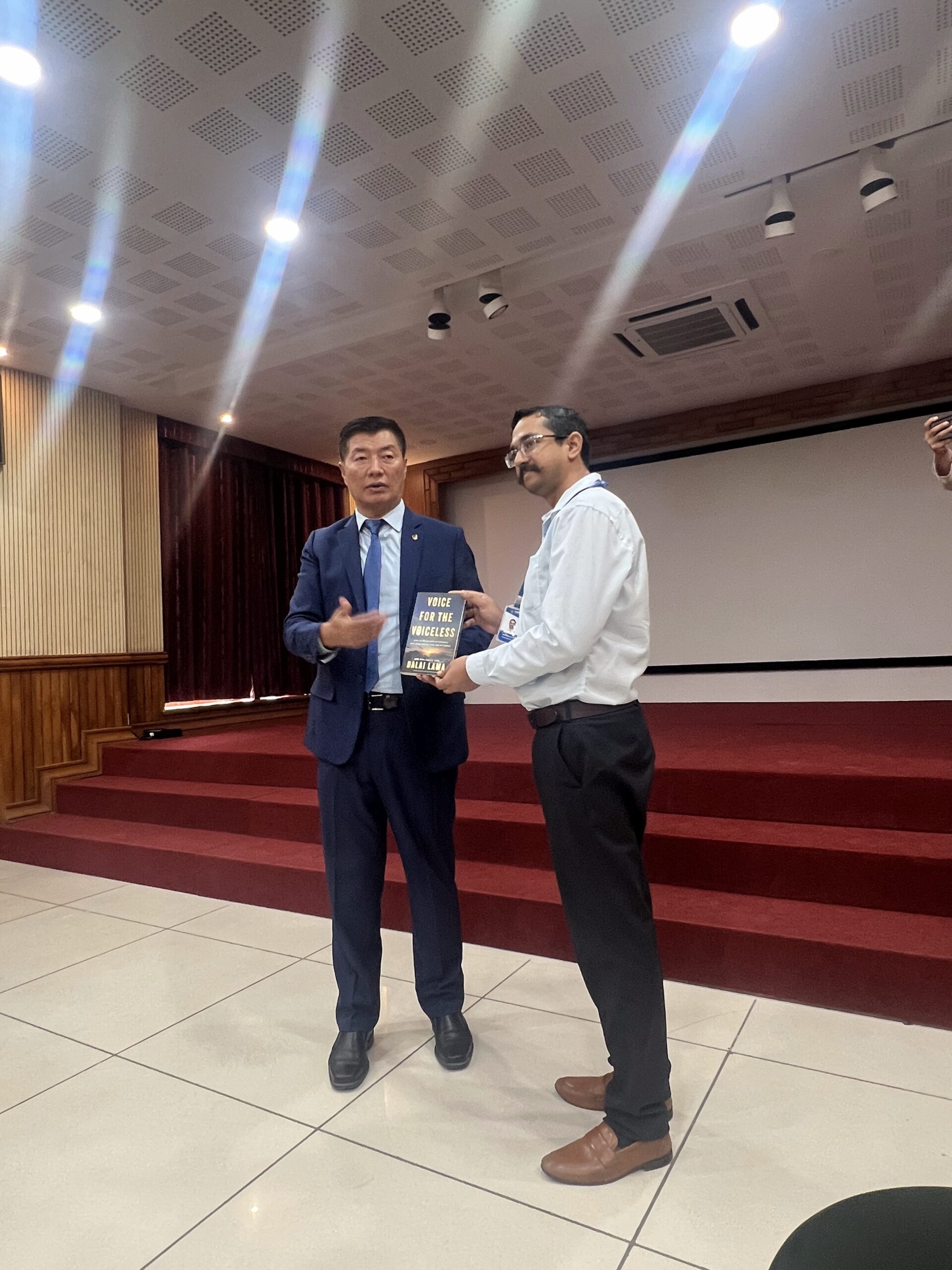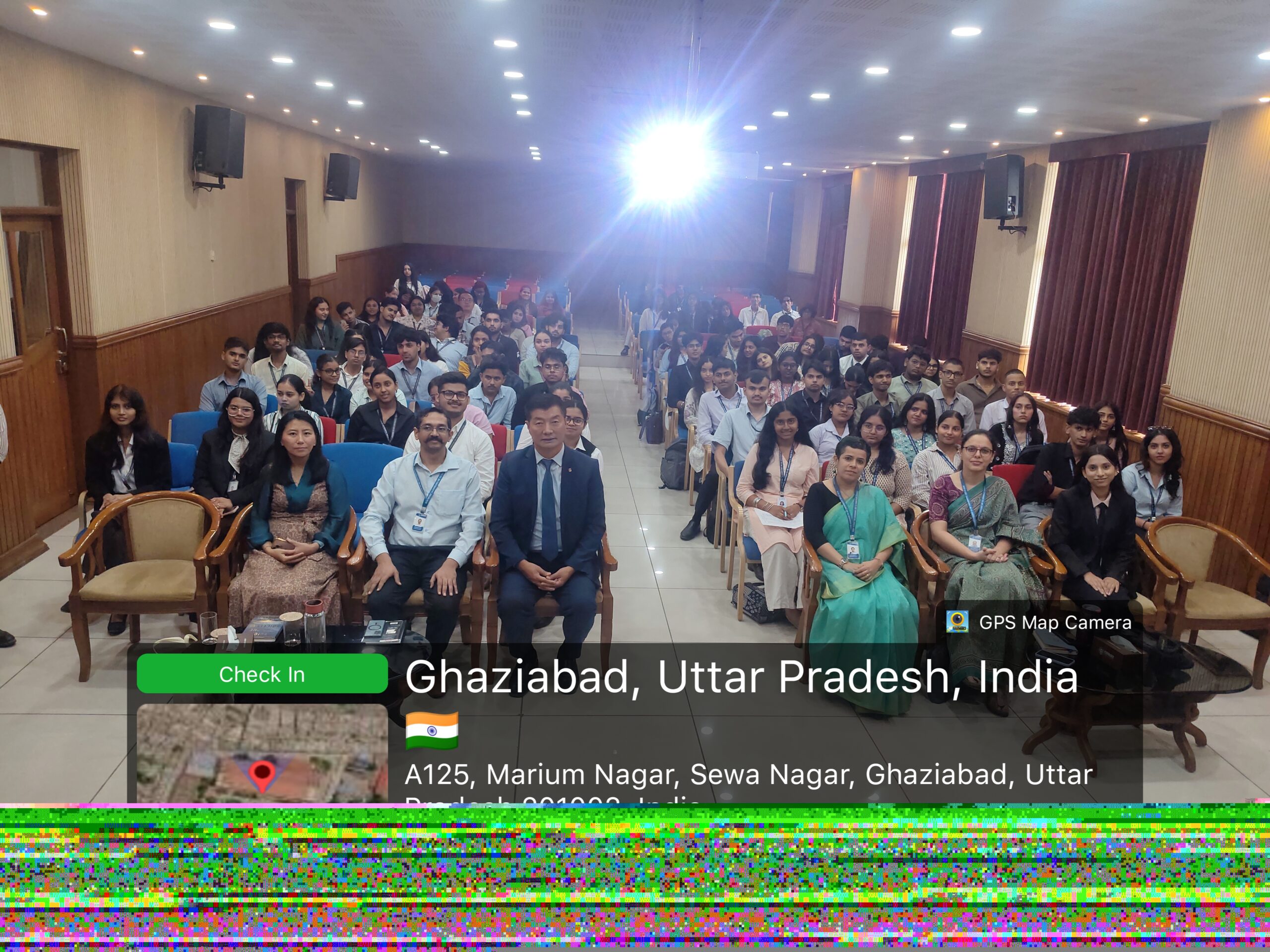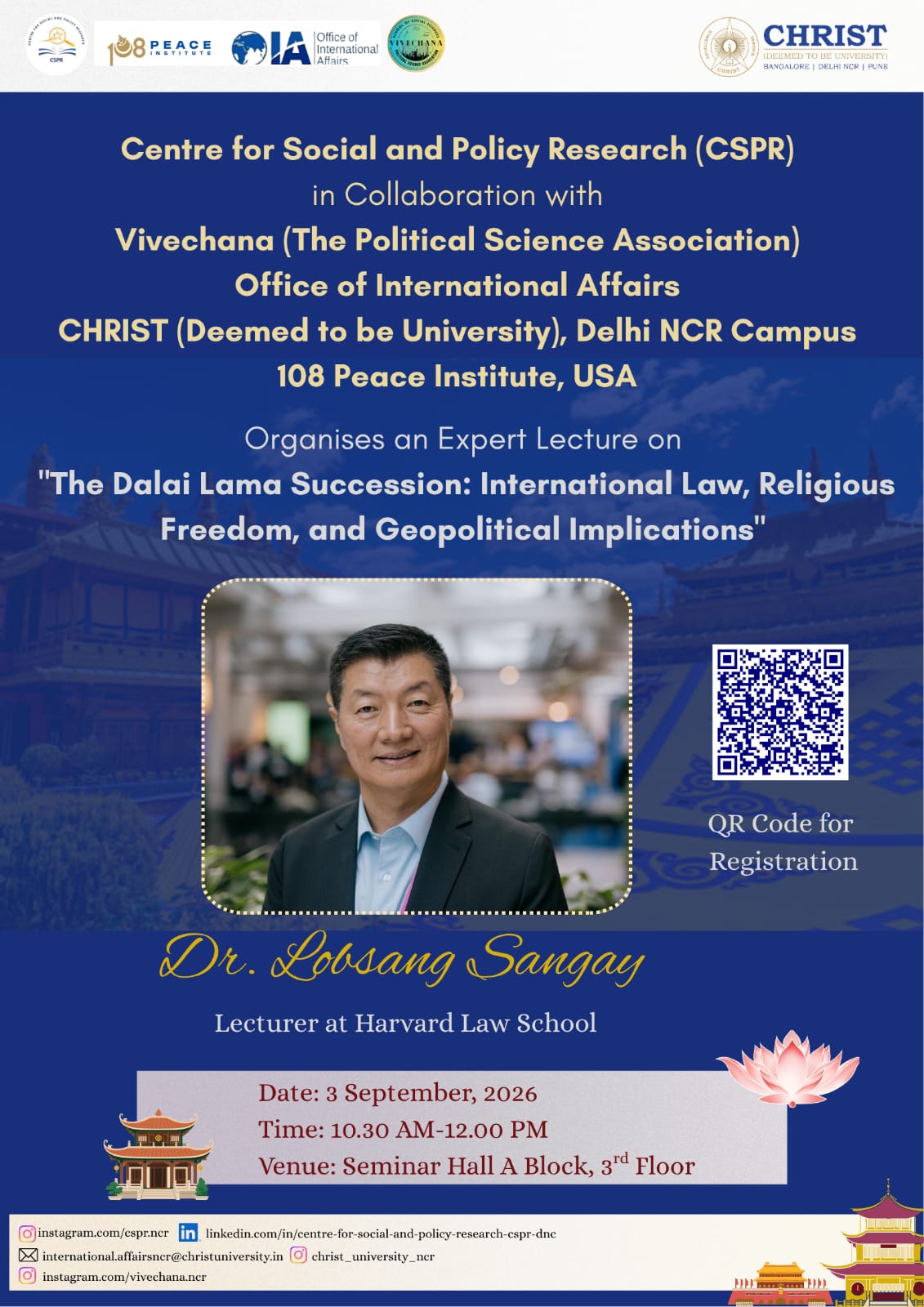
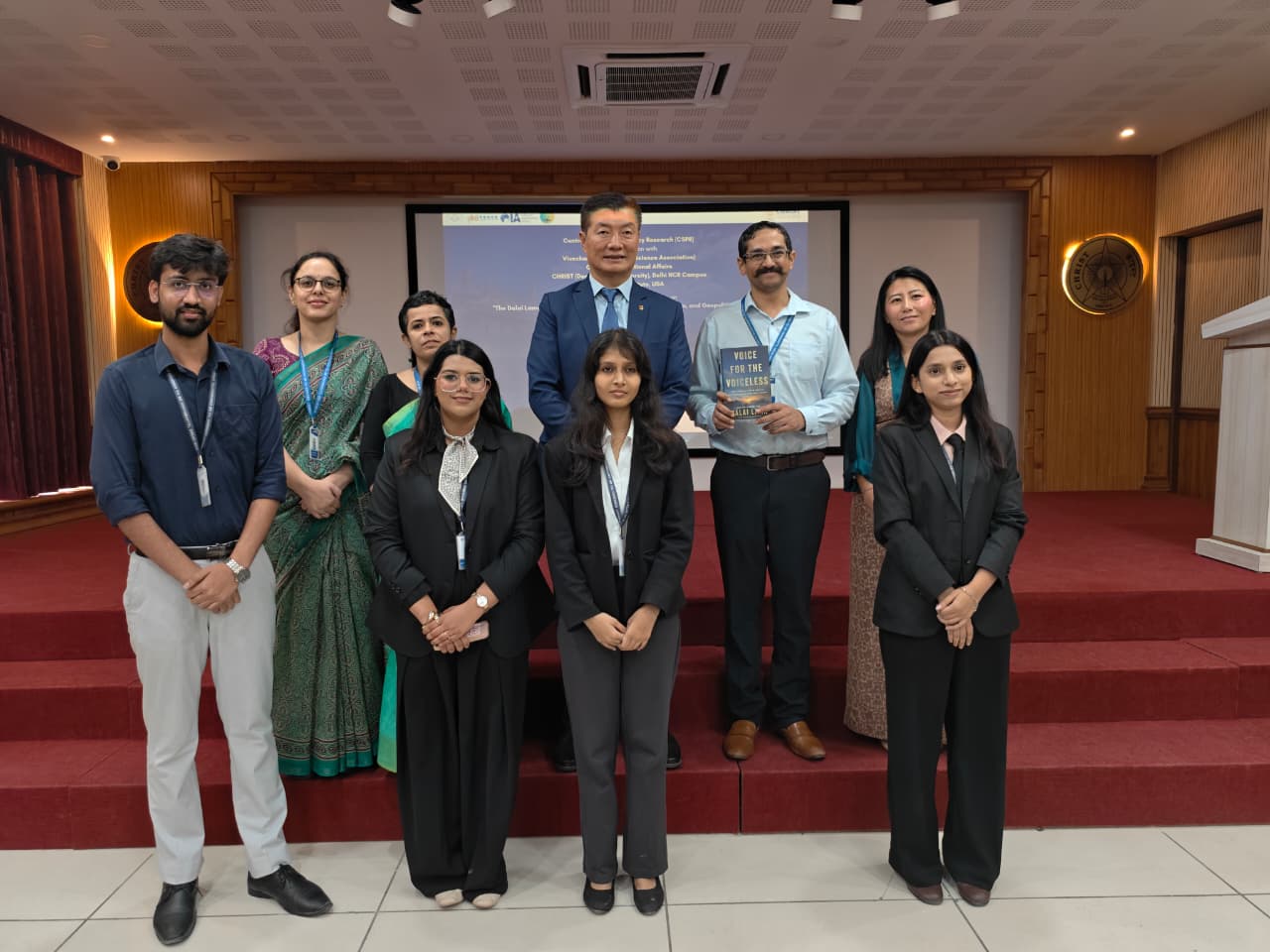
September 03, 2026: The 108 Peace Institute, in collaboration with the Christ University, Ghaziabad, hosted a lecture session on “The Dalai Lama Succession: International Law, Religious Freedom and Geopolitical Implications” at Christ University, Ghaziabad.
Dr. Lobsang Sangay began the talk by highlighting the devastating flash flood in Nepal’s Rasuwa district, which caused widespread loss of life and destroyed thousands of homes. He observed that the flood began in Tibet at 8:37 a.m. and reached the Nepal border at 9 a.m., arguing that Chinese authorities had approximately 20–25 minutes to warn Nepal but failed to do so. He questioned the availability and sharing of information from the Chinese side, arguing that China claims to have sophisticated monitoring capabilities in Tibet and they should have been in a position to provide timely information to Nepal. The absence of an adequate warning either reflected shortcomings in China’s monitoring system or a deliberate effort not to share information. He also criticised restrictions on foreign media access on the Tibet side of the border, contrasting this with the presence of international media outlets reporting from Nepal during the rescue and relief operations.
Tibet’s Fragile Ecosystem, Infrastructure, and Security Concerns
Describing the Tibetan plateau as the “water tower of Asia”, Dr. Sangay highlighted that Tibet is the source of several major Asian river systems, including the Brahmaputra, Indus, Sutlej, Salween, Yellow, and Mekong. Due to the Chinese illegal occupation of Tibet, China now controls over the upper reaches of these rivers and it has long been a concern for downstream countries, particularly India, Nepal, and Bangladesh. Dr. Sangay criticized China for not signing the UN International Convention on water sharing.
Furthermore, Dr. Sangay criticised China’s construction of hydropower projects on the plateau, arguing that dams and other infrastructure have environmental and strategic consequences for downstream countries. He particularly highlighted the large hydropower project being developed on the Yarlung Tsangpo, which is known as the Brahmaputra after entering India. The project in the Medog region has attracted considerable attention in India because of its scale and its location close to the Indian border in the state of Arunachal Pradesh. Sangay linked China’s infrastructure development in Tibet with India’s broader security concerns.
Furthermore, Dr. Sangay pointed to China’s expansion of roads, railways, mining operations, hydropower projects and urban settlements across the Tibetan Plateau. According to him, these developments have implications not only for Tibet’s environment and demography but also for India’s strategic position along the Himalayan frontier. China has significantly expanded transportation infrastructure in Tibet, including railway connections extending westward from Lhasa. Such infrastructure has both civilian and strategic significance, particularly because it can improve China’s ability to move personnel and equipment across the high-altitude region.
He argued that China’s combination of resource extraction, infrastructure development, and hydropower construction is changing the strategic landscape of the Himalayan region. He warned that China could be testing the impact of such a flash flood on downstream nations and worse could happen anytime with China having the remote control of the river system.
Reincarnation of the Dalai Lama
Dr.Sangay emphasized His Holiness the Dalai Lama’s July 2025 announcement on his reincarnation that the institution of the Dalai Lama will continue and the Gadhen Phodrang Trust ( His Holiness’ Office) have sole authority over the recognition of his reincarnation. He also noted His Holiness the Dalai Lama’s statement that he will be born in a free country, meaning away from the repressive Chinese regime. He criticized and expressed absurdity over atheist China’s claim over the recognition of Tibetan Buddhist reincarnations, particularly the Dalai Lama.
Dr. Sangay warned that the implication of a Chinese recognized fake Dalai Lama will cross far beyond the border of Tibet. The fake Dalai Lama will be used by Beijing to advance its political position among Tibetan communities and across the Himalayan region.
India-China Relations
Dr. Sangay also drew parallels between China’s engagement with India and subsequent periods of border tensions. He referred to the 1962 India-China war, former External Affairs Minister Atal Bihari Vajpayee’s 1979 visit to China, the 2017 Doklam standoff and the 2020 clash in the Galwan Valley. He argued that repeated diplomatic engagements have been followed by renewed tensions and questioned whether a fundamental recalibration in India-China relations is possible.
Dr. Sangay also referred to Chinese claims over parts of Arunachal Pradesh and its longstanding differences with India over the disputed boundary. He described China’s alleged strategy toward the Himalayan region using the phrase “five fingers strategy”, suggesting that Tibet forms the central strategic base from which Beijing seeks greater influence over areas including Ladakh, Sikkim, Arunachal Pradesh, Nepal and Bhutan.
Ethnic Unity and Progress Law
Dr. Sangay further discussed the case of Tibetan Martyr Lobga Rangzen, who self-immolated in front of the United Nations office on July 2 in protest against China’s Ethnic Unity and Progress Law. He criticised China’s policies toward ethnic minorities, describing them as a brutal effort to assimilate Tibetans and other minority communities into the dominant Han Chinese cultural and political framework.
Dr. Sangay ultimately framed Tibet as a central issue in the security, environmental, and geopolitical future of Asia. From water resources and hydropower to infrastructure, mineral extraction, border security and the reincarnation of the Dalai Lama, he argued that developments in Tibet have consequences extending well beyond the Tibetan Plateau. The July 2025 Nepal flood, he suggested, provides another example of how events originating on the Tibetan side of the Himalayas can have immediate consequences for downstream countries.
The talk concluded with a vibrant questions and answer session. Around 120 students and faculty from Dept. of Law and Political Science attended the session.