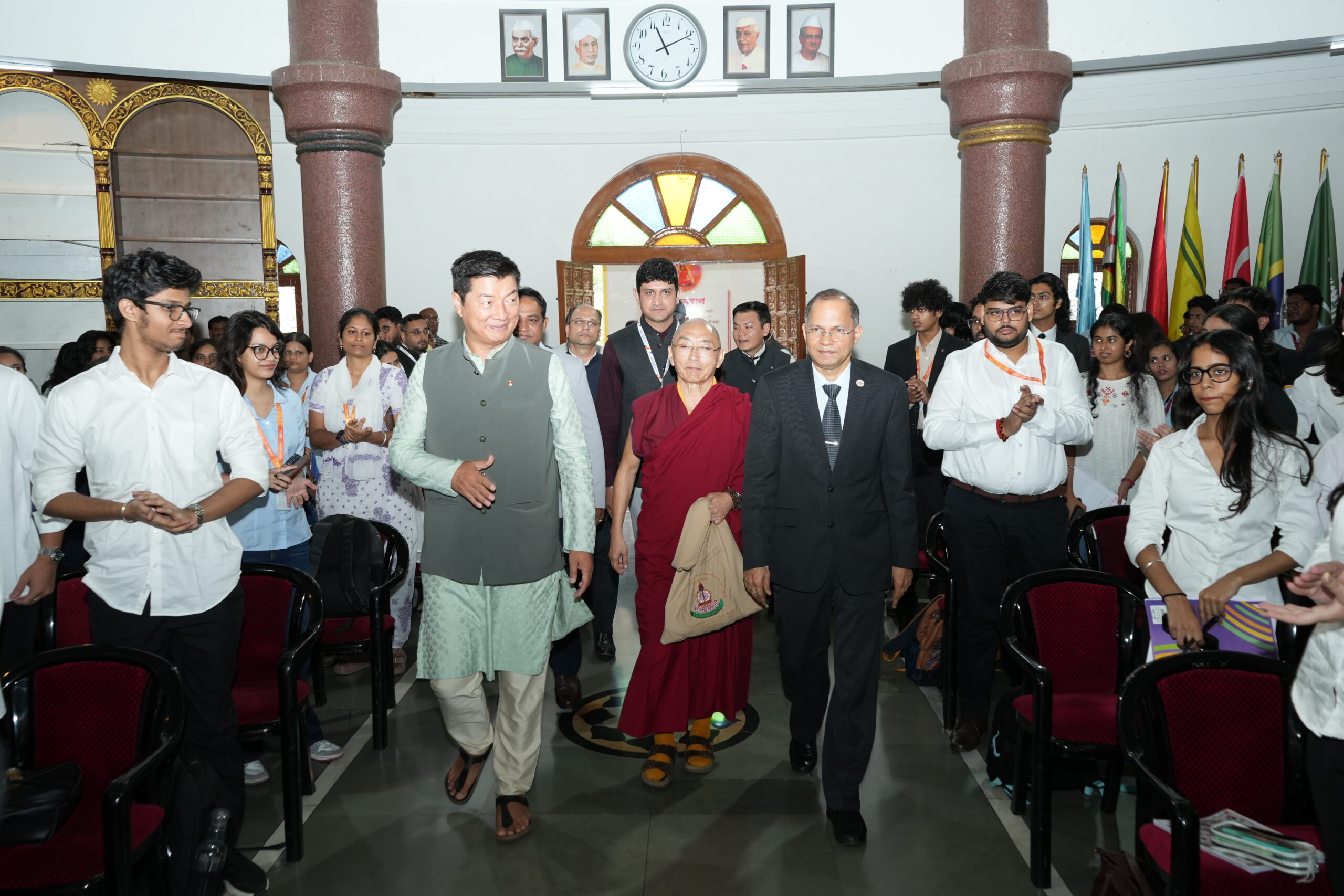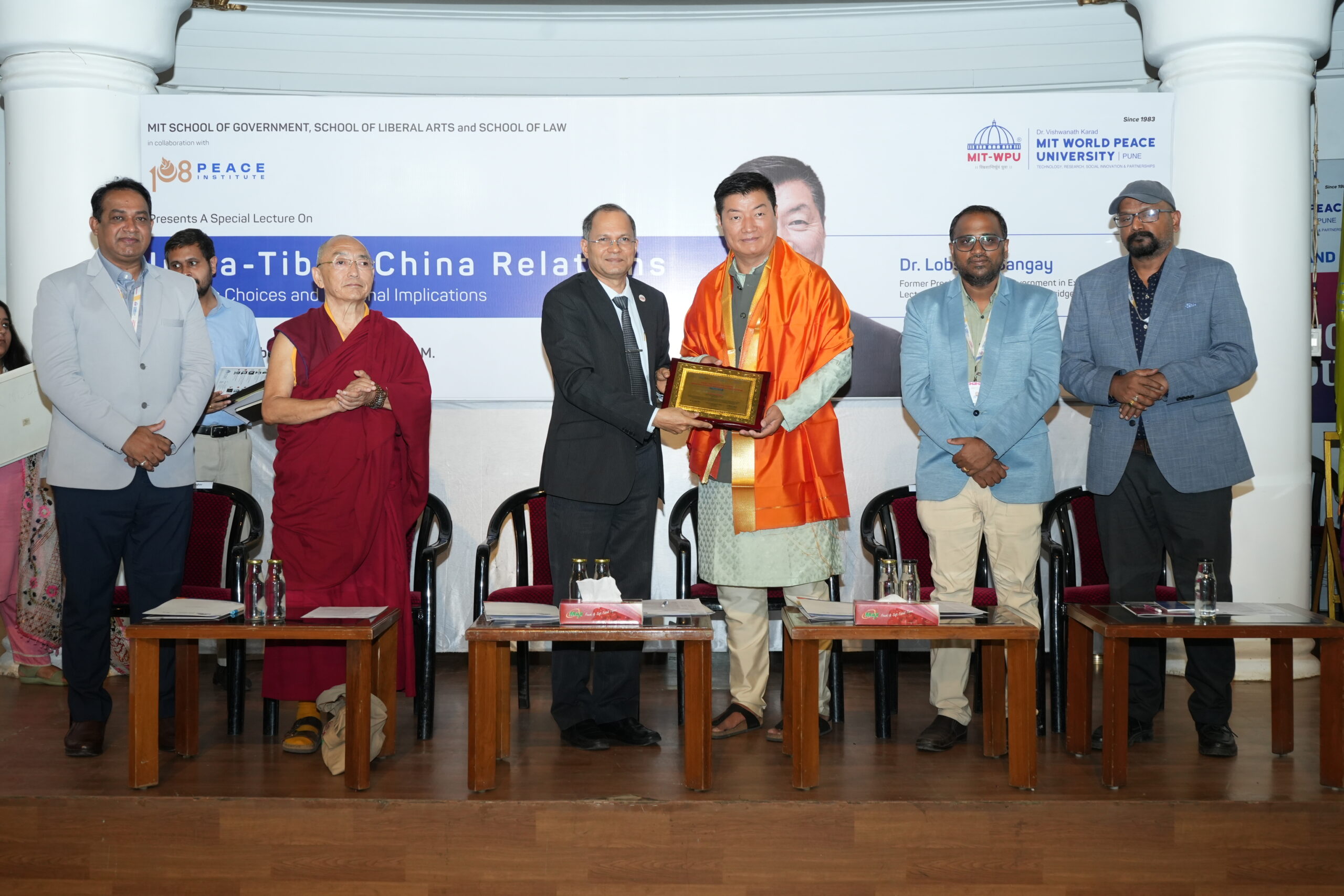
17 September 2026: The 108 Peace Institute Founder Dr. Lobsang Sangay delivered an insightful lecture on “India–Tibet–China Relations: Strategic Choices and Regional Implications” at Dr. Vishwanath Karad MIT World Peace University (MIT-WPU), Pune.
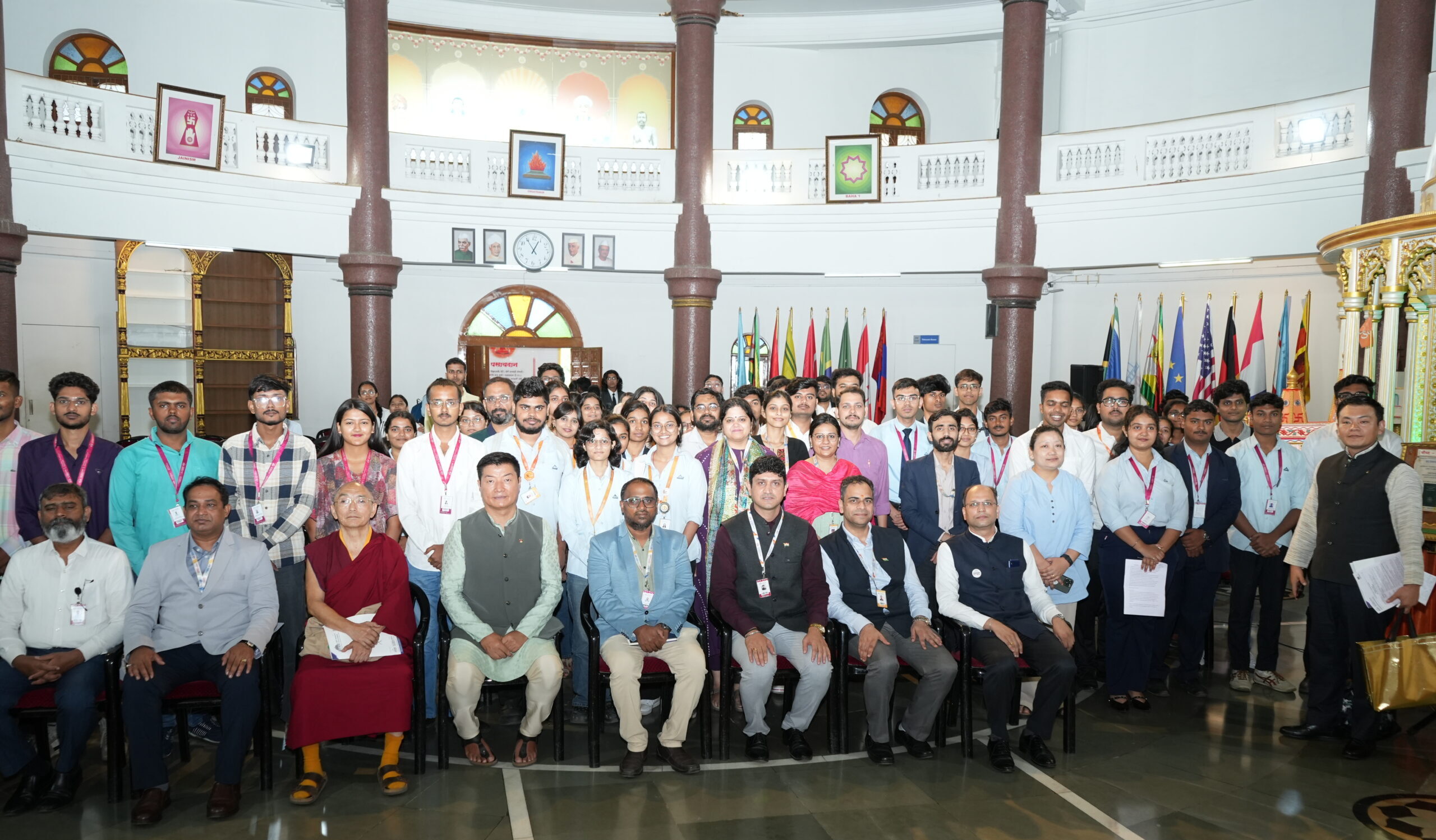
The programme was organized by the MIT-WPU School of Government, School of Liberal Arts, and School of Law, in collaboration with the 108 Peace Institute, and was presided over by Prof. (Dr.) Raviraja N. Seetharam, Vice Chancellor of MIT-WPU, along with senior faculty members and heads of departments. Around 200 students and faculty members attended the programme, which provided a platform for discussion on regional security, Himalayan geopolitics, leadership, education, and civilizational values.
In his opening remarks, Dr. Sangay introduced the audience to what he described as China’s “five-finger strategy” and its broader implications for India’s security and regional position. Referring to recent India-China diplomatic developments, he discussed China’s continuing claim over Arunachal Pradesh, which Beijing refers to as “South Tibet,” and argued that the issue remains central to the broader boundary dispute. He observed that following a recent BRICS summit, India and China issued separate statements, with India emphasizing the importance of resolving the boundary question, while China continued to maintain its position on Arunachal Pradesh.
Dr. Sangay emphasized Tibet’s strategic significance in understanding contemporary India-China relations. He argued that following China’s occupation of Tibet, India’s northern frontier underwent a significant geopolitical transformation. He urged students in Pune to pay attention to developments along the Himalayan border, emphasizing that developments in the region have consequences for the country as a whole.
Leadership and the Role of Young People
Dr. Sangay also shared his personal journey, from growing up in a small village to studying at Harvard Law School, and reflected on his experiences as a student activist at the University of Delhi. His journey, he noted, demonstrated the importance of education, perseverance, and civic engagement.
Encouraging students to become “changemakers,” he emphasized that meaningful leadership should be directed towards something larger than the individual, such as a cause, community, or country. He also spoke about what he described as the moral clarity of Generation Z and the importance of translating activism into sustainable social and institutional change.
Dr. Sangay distinguished between “revenge-based courage” and “compassion-based courage.” While anger may provide short-term motivation, he argued that compassion offers a more sustainable foundation for long-term engagement. Referring to an interaction with an activist who hoped to bring democracy to North Korea during his lifetime, he emphasized that commitment to a cause should not depend solely on personal timelines. He encouraged students to become “happy warriors”—people who remain committed to their principles while sustaining compassion, resilience, and inner balance.
China’s Rise and India’s Strategic Choices
A meaningful interaction followed between Dr. Sangay and the students. Addressing the central theme of the lecture, he presented what he described as two contrasting dimensions of contemporary China: China’s remarkable economic development and technological advancement and its ambition to become the world’s leading power by 2049 on the one hand. He drew a comparison with the rise of the United States, arguing that the US consolidated its position as the world’s leading power while keeping potential competitors such as Canada and Mexico relatively distant from the race for global dominance. In a similar context, he suggested that China’s pursuit of global leadership involves containing India’s rise as a major power.
Dr. Sangay also discussed India’s aspiration for a permanent seat on the United Nations Security Council (UNSC). He stated that India’s claim has received support from UN member states, including countries with veto power, but argued that China has opposed India’s bid because it does not want India to attain an equal position in the international system. He further referred to India’s efforts to secure international action against terrorism through the United Nations and argued that China has blocked some such initiatives. According to Dr. Sangay, these positions reflect broader strategic differences between China and India and demonstrate China’s reluctance to see India emerge as a stronger global power.
On the other hand, Dr. Sangay also highlighted what he described as China’s demographic decline, particularly the decline in birth rates over the past five years. He noted projections suggesting that China’s population could decline from approximately 1.4 billion to around 700 million by 2070 or 2100. He observed that demographic decline is also a broader global trend, but argued that for China it could have significant economic consequences, including a potential reduction in foreign direct investment if investors perceive a shrinking domestic market.
He further discussed China’s restrictions on capital outflows, noting that Chinese citizens are reportedly subject to a limit of USD 50,000 per person for transferring money abroad, compared with an annual limit of USD 250,000 per person in India. Dr. Sangay also referred to China’s record in poverty reduction, stating that while approximately 600 million people have been lifted out of poverty, another 600 million Chinese continue to live on less than USD 100 per month. He cited China’s debt-to-GDP ratio at approximately 97 percent and stated that debt among state-owned enterprises is around 300 percent.
Turning to China’s manufacturing sector, Dr. Sangay argued that the Chinese economy is increasingly dependent on exports, particularly in sectors such as electric vehicles (EVs). He stated that China exported approximately 12 million EVs last year, while its production capacity has reached around 50 million vehicles, creating concerns about excess capacity and limited market demand. He further noted that 83 countries have adopted measures or resolutions aimed at restricting the import of inexpensive Chinese steel, reflecting growing concerns over Chinese industrial overcapacity.
Dr. Sangay then examined India–China trade relations, highlighting a trade volume of approximately USD 150 billion, of which, according to the figures he cited, India exports around USD 30 billion worth of goods to China while importing approximately USD 120 billion from China. He argued that this substantial trade imbalance reflects India’s economic dependence on China and has contributed to pressures on Indian domestic manufacturing, including the closure of some local factories. He emphasized the need for India to strengthen its domestic production capacity while addressing the challenges arising from its economic dependence on China.
Tibet, Water Security and Himalayan Environmental Risks
A major part of the discussion focused on the environmental and water-security challenges of the Himalayan region. In response to a question on cooperation among the Himalayan states to prevent and respond to disasters such as the recent floods in Nepal, Dr. Sangay highlighted Tibet’s significance as the “water tower of Asia.” He noted that the Tibetan Plateau is the source of major rivers flowing into India, Nepal, Bangladesh, Bhutan, China, and ASEAN countries, and emphasized that Tibet historically shared these water resources with its neighboring regions before the Chinese occupation.
Dr. Sangay pointed out that China has not signed the 1971 UN Convention on water sharing, which, according to him, means that China is not obligated under that framework to share relevant data or undertake joint research with downstream countries. He highlighted the risks posed by the region’s numerous glacial lakes, noting that there are approximately 2,000 glacial lakes between Nepal and Tibet, of which around 20 are considered to be at a dangerous stage, while approximately 7,900 glacial lakes lie between India and Tibet. He stressed that the absence of adequate cooperation on joint research, data sharing, and disaster prevention could leave downstream countries particularly vulnerable to the consequences of glacial lake outburst floods (GLOFs).
Looking ahead, Dr. Sangay noted that environmentalists have warned that by 2030, glacier melt could exceed snowfall in the mountains, potentially intensifying water and ecological risks across the Himalayan region. He also highlighted China’s construction of approximately 300 medium-sized dams on the Tibetan Plateau, which he described as a highly seismic region. Dr. Sangay expressed concern about the relationship between large-scale dam construction and seismic risks, stating that dams can contribute to or exacerbate earthquake-related risks, a position on which he noted that he has been quoted several times.
Ancient Indian Wisdom and Education
Padma Shri Geshe Ngawang Samten also addressed the gathering, emphasizing the importance of cultivating peace within the mind rather than seeking peace solely through external circumstances. He appreciated MIT-WPU’s commitment to contributing to a peaceful world and suggested that the principles of ancient Indian wisdom and the transformation of the mind could be meaningfully incorporated into university education.
The programme concluded with an engaging interaction between Dr. Sangay and students on India–China relations, leadership, economic interdependence, environmental security, and the future of the Himalayan region. The lecture provided students with an opportunity to examine contemporary regional affairs through interconnected geopolitical, economic, environmental, security, and civilizational perspectives.