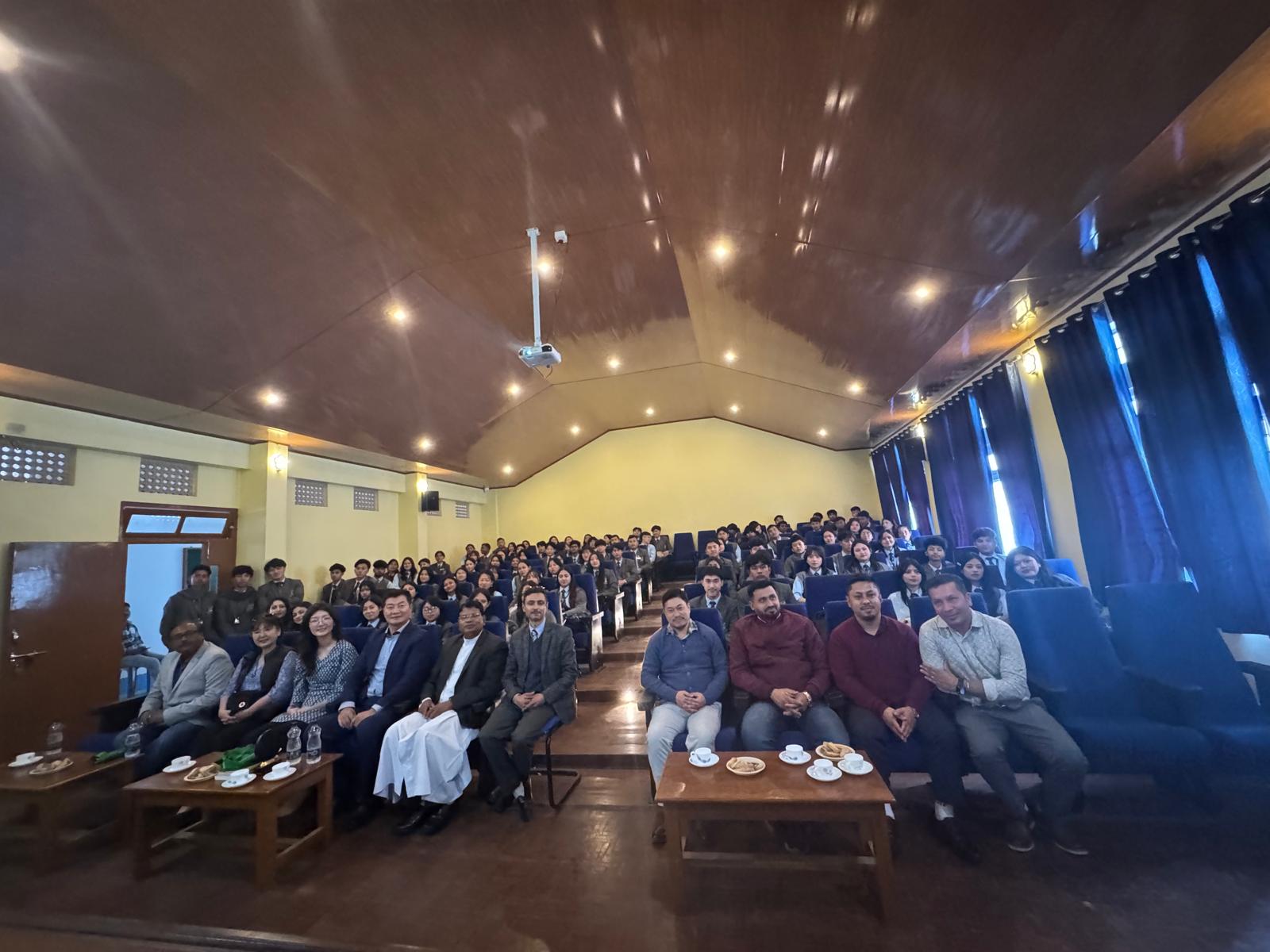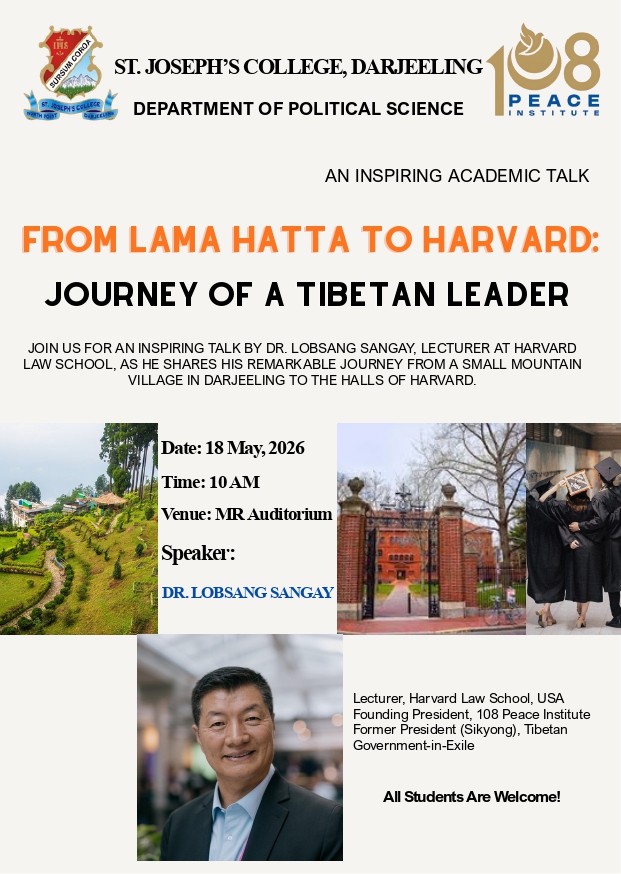
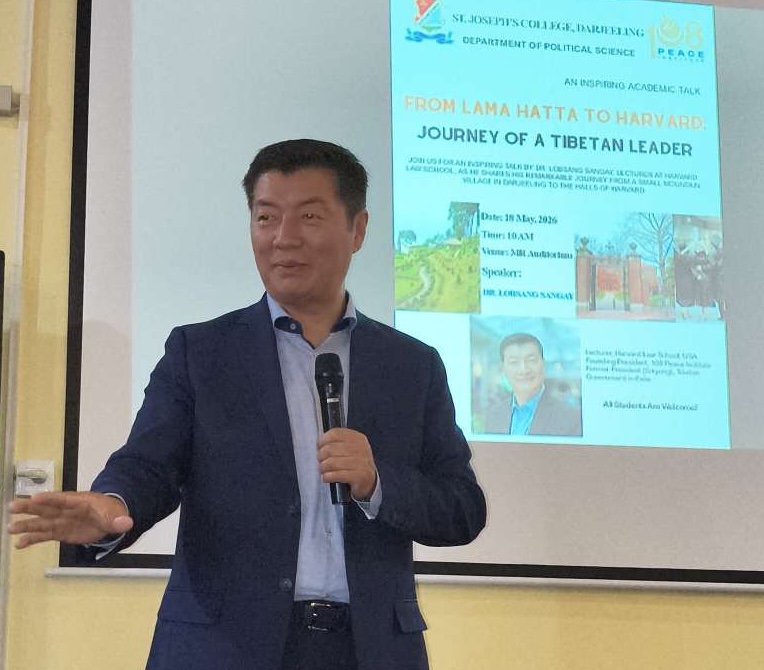
May 18, 2026: The 108 Peace Institute, in collaboration with the Department of Political Science, St. Joseph’s College, Darjeeling hosted a lecture titled “From Lama Hatta to Harvard: Journey of a Tibetan Leader.” The session featured Lobsang Sangay, Lecturer at Harvard Law School, and Founding President of the 108 Peace Institute.
Dr. Sangay opened the lecture by sharing his remarkable life journey, from his early years as a refugee child in Darjeeling to his tenure as Sikyong (President) of the Central Tibetan Administration from 2011 to 2021. He reflected on how his close association with His Holiness the Dalai Lama profoundly shaped both his personal values and political philosophy.
Reflecting on his experiences, Dr. Sangay emphasized that hard work and perseverance can open doors of opportunity for every student. He spoke about the role of compassion in helping individuals face challenges and criticism with resilience, describing it as a powerful catalyst for peace and positive change at both personal and societal levels. He noted that his decision to lead the Tibetan Government-in-Exile for over a decade, despite the significant opportunity cost of stepping away from a promising academic and professional career was deeply rooted in this principle.
Dr. Sangay also recounted the challenges involved in securing the passage of the Tibetan Policy and Support Act of 2020 during the height of the COVID-19 pandemic. Despite global travel restrictions and widespread shutdowns, he undertook extensive advocacy efforts and international engagement to build bipartisan support for the legislation. “Courage, when guided by compassion, will propel you toward your goal, no matter the odds,” he remarked.
He further highlighted that the U.S. government formally recognizes the Central Tibetan Administration as the institution representing the aspirations of the Tibetan diaspora and acknowledges Sikyong as its President.
Another key theme of the lecture was the Buddhist concept of equanimity, the ability to maintain balance during both adversity and success, which Dr. Sangay described as an essential quality of effective leadership across political systems.
Following his reflections on leadership, compassion, and public service, Dr. Lobsang Sangay addressed the spiritual and political significance of the future reincarnation of His Holiness the 14th Dalai Lama. He highlighted the Dalai Lama’s enduring influence on Buddhist communities across Tibet, Mongolia, the Russian republics of Tuva, Buryatia, and Kalmykia, as well as the Himalayan regions of Ladakh, Nepal, Bhutan, Sikkim, Arunachal Pradesh, and Himachal Pradesh. Revered by many as their “Root Guru,” the Dalai Lama continues to serve as a unifying spiritual figure for Buddhist communities across Asia.
Dr. Sangay referred to His Holiness’s recent statement affirming that the institution of the Dalai Lama will continue through reincarnation. He noted that this announcement came in response to longstanding requests from Buddhist communities worldwide for His Holiness to continue his legacy through reincarnation. Dr. Sangay emphasized that His Holiness has stated that his future incarnation will be born in a free country, a position also articulated in his book Voice for the Voiceless. He mentioned that the recognition of a reincarnated spiritual leader is a sacred matter rooted in Tibetan Buddhist tradition and should remain free from political interference. Criticizing attempts by the Chinese Communist Party (CCP) to influence the succession process, he argued that no political authority possesses the spiritual legitimacy to determine matters of reincarnation.
Explaining the traditional process of recognizing a reincarnation, Dr. Sangay noted that a regency or search committee authorized by the Dalai Lama would oversee the search for his successor following his passing. He stressed that the process is deeply spiritual and guided by centuries-old religious practices. Dr. Sangay also discussed concerns surrounding the 11th Panchen Lama, Gedhun Choekyi Nyima, whose whereabouts have remained unknown since 1995 after his recognition by the Dalai Lama. He expressed concern that China’s state-appointed Panchen Lama could be used to influence the future recognition of the next Dalai Lama.
The discussion offered students a deeper understanding of the intersection of spirituality, identity, and politics in contemporary Tibetan affairs, while underscoring the enduring relevance of compassion, courage, and moral leadership in addressing global challenges. The event saw participation of around 150 students and faculty members.