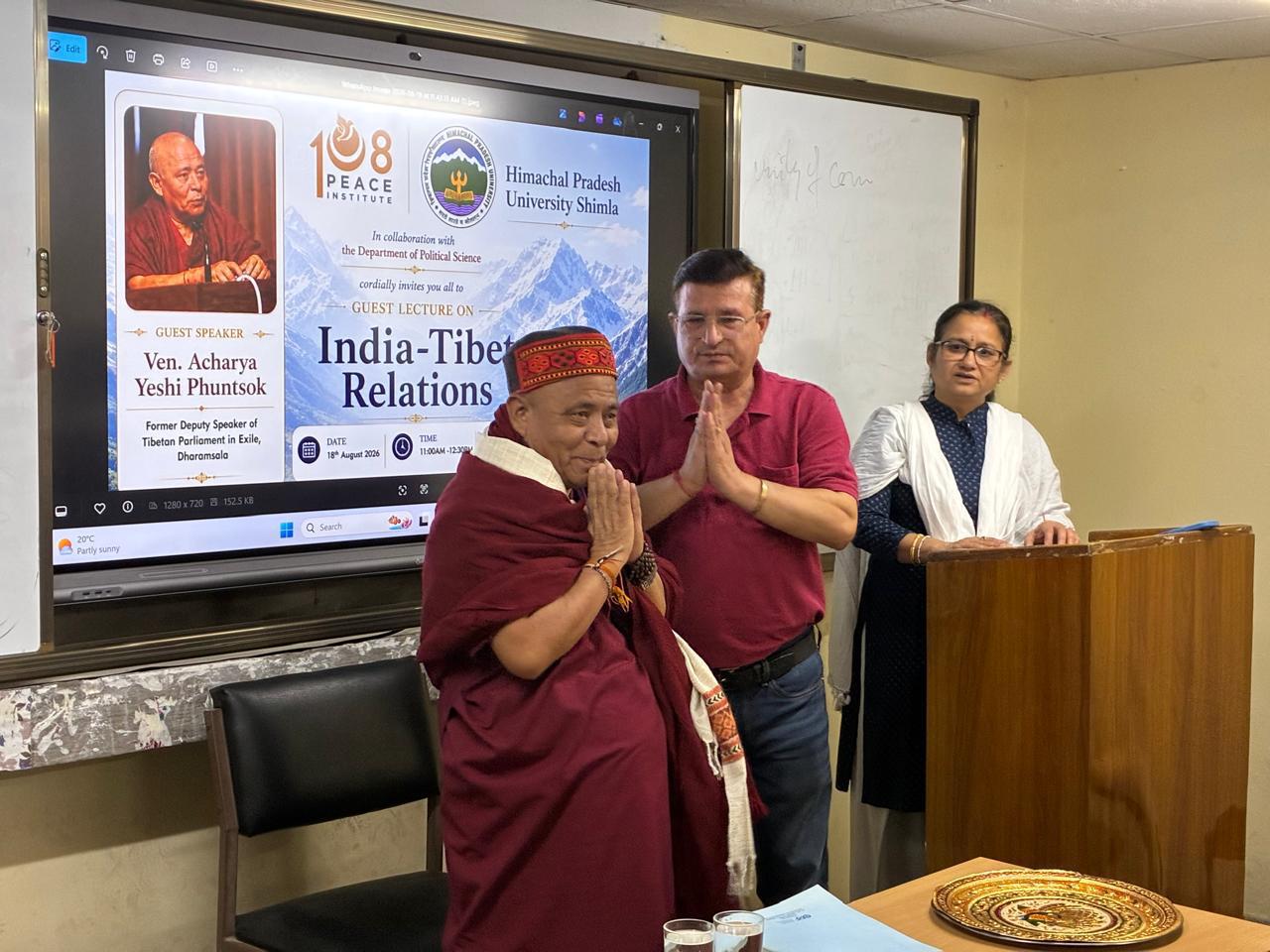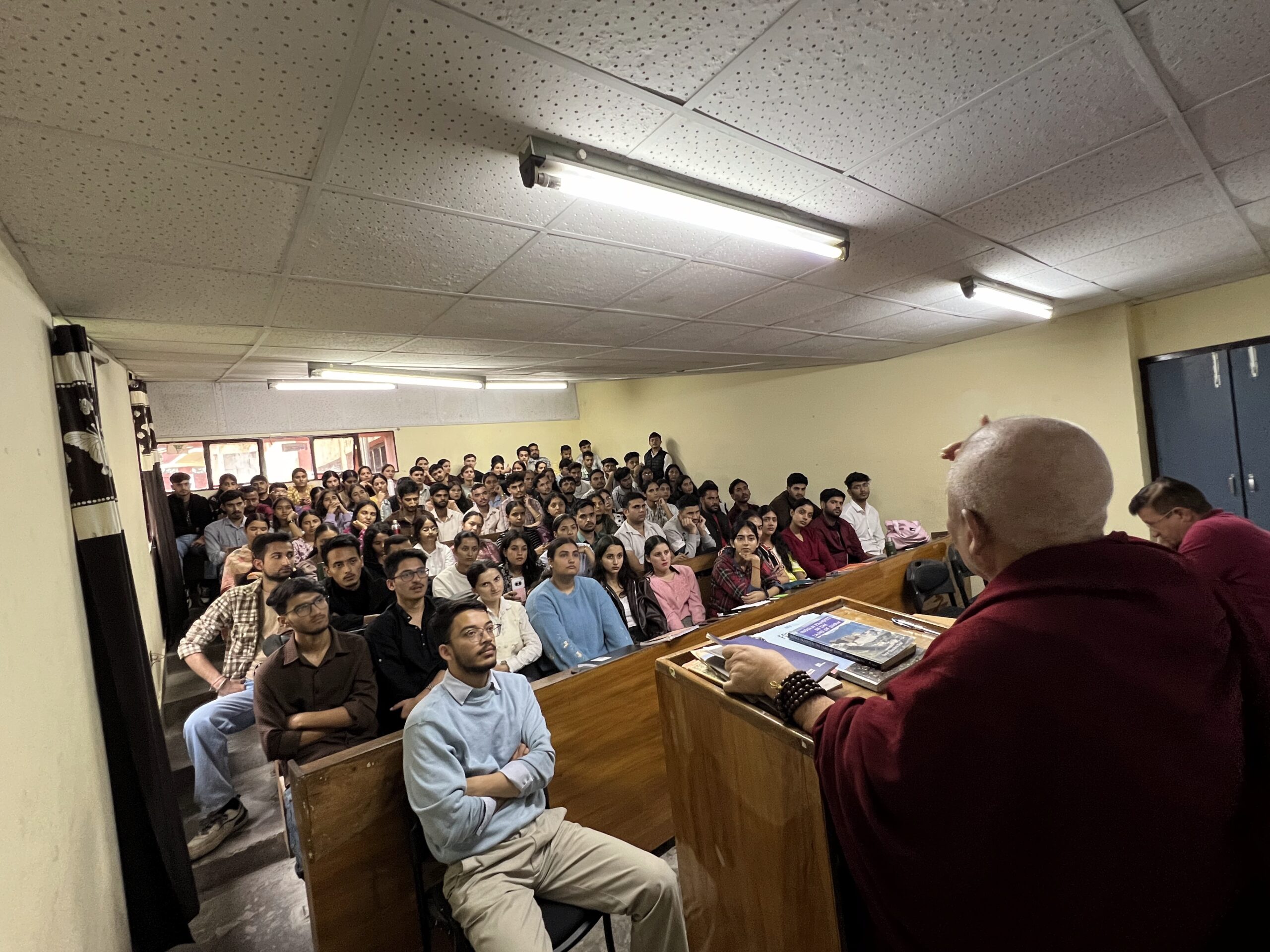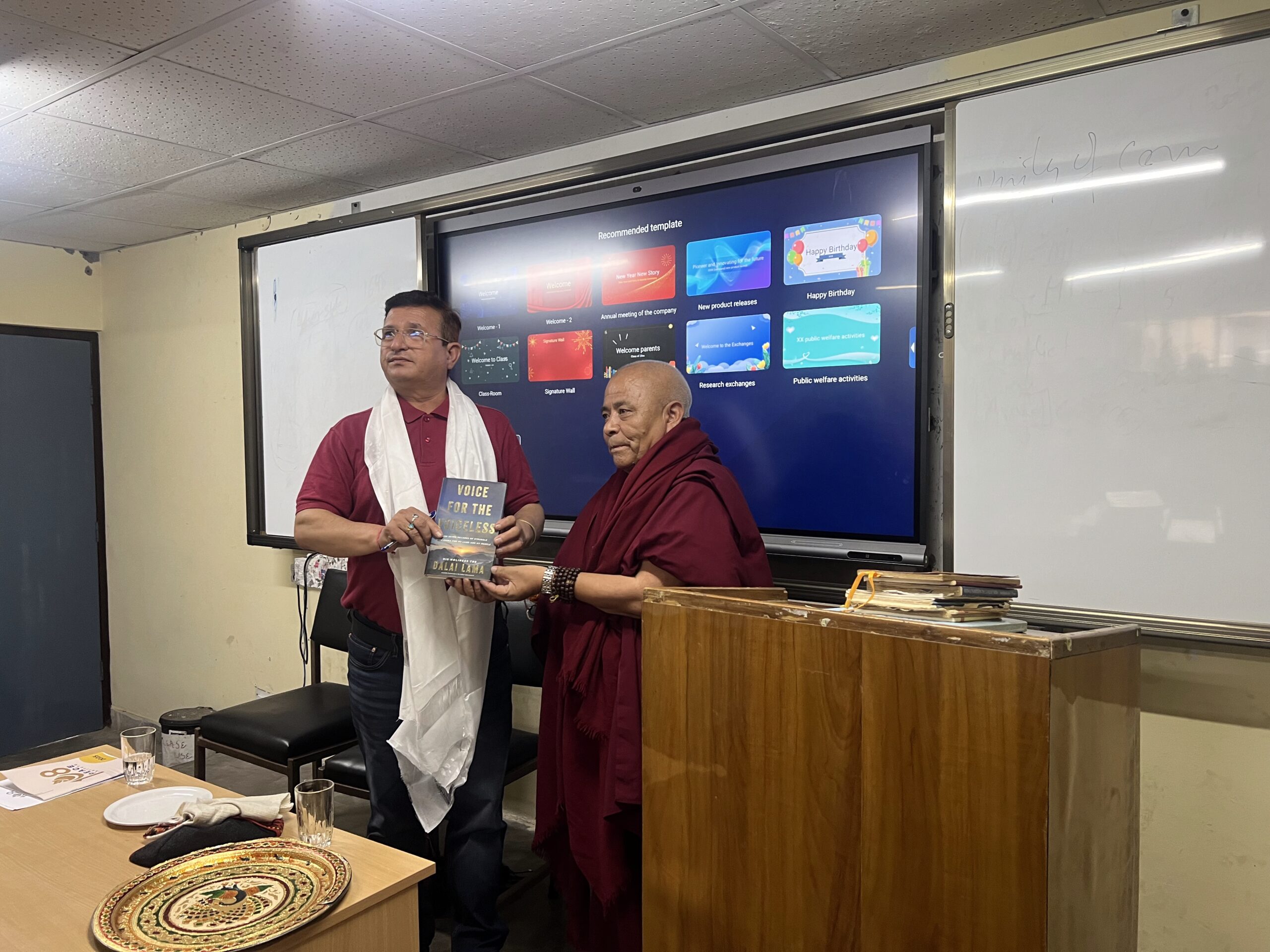
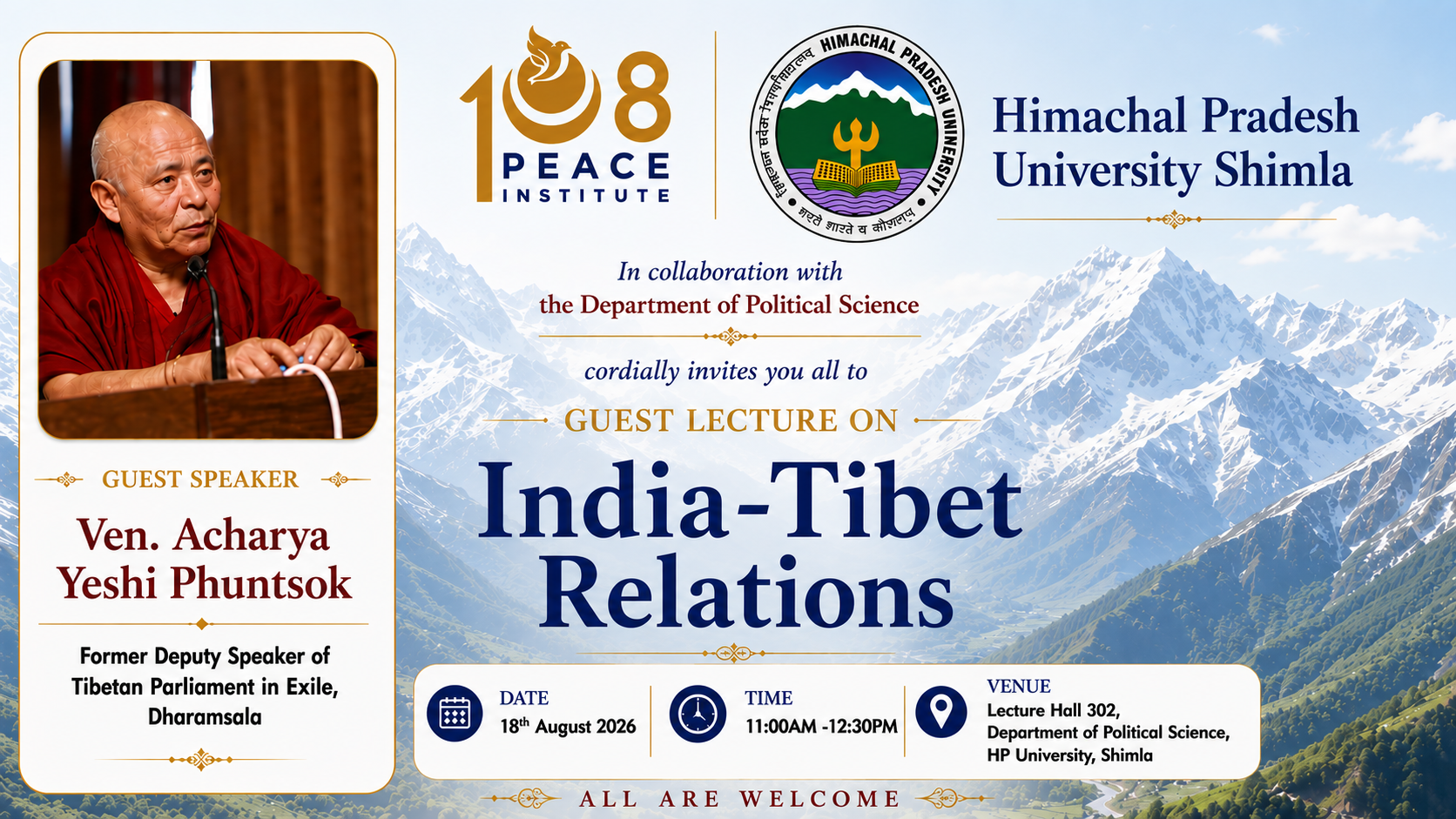
As part of 108 Peace Institute’s ongoing lecture series, the institute, in collaboration with the Department of Political Science, Himachal Pradesh University, Shimla, organized a lecture on India–Tibet Relations on 18 August 2026. The lecture was delivered by Venerable Acharya Yeshi Phuntsok, Former Deputy Speaker of the Tibetan Parliament-in-Exile, who examined the relationship through its historical, cultural, strategic, economic, and environmental dimensions.
Addressing the geographical and strategic importance of Tibet to India, the speaker highlighted the approximately 4,000-kilometre India–Tibet border, describing it as one of India’s longest international frontiers. He noted that Tibet shares geographical connections with the Indian states of Himachal Pradesh, Uttarakhand, Sikkim, and Arunachal Pradesh, as well as the Union Territory of Ladakh.
Providing a historical perspective, Acharya Yeshi Phuntsok explained that the India–Tibet frontier was relatively peaceful and lightly militarized before Chinese occupation of Tibet in 1959. He also discussed the historical significance of the Simla Convention of 1914, emphasizing the Tibetan and British Indian participation in the negotiations and the absence of Chinese agreement to the convention’s proposed boundary arrangements. He further reflected on how the 1962 Sino-Indian War fundamentally transformed the security dynamics along the Himalayan frontier and contributed to the militarization of the region.
Discussing trade relations, the speaker highlighted the reopening of traditional trading points such as Lipulekh Pass, Nathu La, and Shipki La by India and China, while noting that contemporary cross-border trade is subject to restricted trading periods, designated commodities, and other regulations. He contrasted this with the historical trading relationship between India and Tibet, when merchants exchanged goods based largely on local needs and established commercial traditions.
He also discussed the historical significance of the Lavi Mela, held annually in Rampur Bushahr in Himachal Pradesh. According to the speaker, the fair has longstanding historical links with the trading relationship between the former Bushahr State and Tibet. Traditionally held around 11–14 November, the fair continues to preserve aspects of this historic commercial and cultural relationship. Although traders from Tibet are no longer able to participate because of the closure and restrictions along the border, Tibetan communities in India, including those from Bir and Chauntra settlements, continue to participate in the fair, helping sustain this historical tradition.
A major focus of the lecture was also on Tibet’s role as the “Water Tower of Asia.” The speaker explained the importance of rivers originating on or around the Tibetan Plateau, including the Indus, Brahmaputra, Sutlej, and Karnali, which support millions of people across South and Southeast Asia. Referring to the 2005 Parechu Lake outburst, which caused extensive damage downstream in Himachal Pradesh, particularly in the Kinnaur and Lahaul-Spiti regions, he emphasized the environmental and security risks faced by downstream communities and the need for greater cooperation on transboundary water resources. He also highlighted the 14th Dalai Lama’s longstanding advocacy for protecting Tibet’s fragile environment and addressing climate change.
The lecture also explored the deep historical and cultural connections between India and Tibet. Referring to the Asian Relations Conference held in New Delhi in 1947, the speaker noted Tibet’s participation and highlighted the historical recognition of Tibet’s distinct political and cultural identity during that period. He also recalled Mahatma Gandhi’s interaction with the Tibetan delegation, emphasizing Gandhi’s recognition of the importance of preserving and reviving Buddhist traditions in India and Tibet.
Following the Tibetan people’s arrival in exile, the Government of India played an important role in supporting the development of Tibetan educational institutions. The speaker referred particularly to the establishment of the Central Institute of Higher Tibetan Studies in Sarnath, Varanasi, and expressed his personal pride as an alumnus of the institution. He emphasized that India’s support for Tibetan education and cultural preservation represents an important dimension of the longstanding relationship between the two peoples.
Encouraging students to consult historical sources, the speaker recommended Indian Pandits in the Land of Snow by Sarat Chandra Das and the travel accounts of Pandit Nain Singh Rawat, whose nineteenth-century journeys provide valuable documentation of the Himalayan region and Tibet. He also recommended The Tragedy of Tibet by retired Brigadier Man Mohan Sharma. In addition, he referred to the views of Dr. B. R. Ambedkar, Sardar Vallabhbhai Patel, Dr. Ram Manohar Lohia, and Swami Vivekananda on China’s illegal occupation of Tibet, India’s security, and the strategic importance of the Himalayas.
During the question-and-answer session, students raised issues concerning India’s One-China policy, Tibet’s political status, and the use of the term “India–Tibet border.” The speaker addressed their question and emphasized that terminology reflects historical and geographical realities and influences public understanding of the Himalayan region.
Drawing on the words of Vinoba Bhave, the renowned Indian philosopher and advocate of nonviolence and human rights, Acharya Yeshi Phuntsok concluded the talk by emphasizing the value of sharing knowledge and ideas. The lecture, attended by more than 100 undergraduate and graduate students from the Department of Political Science, offered them a comprehensive understanding of India–Tibet relations and encouraged informed engagement with the region’s history, culture, security, trade, and environmental challenges.