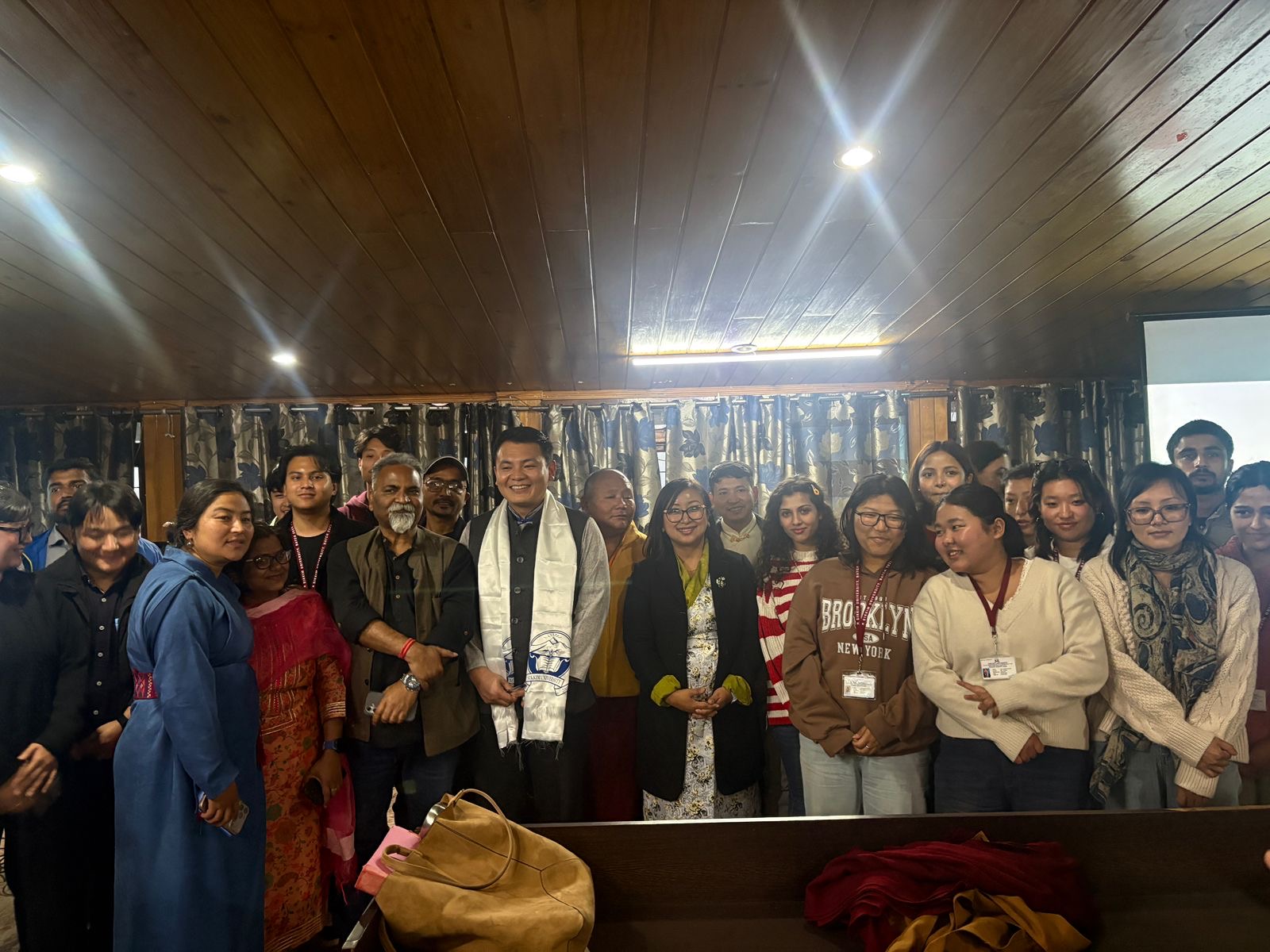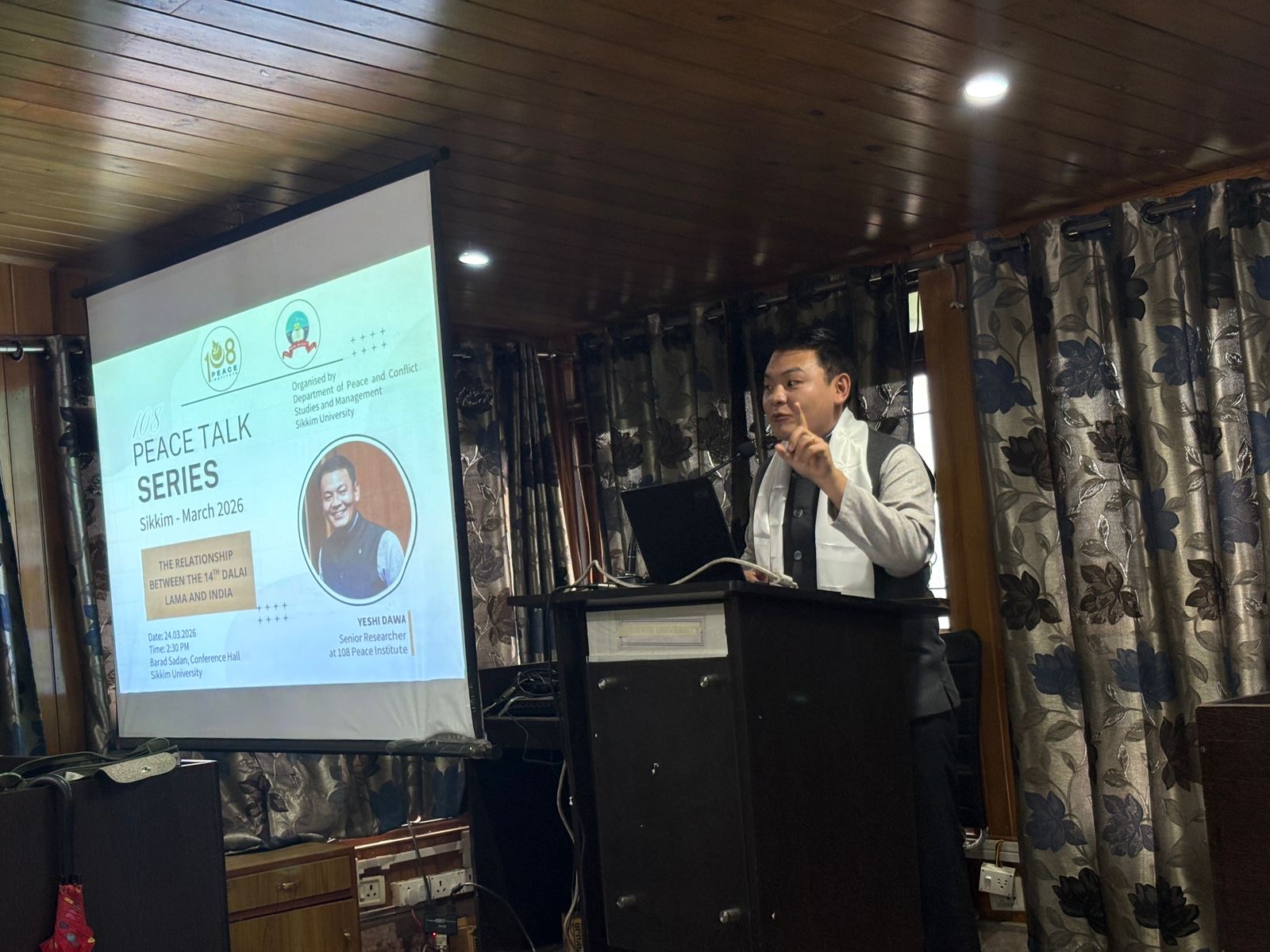
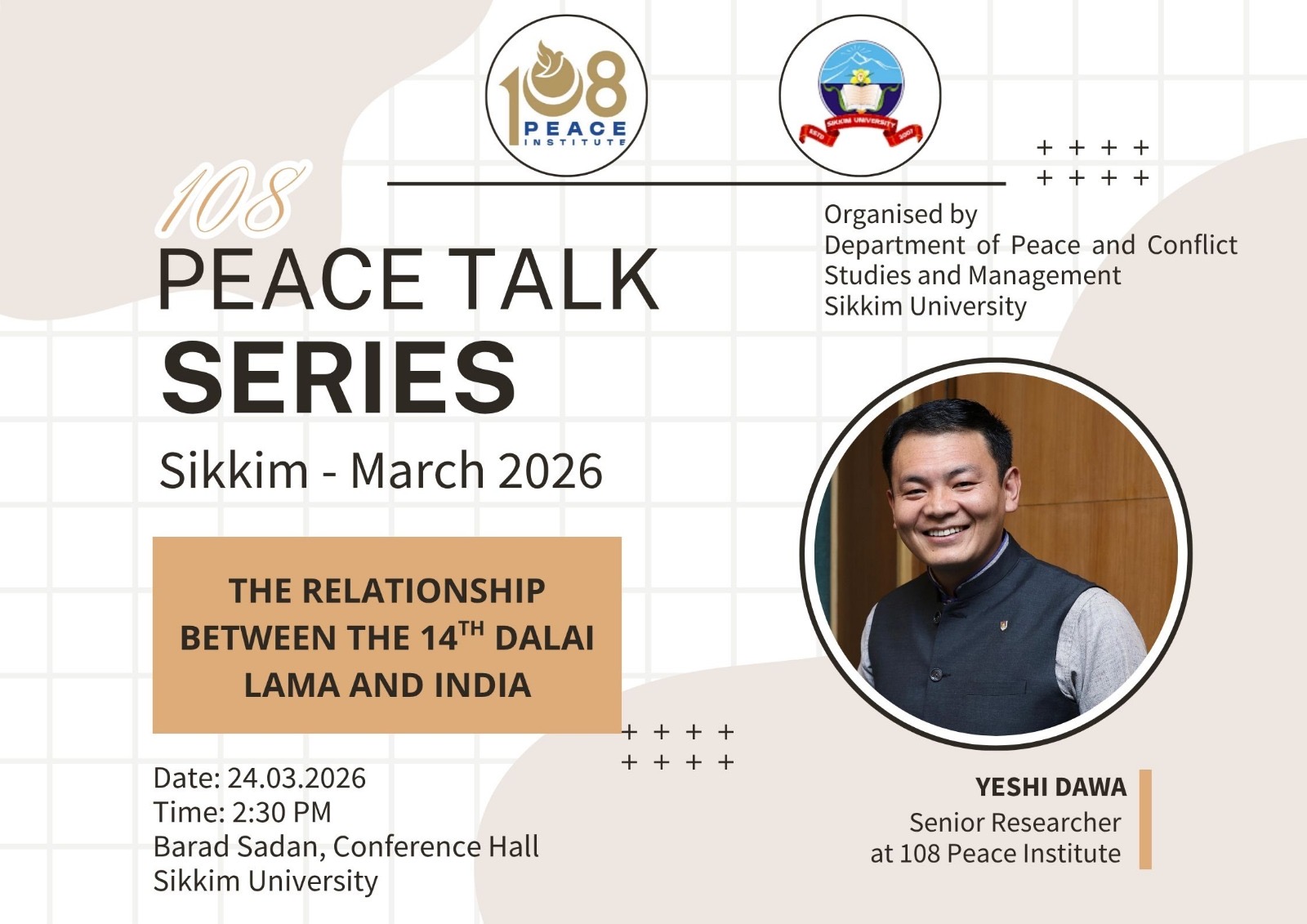
March 24, Gangtok: The 108 Peace Institute, in collaboration with the Department of History and the Peace & Conflict Studies Programme at Sikkim University, Gangtok, organised a talk on “The Relationship between the 14th Dalai Lama and India”, delivered by Mr. Yeshi Dawa, a senior researcher at the 108 Peace Institute. The talk was attended by more than 75 students and faculty members.
The opening remarks were delivered by the Dean, Dr. Nawal K. Paswan, who spoke about the special relationship between India and Tibet. He elaborated on the importance of Tibet to India and vice versa, and highlighted the role and relevance of the 14th Dalai Lama in today’s chaotic world. He also emphasized the similarities between Buddhism and Hinduism, thoughtfully setting the stage for Mr. Dawa’s address.
Mr. Dawa began by acknowledging the immense contribution of India and its people in sustaining the Tibetan cause. He noted that no other country has contributed as significantly to the Tibetan cause as India, and invited the participants to applaud themselves for this support.
He traced the historical relationship between Tibet and India back to the 7th century, when the 33rd King of Tibet sent disciples to India. Upon returning, one of them developed the Tibetan script based on the Gupta-Brahmi script. Since then, the relationship between India and Tibet has remained strong. Mr. Dawa also highlighted India’s role in providing refuge to the 14th Dalai Lama and the Tibetan people. From the outset, the Government of India treated the 14th Dalai Lama with great respect. For instance, the Crown Prince of Sikkim invited him to India to attend the 2,500th Buddha Jayanti celebrations. He also referred to the Dalai Lama’s arrival in India in 1959 and his escort by the Assam Rifles. Additionally, Mr. Dawa noted that the first international recognition awarded to the 14th Dalai Lama came from Banaras Hindu University in 1957.
Mr. Dawa further spoke about the contributions of the 14th Dalai Lama in promoting ancient Indian wisdom across the globe.
He then addressed the paradoxical claims of the Chinese Communist Party regarding the selection of the next Dalai Lama. Tracing its historical stance toward the 14th Dalai Lama and Tibetan Buddhism, he quoted Mao Zedong’s remark that “religion is a poison.” He also referred to the destruction of Tibetan monasteries and the tightening control over religious freedom in Tibet. In this context, Mr. Dawa questioned the legitimacy of the Chinese Communist Party in choosing the next Dalai Lama, asking why it appears more concerned with the 15th Dalai Lama than with the present one. His remarks highlighted what he described as the Party’s underlying intentions in the succession issue.
Mr. Dawa concluded by discussing the geopolitical ramifications should the Chinese Communist Party succeed in selecting the next Dalai Lama. He raised important questions: How might the institution of the Dalai Lama be used to influence Buddhist nations and regions in India? How would India approach the issue of the 14th Dalai Lama’s reincarnation?
The talk was followed by an interactive Q&A session, during which students asked questions related to the history of Tibet and the 14th Dalai Lama.
Mr. Dawa concluded by acknowledging the warm hospitality and the contributions of Dr. Nawal K. Paswan, Dr. Anira Phipon Lepcha, Dr. Sangmu Thendup, and Dr. Tsewang Dorji in making the event possible. As a token of gratitude, a copy of “Voice of the Voiceless” was presented to Dr. Nawal K. Paswan.