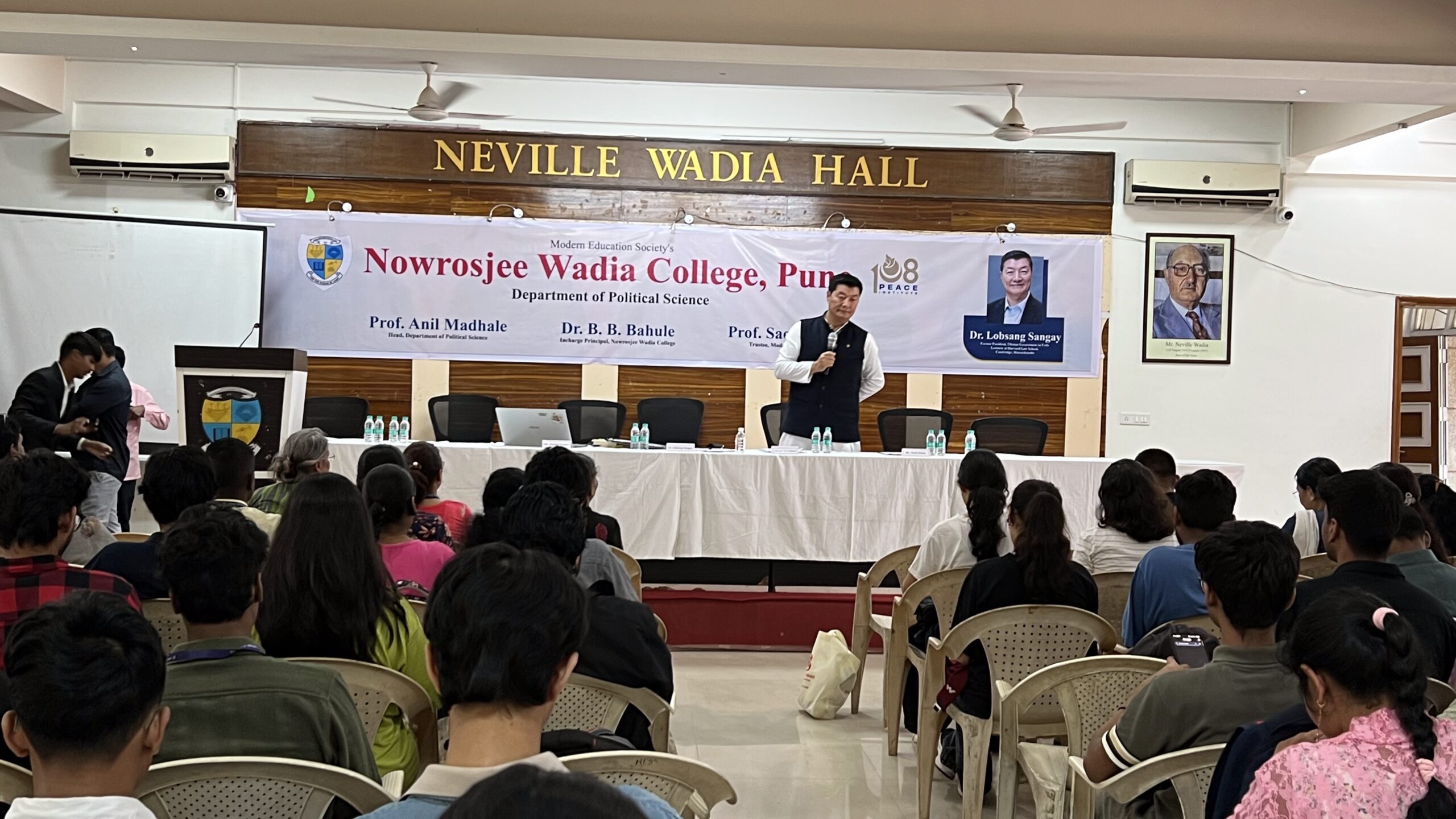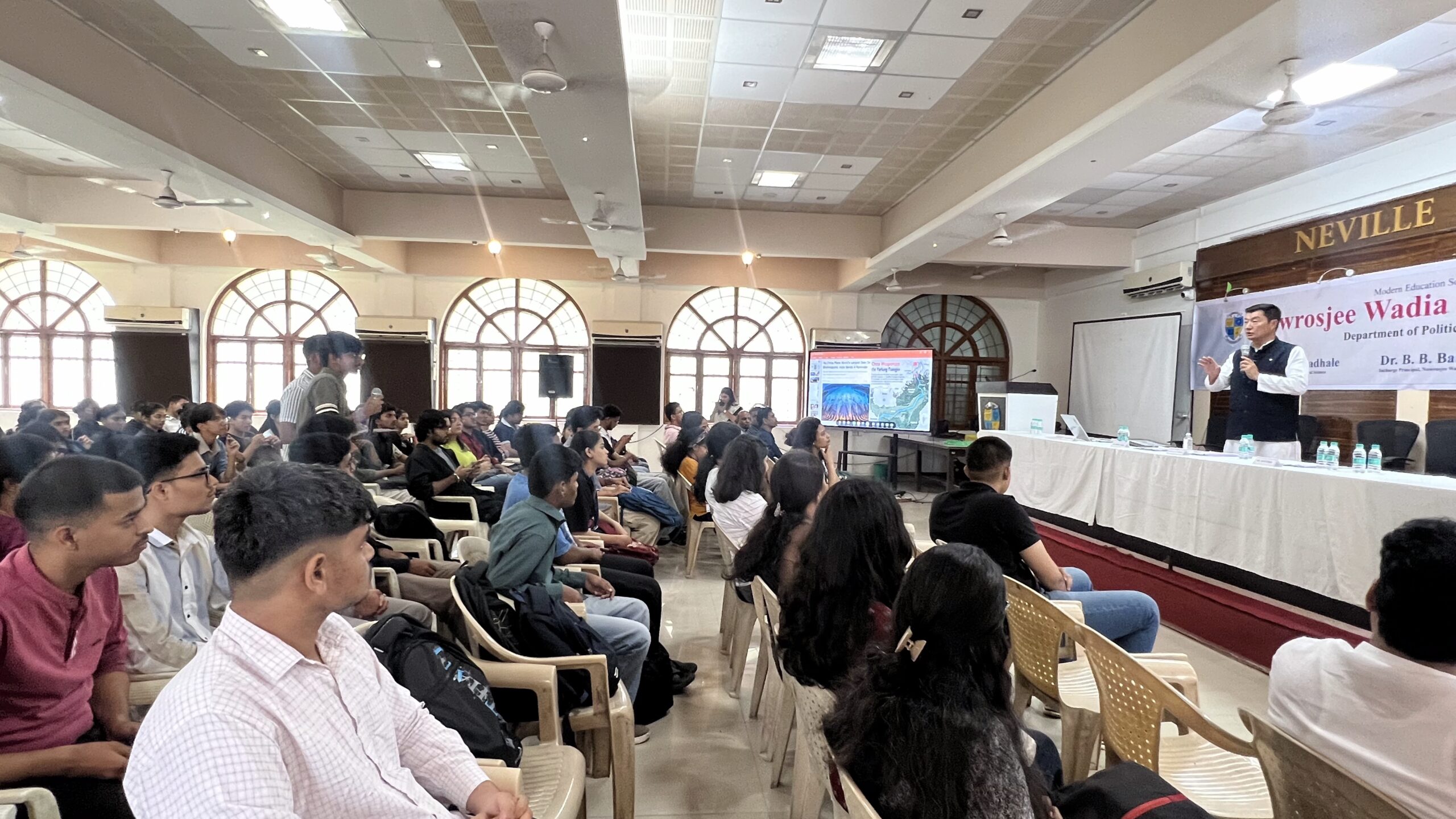
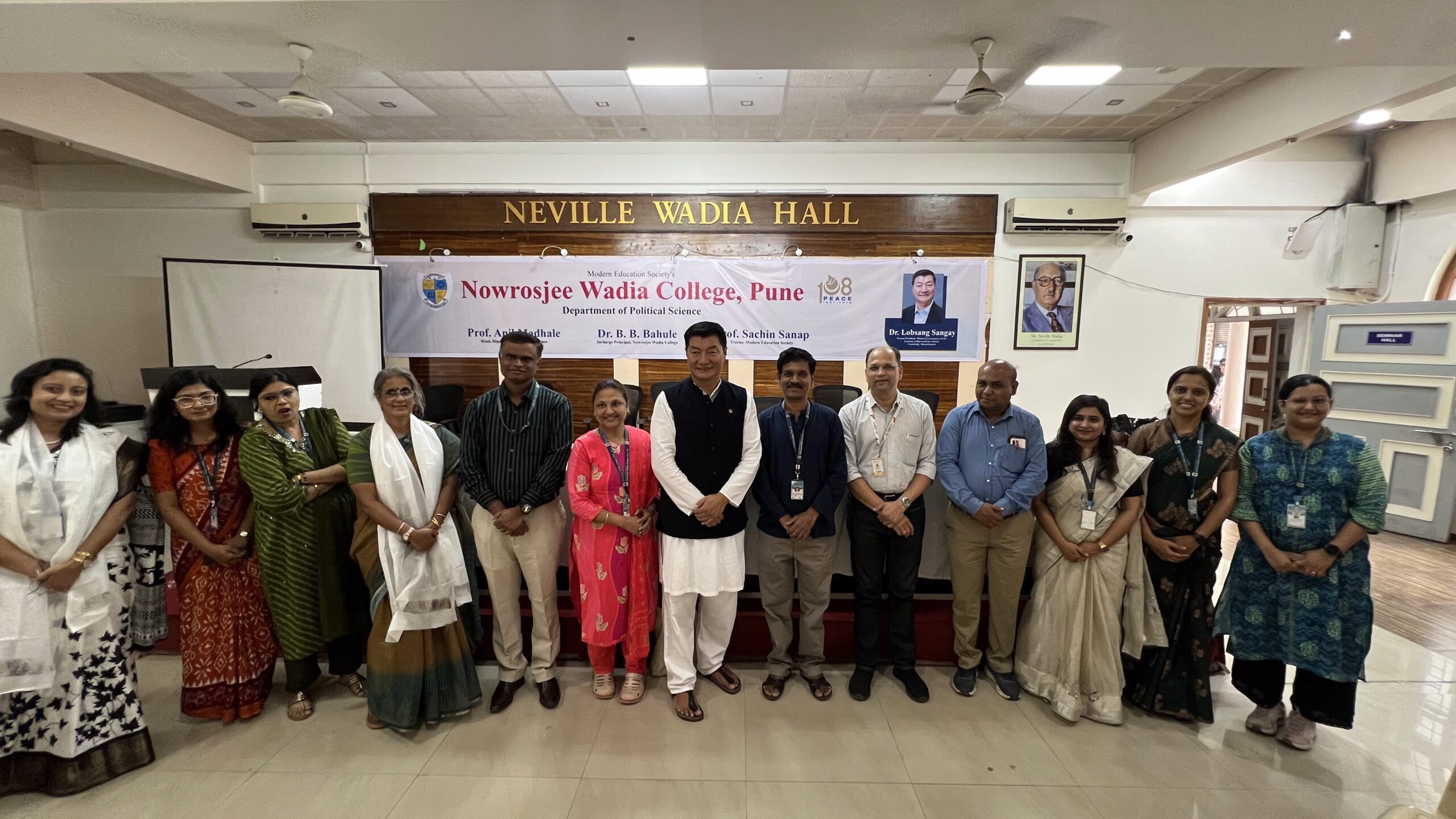
16th September 2026: The 108 Peace Institute, in collaboration with the Department of Political Science, Modern Education Society’s Nowrosjee Wadia College, Pune, successfully hosted an insightful talk titled “Himalayan Geopolitical Conundrum: Resources, Borders and Politics,” featuring Dr. Lobsang Sangay, Former President of the Central Tibetan Administration and Lecturer at Harvard Law School. More than 150 students attended the event, including students from the Department of Political Science, National Cadet Corps, Department of English, and other enthusiastic students and faculty members. The lecture focused on the challenges facing the Himalayan region, China’s mining and resource extraction in Tibet, China’s mega-dam projects, the impact of floods in Nepal, and the wider security implications for India.
In his lecture, Dr. Sangay highlighted challenges facing the Himalayan region. He drew the audience’s attention to China’s proposed mega-dam project in Medog County. The megaproject was described as larger than the Three Gorges Dam, among the world’s most powerful dams. He highlighted that the project is expected to generate 60,000 megawatts of electricity and explained its potential scale in terms that could be easily understood by the general public. He stated that 60,000 megawatts is equivalent to 362 billion kilowatts. In the Indian context, he noted that an average Indian family consumes approximately 1,100 kilowatt-hours of electricity annually. Based on this comparison, he explained that one such dam could theoretically supply electricity to approximately 260 million households and, assuming four members per family, could provide electricity to around 800 million people in India.
However, Dr. Sangay argued that the electricity generated from the dam, which is being constructed on the Brahmaputra River, would be transmitted from Tibet to China to support Chinese factories and artificial intelligence facilities. He emphasized that, as China is the “factory of the world,” it is using Tibet’s rivers to generate electricity to support its industrial and technological infrastructure. He further highlighted that Tibet is the source of several major rivers flowing through India, Bangladesh, Pakistan, Nepal, and China.
He warned about the potential dangers associated with constructing large dams in a highly seismic region. He explained that such dams could artificially hold back billions of liters of water, while the Tibetan Plateau lies within one of the world’s highest seismic zones. He cautioned that large-scale water seepage and pressure in the event of an earthquake could have serious consequences. He noted that China has constructed around 300 medium-sized and large dams on the Tibetan Plateau.Dr. Sangay recalled earthquakes and seismic events in Nepal, Afghanistan, Tibet, China, Sikkim, Burma, and Thailand, noting that the entire Himalayan belt has repeatedly experienced earthquakes. He connected the construction of numerous dams with the broader seismic vulnerabilities of the Himalayan region.
He also discussed China’s continued mining and resource extraction in Tibet, which he noted has 136 minerals. According to Dr. Sangay, China is constructing houses, highways, and railways, bringing in increasingly large machines for resource extraction, and encouraging mass migration in Tibet without adequately considering the implications of these activities in a highly seismic region. He argued that these activities are contributing to the warming of the Tibetan Plateau and the melting of glaciers.
Dr. Sangay noted that Tibet has around 40,000 glaciers, while the region between Nepal and Tibet has more than 2,000 glacial lakes. Of these, he stated that approximately 20 are considered particularly dangerous because they could potentially burst at any time. He asked the audience to consider the consequences of a glacial lake outburst, referring to the destruction caused by such events in Nepal, and emphasized that the potential scale of destruction from multiple glacial lake outbursts could be enormous. He also explained how glacial lakes are formed and noted that there are approximately 7,900 glacial lakes between India and Tibet.
Referring again to the proposed Chinese dam, which is expected to generate 60,000 megawatts of electricity, Dr. Sangay described it as a potential strategic weapon. He argued that if the dam holds billions of tonnes of water, a deliberate release or an accidental breach could have severe consequences for downstream regions such as Arunachal Pradesh and Assam. He further suggested that, in an extreme scenario, the northeastern region of India could face major strategic disruption if the Siliguri Corridor, or “Chicken’s Neck,” were affected. In his view, under normal circumstances, the dam could be strategically weaponized, while in the worst-case scenario, a dam failure could result in catastrophic flash floods across downstream regions of India.
Dr. Sangay further noted that China has not signed the UN Convention on the Law of the Non-Navigational Uses of International Watercourses, which addresses the sharing and management of international water resources. He stated that the convention calls for upstream countries to avoid preventing the free flow of water, facilitate joint studies and research concerning glaciers and glacial lakes, and share relevant data with downstream countries to help prevent disasters such as floods faced by Nepal. He argued that China’s non-participation means that these provisions in relation to countries such as Nepal, Bhutan, and India do not bind it.
Dr. Sangay also questioned China’s advanced satellite, surveillance, and technological capabilities in the context of the flash floods in Nepal. He asked why, despite China’s claims regarding the superiority of its technology and satellite systems, adequate warnings were not provided during the disaster. He argued that timely information shared with downstream communities could have reduced the scale of destruction. He noted that generations of savings belonging to poor families were washed away and that it could take years for the affected communities to rebuild their lives.
Dr. Sangay also questioned the Nepal government’s approach of attributing the disaster collectively to global warming and the actions of India, the United States, and China. He argued that such a blanket attribution does not adequately distinguish between different causes and their respective impacts. While emissions and activities in distant countries can contribute to global warming and glacier melt, he emphasized that China’s extensive mining and construction activities in a seismically sensitive region immediately north of Nepal could have a more direct regional impact. He therefore argued that China should assume greater responsibility, sign the UN Watercourses Convention, and work jointly with neighboring countries to prevent future disasters.
Regarding the devastating flood in Nepal, Dr. Sangay said the glacial lake outburst occurred at 8:37 a.m. The lake washed away the Kyidong port between Nepal and Tibet at 9:02 a.m. He noted that the 25-minute interval could have provided sufficient time to alert downstream communities and enable people to move to safer areas. However, he said that Nepal was not informed in time and questioned why China’s detection and warning systems did not function effectively on that occasion.
Dr. Sangay concluded this part of his lecture by emphasizing why Tibet matters to India’s security and environmental future. He noted that before China’s occupation of Tibet, there was no land border between India and China; rather, India shared a border with Tibet. According to him, only around 80 guards were required to patrol the border at that time, as India and Tibet maintained a relationship of mutual trust. Following China’s occupation of Tibet, he argued, India’s security and financial burden increased significantly. He noted that India now has eleven mountain divisions along the India-Tibet border, with substantial financial resources being spent on border security and infrastructure.
The lecture offered students an opportunity to understand the interconnected environmental, geopolitical, economic, and security challenges. These challenges emerge across the Himalayan region. The lecture also examined Tibet’s significance to India’s long-term interests.