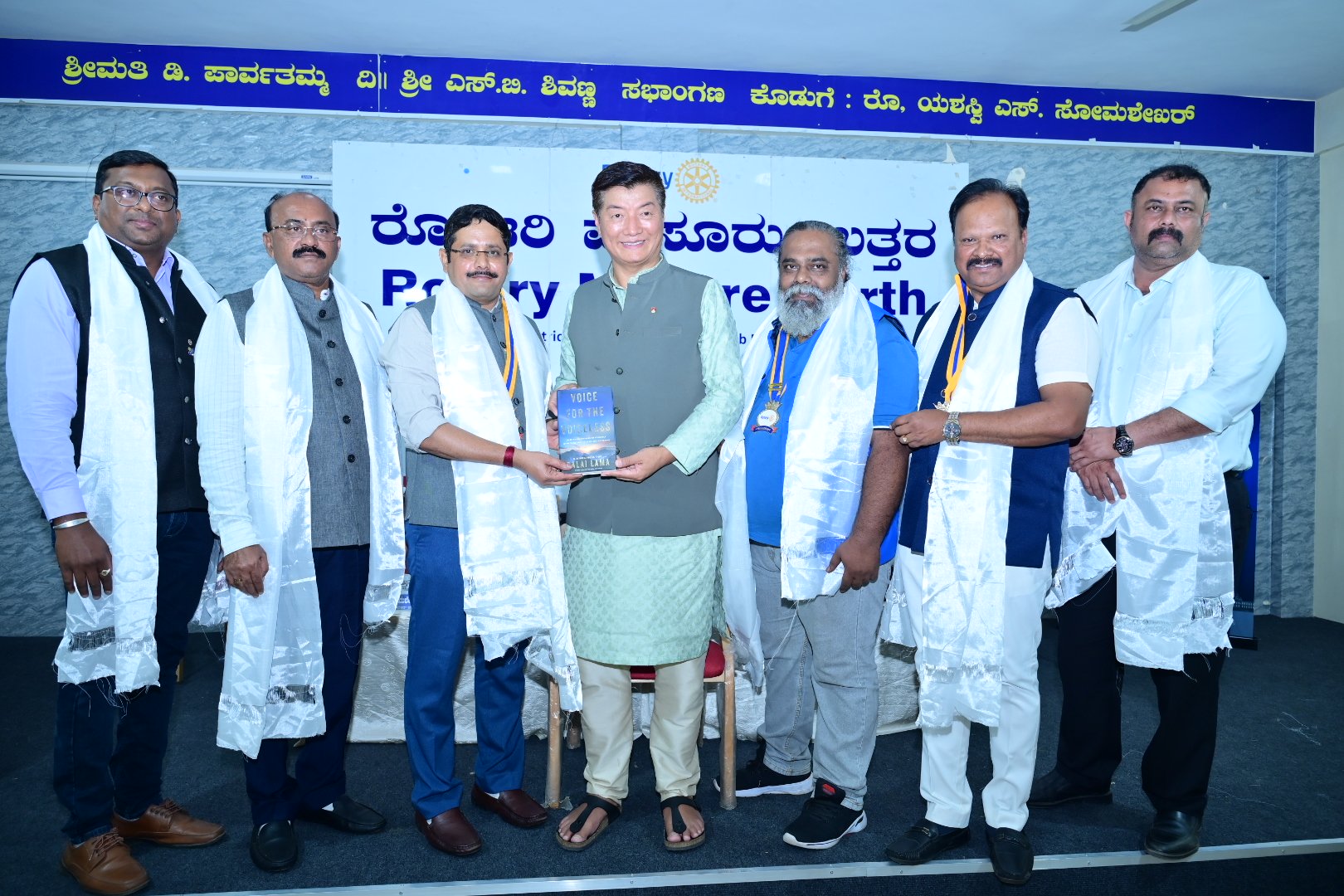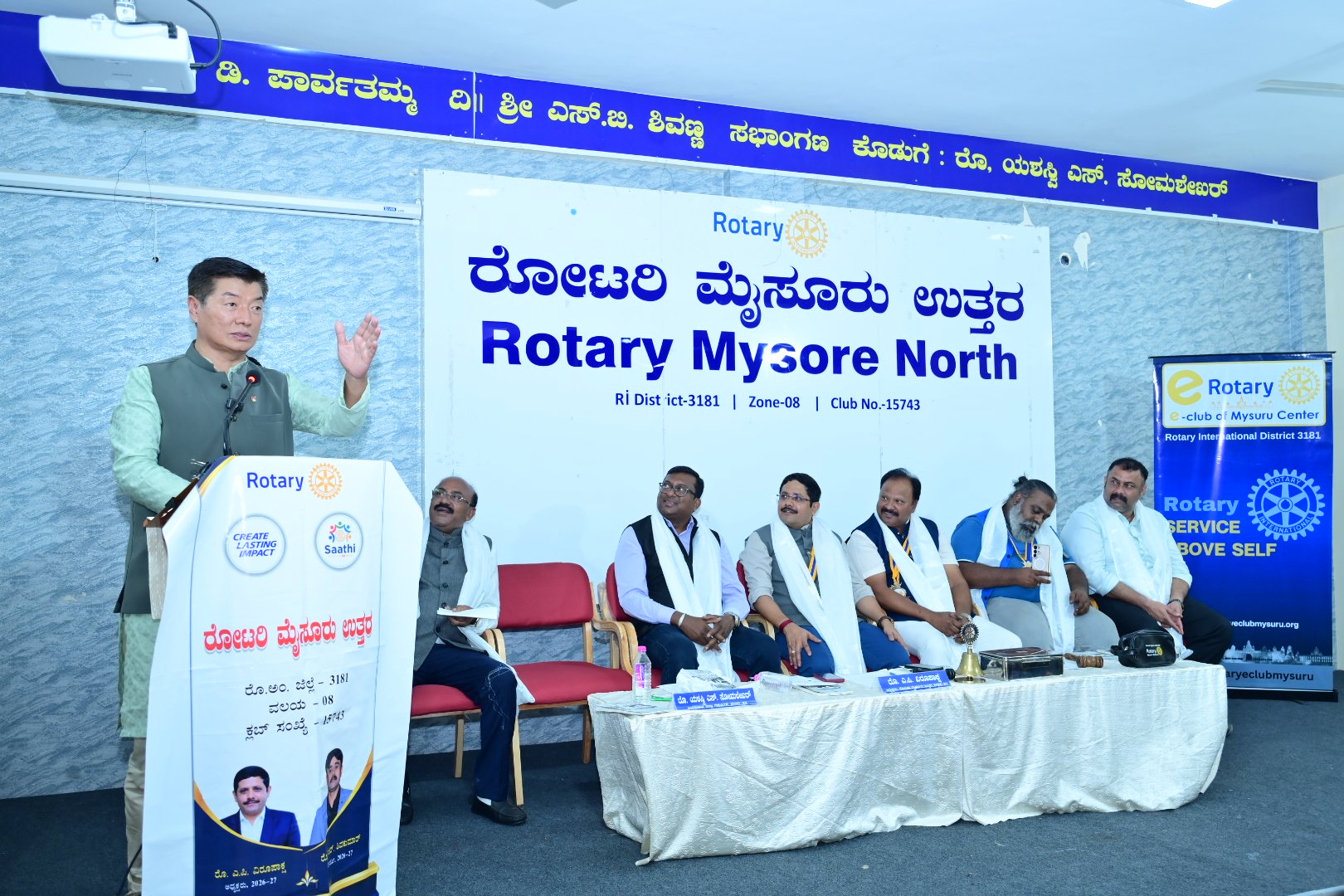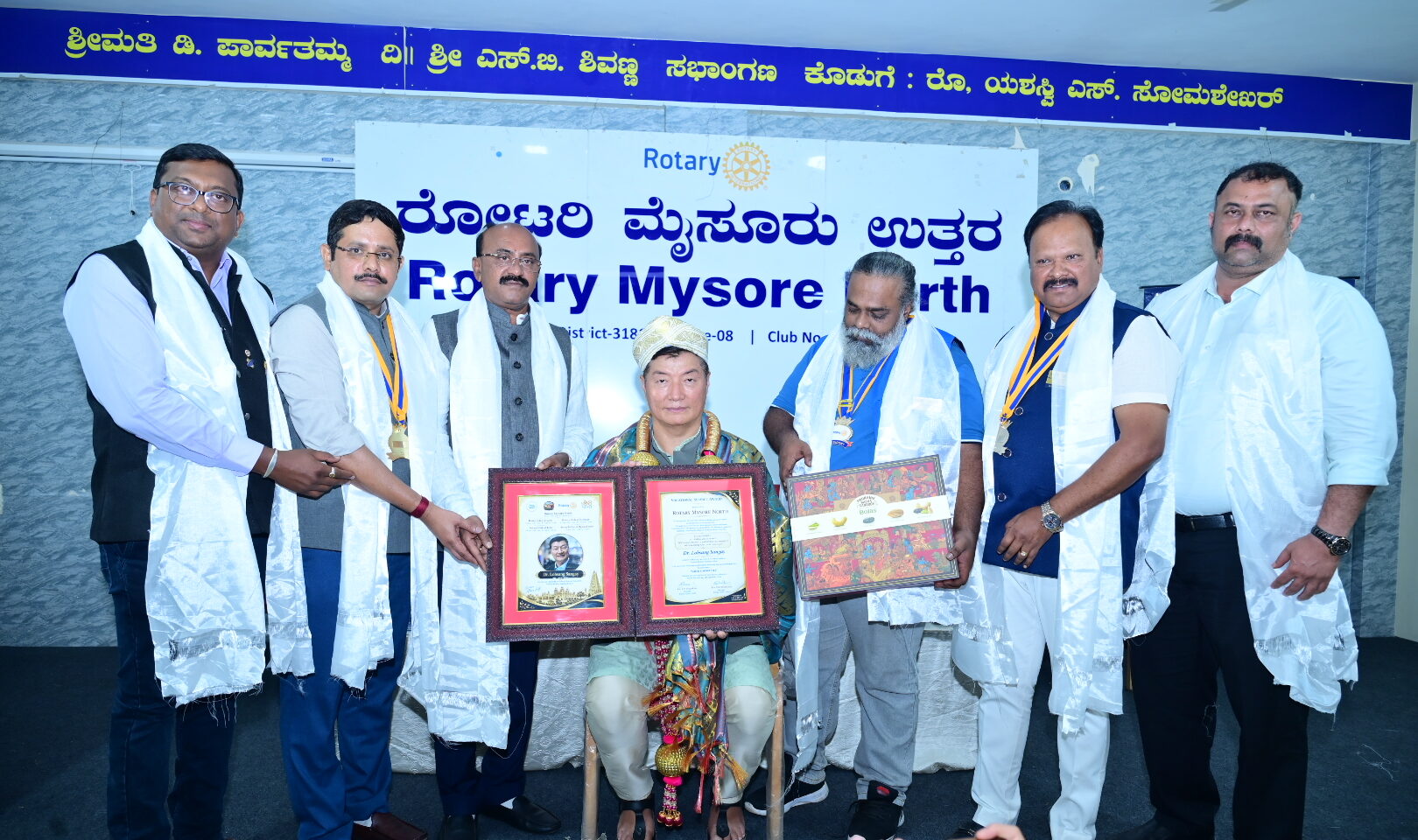
September 11, 2026: The five Rotary Clubs of Mysuru- Rotary Mysore North, Rotary Club of West, Rotary Club of Heritage, Rotary Club Elite and Rotary E-Club of Mysore Centre, jointly conferred the Rotary Award on Dr. Lobsang Sangay in recognition of his excellent professional achievement and service to the community. The award ceremony was jointly organised by the Rotary Clubs and the Indo-Tibetan Friendship Society (ITFS), Mysuru, led by Yashaswi S. Somashekar and Mr. Niranjan.
Accepting the prestigious Rotary Award, Dr. Lobsang Sangay expressed his heartfelt gratitude to all five Rotary Clubs of Mysuru and the Indo-Tibetan Friendship Society (ITFS), Mysuru.
Tibet: The Water Tower of Asia
Beginning his address with a reference to the devastating flash floods in Nepal, Dr. Sangay raised concerns about the lack of adequate regional cooperation and information-sharing on transboundary rivers and glacial disasters. He criticized China for not signing the United Nations Convention on the Law of the Non-Navigational Uses of International Watercourses and questioned its commitment to sharing hydrological information with downstream countries.
Describing Tibet as the “Water Tower of Asia”, he pointed out that several of Asia’s major rivers including the Indus, Brahmaputra, Ganga, Mekong, Yangtze and Yellow River systems originate on the Tibetan Plateau. He observed that approximately 1.4 billion people across Asia depend on rivers originating in Tibet, making the region critically important for the continent’s water security.
Comparing Tibet with the Arctic and Antarctica, Dr. Sangay argued that the Tibetan glaciers have a particularly direct significance for human populations because their water feeds major river systems that sustain millions of people. He referred to the approximately 40,000 glaciers and 7,900 glacial lakes in Tibet, warning that accelerated glacier melting could increase the risk of glacial lake outburst floods (GLOFs). He also referred to around 2,000 glacial lakes in the wider Nepal–Tibet border region, of which he described approximately 20 as particularly dangerous.
Mining and Environmental Degradation in Tibet
Dr. Sangay attributed the rapid environmental degradation of Tibet to extensive mining activities under Chinese administration following China’s occupation of Tibet. He recalled historical debates in the Indian Parliament during the 1950s, criticizing the attitude of certain Indian political leaders who had reportedly dismissed Tibet as a region where “nothing grows, not even grass grows”. He countered this perception by highlighting Tibet’s enormous natural wealth, including uranium, copper, gold, lithium and other critical minerals. He stated that Tibet contains substantial mineral resources and claimed that approximately 75 per cent of China’s lithium reserves are located there, alongside 136 different types of critical minerals. Dr. Sangay argued that the extraction of these resources, combined with large-scale infrastructure development, is placing additional pressure on Tibet’s fragile environment.
Concerns Over China’s Mega Dam Projects
Dr. Sangay expressed serious concern over China’s extensive dam-building activities on Tibetan rivers. He referred to approximately 300 medium-sized and large dams in Tibet and drew particular attention to the proposed mega dam on the Yarlung Tsangpo (Brahmaputra) River near the Indian border in the Medog region. He described the proposed project as potentially the world’s largest hydropower project, with a planned generating capacity of approximately 60,000 megawatts. Comparing it with China’s Three Gorges Dam, which has an installed capacity of approximately 22,500 megawatts, he said the proposed project would have enormous implications for the region.
Dr. Sangay questioned the environmental and strategic consequences of constructing such massive dams on a geologically fragile Himalayan plateau, particularly given the dependence of downstream communities in India and Bangladesh on the Brahmaputra’s waters. He also raised concerns about the possible relationship between large reservoirs, geological instability and seismic activity, arguing that the environmental consequences of mega dam construction deserved greater scientific scrutiny. Recalling the proposals by Chinese environmentalists to recognise Tibet as a protected “Third Pole National Park”, Dr. Sangay said Tibet should be protected as an environmentally sensitive region.
Tibet and India’s Strategic Security
Turning to India–China relations, Dr. Sangay emphasized the historical and geographical connections between India and Tibet. He referred to the geological formation of the Tibetan Plateau through the collision of the Indian and Eurasian continental plates and described the relationship between the two regions as deeply rooted in history.
He recalled several episodes in India–China relations to underline the need for caution in assessing China’s diplomatic assurances. Referring to Chinese President Xi Jinping’s 2014 visit to India, he drew attention to the subsequent Doklam standoff in 2017. He also recalled the 2019 informal summit between Prime Minister Narendra Modi and President Xi Jinping in Tamil Nadu, followed by the Galwan Valley confrontation in 2020. He further referred to the 1967 clashes at Nathu La and the circumstances surrounding former Indian External Affairs Minister Atal Bihari Vajpayee’s visit to China in 1979, which coincided with China’s military action against Vietnam.
Dr. Sangay also referred to reports of the disappearance or removal of several senior Chinese officials, including defence and foreign ministers and military leaders, under Xi Jinping’s leadership. He cautioned against taking China’s diplomatic assurances at face value and invoked the ancient Chinese military strategist Sun Tzu’s observation that deception is central to the art of war.
He suggested that China’s growing engagement with neighbouring countries and participation in international groupings such as BRICS should also be viewed in the wider context of its regional ambitions.
China’s ‘Five Fingers Strategy’
Dr. Sangay discussed what he described as China’s “Five Fingers Strategy”, portraying Tibet as the central strategic base from which Beijing seeks influence over the wider Himalayan region, including Ladakh, Sikkim, Arunachal Pradesh, Nepal and Bhutan. He also referred to China’s territorial claims over parts of Arunachal Pradesh and its growing presence in countries surrounding India, including Pakistan, Bangladesh, Nepal, Sri Lanka and the Maldives. According to Dr. Sangay, China’s ambition to become the world’s leading power by 2049 is closely connected to establishing strategic dominance in Asia. He argued that India’s security cannot be separated from Tibet’s security.
Highlighting the substantial deployment of Indian military and border security personnel along the Himalayan frontier, he said that India has to maintain a significant military presence and spend enormous financial resources on border security. Such resources, he observed, could otherwise contribute to education, healthcare and public welfare. “India’s security is Tibet’s security, and Tibet’s security is India’s security,” was the central message of his argument.
The Question of the Dalai Lama’s Reincarnation
One of the most significant portions of Dr. Sangay’s address concerned the future reincarnation of His Holiness the 14th Dalai Lama. He strongly criticized China’s attempts to assert authority over the selection of the Dalai Lama’s reincarnation, questioning how a communist government that officially follows atheism could claim the right to determine the reincarnation of a religious leader.
Referring to the Dalai Lama’s book “Voice for the Voiceless”, Dr. Sangay reiterated that His Holiness has stated that his future reincarnation will take place in a free country, beyond the control of the Chinese Communist Party.
He maintained that the selection of the next Dalai Lama is a matter of Tibetan Buddhist religious tradition and should be decided by the Gaden Phodrang Trust. He warned that China’s attempt to appoint its own Dalai Lama is solely to serve Beijing’s political interests. He urged Indians to read the book “Voice for the Voiceless” and stand with the Tibetan people in protecting their religious traditions.
Dalai Lama: A Symbol of Non-Violence
Paying tribute to His Holiness the 14th Dalai Lama, Dr. Sangay wished him a long life and described him as a great practitioner of non-violence and a follower of Mahatma Gandhi’s philosophy. He highlighted the Dalai Lama’s international recognition, including the Nobel Peace Prize, Templeton Prize and United Nations Environment Award, as well as the numerous honors and books associated with his work.
Dr. Lobsang Sangay highlighted that His Holiness the 14th Dalai Lama has often described himself as a “proud son of India”. He also fondly recalled the Dalai Lama’s expression of gratitude to India, saying that while his wisdom was nurtured by the teachings of Nalanda, his body was nourished by Indian rice and dal. Dr. Sangay emphasised that this reflected the Dalai Lama’s profound affection and gratitude towards India, which has been home to him and the Tibetan community for more than six decades.
Indo-Tibetan Friendship Society (ITFS) as a Bridge Between India and Tibet
Dr. Sangay described the Indo-Tibetan Friendship Society as an important platform for strengthening public understanding of Tibet and building closer relations between Indians and Tibetans. He said that Tibetans possess valuable knowledge and experience concerning China’s policies and that understanding Tibet is essential to understanding China and its regional ambitions. He urged Indian citizens not to overlook developments in Tibet, particularly when considering the long-term implications for India’s national security, water resources and Himalayan environment.
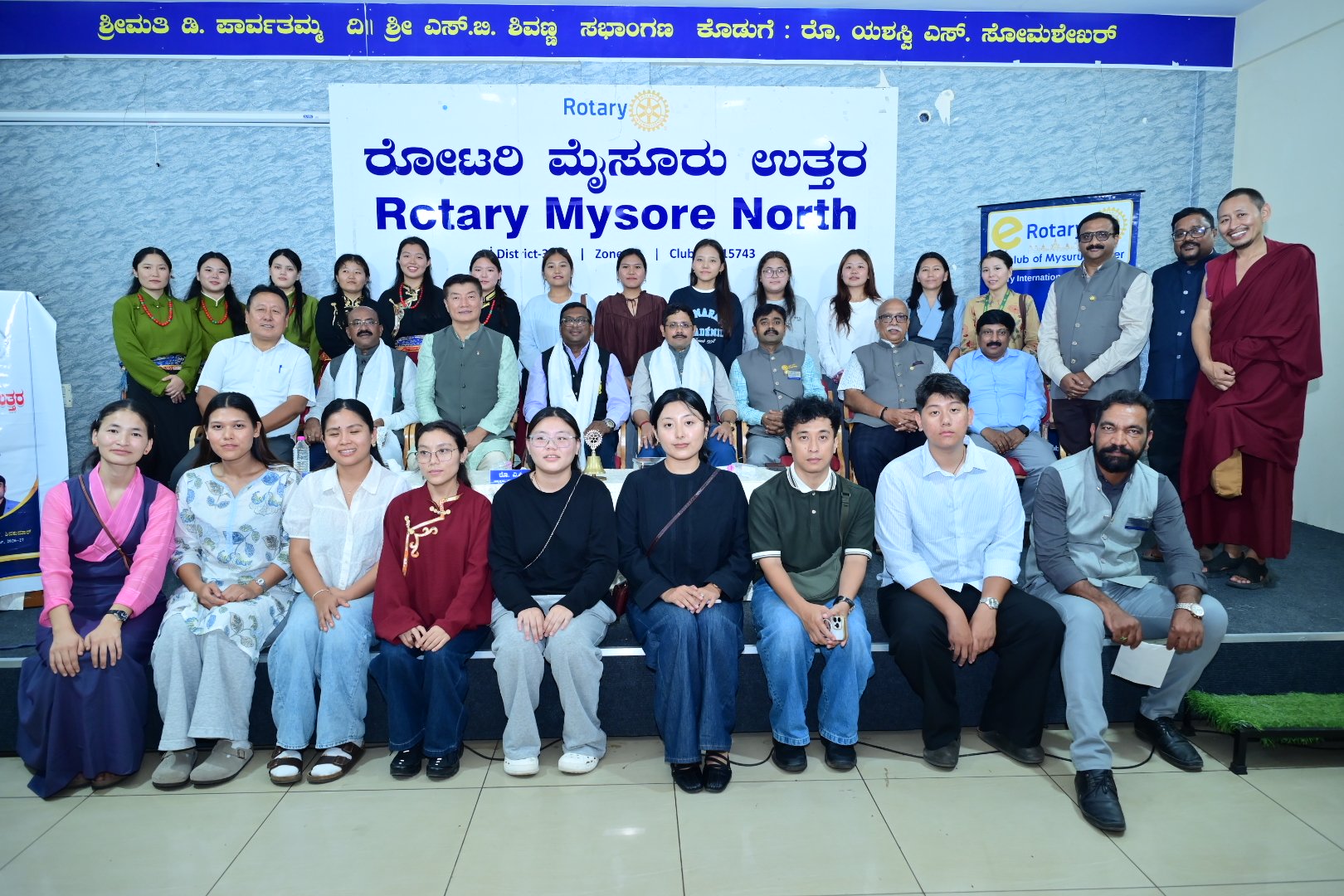
Concluding his address, Dr. Sangay reiterated the significance of Indo–Tibet friendship, environmental protection and international awareness of the Tibetan question. The ceremony brought together Rotary organizations, members of the Indo-Tibetan Friendship Society and Tibetan College students in Mysuru.