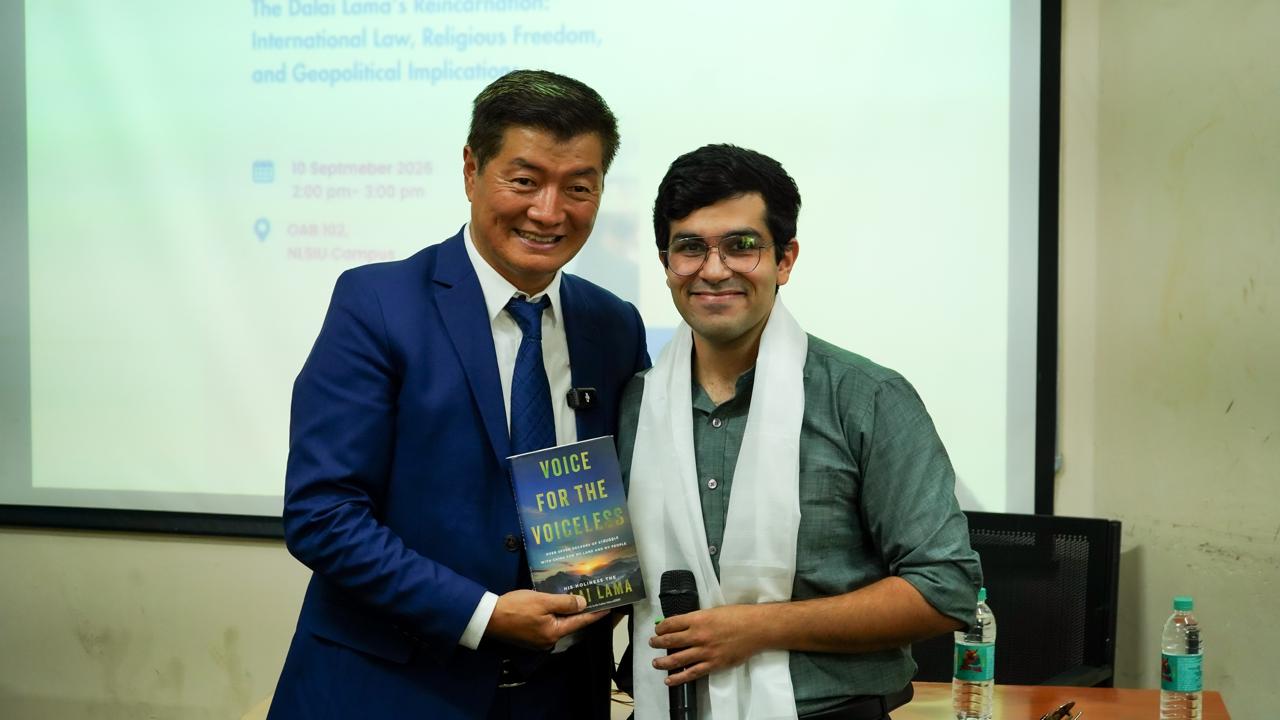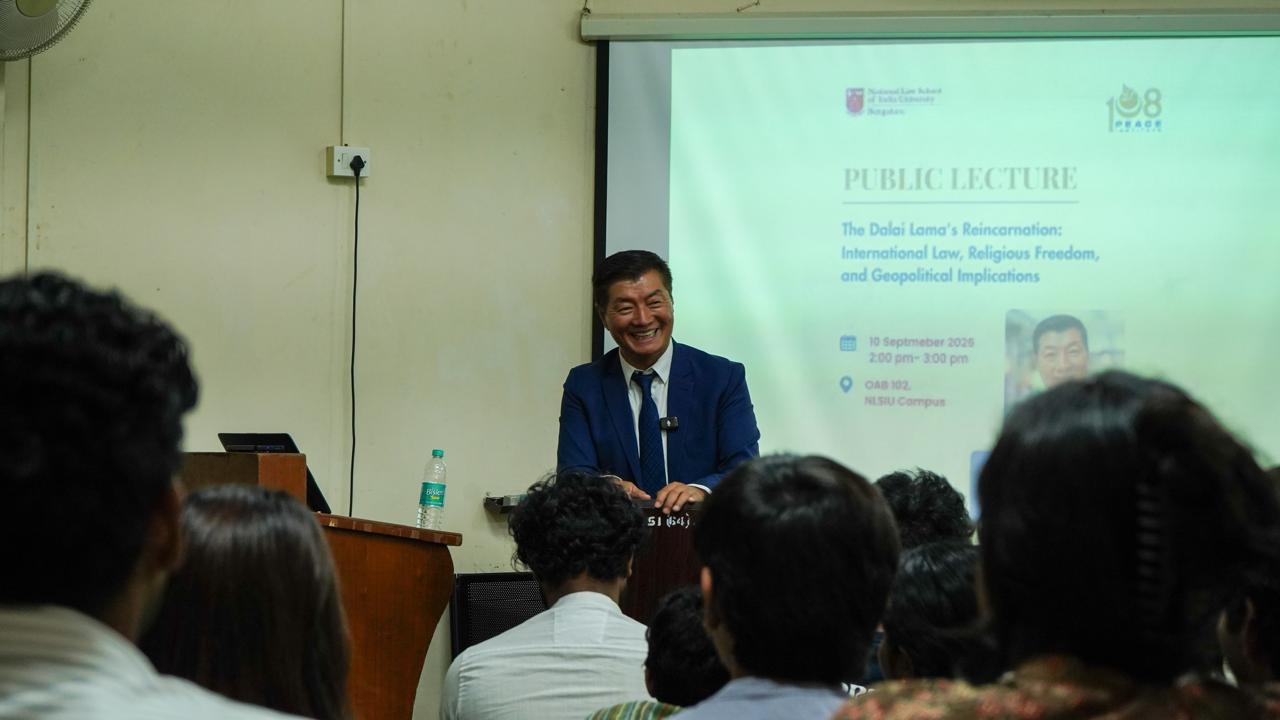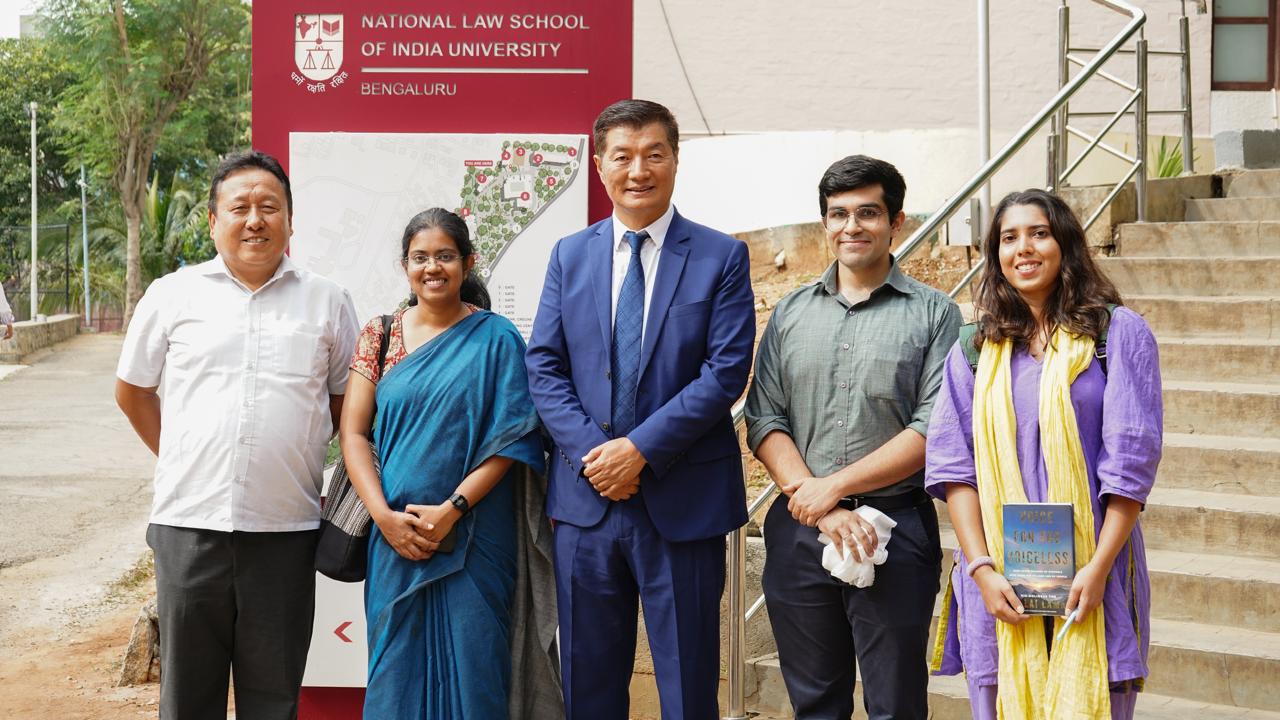
September 10, 2026: The 108 Peace Institute, in collaboration with the National Law School of India University (NLSIU), Bengaluru, organised a talk titled “The Dalai Lama Reincarnation: International Law, Religious Freedom and Geopolitical Implications,” at NLSIU. The talk featured Dr. Lobsang Sangay as the guest speaker.
Dr. Sangay opened the discussion by examining the question of the Dalai Lama’s reincarnation through the framework of international law, particularly the Universal Declaration of Human Rights (UDHR) and the International Covenant on Civil and Political Rights (ICCPR). Referring to Article 18 of the UDHR, which guarantees freedom of thought, conscience and religion, Dr. Sangay argued that the selection of the Dalai Lama’s reincarnation is fundamentally a religious matter and should remain within the authority of the Tibetan Buddhist religious institution rather than by a state.
Quoting His Holiness the Dalai Lama’s position on reincarnation, Dr. Sangay underscored that the freedom to decide where and how to be reborn is an essential aspect of religious freedom. He referred to the Dalai Lama’s political autobiography, Voice for the Voiceless, in which His Holiness has categorically stated that his future reincarnation would be born in a free country, outside China. Dr. Sangay stressed that a spiritual leader must have the freedom to practise and fulfil his religious responsibilities without political interference. He explained that the Gaden Phodrang, the Office of His Holiness the Dalai Lama, would oversee the process of identifying the Dalai Lama’s reincarnation, with senior Buddhist monks and religious authorities presiding over the search. He highlighted that the institution of reincarnation is rooted in Tibetan Buddhist tradition and the continued spiritual relationship between the Dalai Lama and his followers.
He also emphasised the significance of the global Buddhist community, extending from Ladakh and Arunachal Pradesh to Nepal, Bhutan and Southeast Asia, as well as Buddhist centers across Europe, particularly in Italy and France. According to Dr. Sangay, the collective devotion and appeal of followers worldwide constitute an important consideration in the continuation of the Dalai Lama institution. Questioning the Chinese government’s claimed authority over the process, he argued that the Chinese state had no religious mandate to identify the Dalai Lama’s reincarnation. He described the government’s position as a violation of religious freedom and the autonomy of Tibetan Buddhist institutions.
The Panchen Lama Controversy and China’s Reincarnation Regulations
Dr. Sangay drew attention to the disappearance of the 11th Panchen Lama, Gedhun Choekyi Nyima, whom the Dalai Lama endorsed in 1995 following the traditional religious process. He alleged that the Chinese government subsequently took him into custody and appointed another individual as the Panchen Lama. He noted that the whereabouts of Gedhun Choekyi Nyima remain unknown, raising serious concerns about religious freedom and the rights of Tibetan Buddhists. He further discussed China’s 2007 regulations on the management of the reincarnation of Tibetan Buddhist living Buddhas, commonly associated with Order No. 5. According to Dr. Sangay, these regulations require state approval and registration for recognised reincarnations, effectively placing religious succession under government supervision.
Dr. Sangay also questioned the historical and legal basis of China’s reliance on the Qing Dynasty’s Golden Urn system, particularly the 1793 Twenty-Nine-Article Ordinance governing Tibet. He challenged the authenticity and applicability of the historical document cited by China to justify state intervention in the reincarnation process, asserting that the original document does not exist and that the available Tibetan handwritten notes cannot be treated as an authentic legal instrument. He argued that China cannot invoke an unverified historical document to claim authority over the religious succession of Tibetan Buddhist leaders.
Drawing a parallel with the 17-Point Agreement of 1951, Dr. Sangay questioned its legitimacy and authenticity, alleging that the agreement was signed by the Tibetan delegation under duress. He further claimed that the delegation had not brought its official seal to Beijing and that the seals appearing on the agreement were fabricated there. Condemning what he described as China’s historical pattern of manipulating official documents and records to advance its political interests, he argued that such historical claims and documents have been used to legitimize Chinese control over Tibet and its religious institutions.
Tibet’s Strategic Importance and the Geopolitics of the Himalayas
Moving beyond the religious and legal dimensions, Dr. Sangay examined Tibet’s strategic significance in China’s regional and global ambitions. He described the so-called “Five Fingers Strategy”, arguing that Tibet occupies a central position in China’s approach to extending influence over the Himalayan region, including Ladakh, Sikkim, Arunachal Pradesh, Nepal and Bhutan.
He cautioned that control over the institution of the Dalai Lama could have consequences far beyond Tibetan religious affairs. According to Dr. Sangay, a fake Dalai Lama selected by the Chinese government will be used to advance Beijing’s political narratives and territorial claims in the Himalayan region. He urged the audience to support the Dalai Lama identified through the religious authority of the Gaden Phodrang.
Reflecting on India’s historical approach to Tibet, Dr. Sangay referred to parliamentary debates in the 1950s and criticized the underestimation of Tibet’s strategic importance by some Indian political leaders. He argued that China’s occupation of Tibet fundamentally altered India’s security environment, bringing Chinese military and strategic influence directly to India’s Himalayan borders.
Tibet: Asia’s Water Tower and a Critical Mineral Hub
Dr. Sangay highlighted the Tibetan Plateau’s vast reserves of critical minerals, including lithium and copper, and its importance to China’s electric vehicle and clean energy industries.
He also described Tibet as the “Water Tower of Asia”, drawing attention to its extensive glacier systems, approximately 40,000 glacial lakes and the major rivers originating from the Tibetan Plateau that sustain millions of people across South and Southeast Asia.
Expressing concern over China’s large-scale hydropower development, Dr. Sangay referred to the construction of hundreds of dams across the Tibetan Plateau. He specifically discussed the proposed Medog hydropower project on the Yarlung Tsangpo, which flows into India as the Brahmaputra. He cited a projected generating capacity of approximately 60,000 megawatts and cautioned that the scale of the project could have far-reaching implications for downstream countries. He warned that large dams in a highly seismic region could create serious environmental and security concerns. Linking large-scale infrastructure development, mining and urbanisation with ecological changes on the Tibetan Plateau, he discussed the accelerating melting of glaciers, rising temperatures and the increasing risks of floods affecting downstream communities.
Dr. Sangay urged India to take a stronger position on the environmental and transboundary implications of major hydropower projects in Tibet. He cautioned that control over upstream water resources could potentially become a strategic instrument of political pressure, particularly during periods of geopolitical tension.
He also called attention to what he described as the limited international discussion of Tibet’s environmental challenges, arguing that political sensitivities surrounding China often discourage environmental advocates and international institutions from addressing the issue adequately.
The Himalayan Buddhist World, Russia and Global Geopolitics
Dr. Sangay further connected the reincarnation issue to developments beyond the Himalayan region. He discussed the Buddhist communities in the Russian republics of Buryatia, Tuva and Kalmykia, which traditionally regard the Dalai Lama as an important spiritual teacher.
He argued that Russia’s growing dependence on China amid the war in Ukraine has placed additional pressure on these Buddhist communities and their ability to invite His Holiness the Dalai Lama for religious engagements. He also expressed concern that Chinese influence could facilitate the promotion of religious leaders recognised by Beijing in these regions.
According to Dr. Sangay, the question of the Dalai Lama’s reincarnation is therefore connected to a much wider geopolitical landscape, extending from Arunachal Pradesh and the Himalayan region to Russia, Europe and Washington, DC. He emphasised that the stakes involve not only religious authority but also strategic resources, water security, regional influence and the future international order.
China’s Religious Policy and the Implications for Other Faiths
Dr. Sangay broadened the discussion to China’s approach to religious institutions across different faiths. He argued that state intervention in Tibetan Buddhism reflects a wider policy of controlling religious leadership and ensuring that religious institutions align with the political objectives of the Chinese Communist Party.
He referred to China’s appointment process for Catholic bishops under its agreement with the Vatican, arguing that the arrangement gives Beijing considerable influence over religious leadership. He also discussed restrictions on Muslim religious institutions and the demolition or alteration of religious symbols and places of worship.
Citing the 2015 campaign against Christian crosses in Zhejiang Province, he referred to reports of hundreds of crosses being removed from churches. He described such measures, alongside restrictions on Buddhist monasteries and Muslim religious sites, as part of China’s broader policy of the Sinicisation of religion.
Dr. Sangay cautioned that allowing governments to determine religious leadership could have implications for religious freedom globally, extending well beyond Tibet. He argued that the issue should be understood as a fundamental question of the relationship between the state, religion and individual freedom.
A Call for a Democratic, Secular and Open World Order
Concluding his address, Dr. Sangay called for an alternative international order based on democratic values, secular principles, openness and respect for religious freedom. He emphasised that the freedom of religious communities to determine their own leadership is essential for preserving cultural identity, spiritual traditions and peaceful coexistence.
The lecture was followed by a vibrant question-and-answer session, during which students and faculty members engaged with Dr. Sangay on the legal, historical, environmental and geopolitical dimensions of the discussion.
The programme provided an important platform for examining the intersection of international law, religious freedom, Tibet’s political future and the strategic significance of the Himalayan region. With approximately 70 participants in attendance, the event encouraged critical reflection on the importance of safeguarding religious autonomy and upholding the principles of freedom, dignity and peaceful coexistence.