
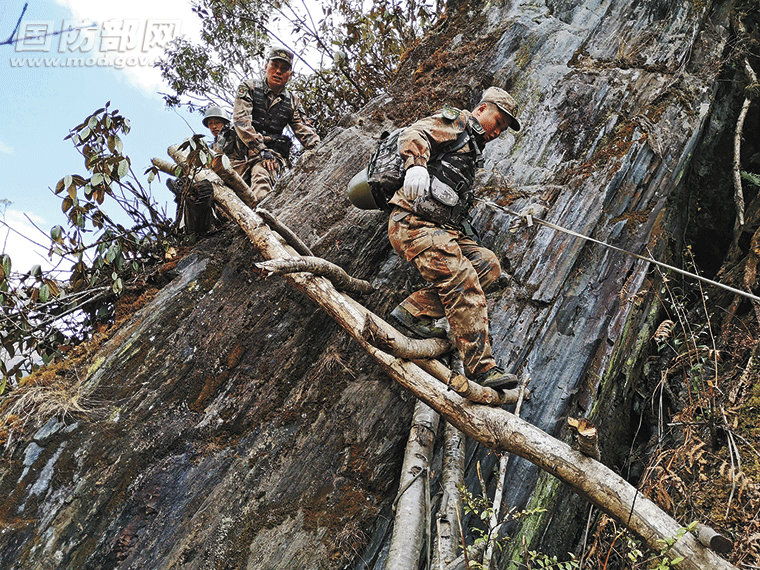
Source: PLA Daily depicts PLA soldiers patrolling in Asaphila near Taksing in 2019
Open-source orders of battle and PLA tender records suggest a border regiment in Longzi County bordering Upper Subansiri district has been improving, since 2021, its ability to stay, watch, and sustain itself near the Taksing frontier
The Standoff: Chinese intrusion into Upper Subansiri district
Indian and Chinese forces are locked in a standoff at Asaphila, near Taksing in Upper Subansiri district. Accounts conflict on how far Chinese forces have intruded into, or occupied, Indian territory at the multiple face-off points in this district. However, Chinese official tenders from Lhunze county and local district reports suggest that improved logistics and infrastructure in recent years may have enabled Chinese forces to deepen their intrusion into the Indian side of the Line of Actual Control (LAC). Under the cover of the 77629 Unit of the PLA, the 354th Border Defence Regiment based in Sanlin Township near the Asaphila-Taksing sector has invested in movable compact houses, repaired roads, specialised monitoring installations, and upgraded barracks since 2021.
ITBP Director General Shatrujeet Kapur said on 22 October that face-offs are continuing at several locations in Arunachal Pradesh, without naming them. Reports citing official sources say Indian and Chinese troops have been in a face-off at Asaphila, near Taksing, since late July. Another report said PLA troops pitched tents on higher ground within 6–7 km of the Indian side of the LAC, near the Maja company operating base in Taksing circle. This tug of war along the long, undemarcated India–China border has been ongoing since China took control of Tibet in 1950–51, with the first armed clash at Longju in 1959. However, the recent disclosure highlights the fact that PLA soldiers have increased their presence and assertiveness in Upper Subansiri district. On the ongoing border incident, Arunachal Pradesh’s Chief Minister Pema Khandu said on 29 October: “No doubt transgression has happened. It keeps happening; it is nothing new since the border is not defined.”
Although the Indian Army has dismissed claims of a Chinese takeover of Asaphila, Longju and Taksing circle, China continues to have the upper hand in maintaining an asymmetrical infrastructure base in the region.
On 26 June, the Nah Welfare Society (NWS) submitted a memorandum to the Deputy Commissioner of Upper Subansiri, alleging that Chinese forces had established roads, bridges and military camps in areas traditionally used by local communities for grazing, hunting and collecting forest produce; the Indian Army dismissed the allegations on 29 June as baseless. Lhünzê County in the Tibet Autonomous Region (TAR) borders Upper Subansiri, including the areas around the recent face-offs at Asaphila and Maja. Procurement records for the PLA unit operating in this region document investments in accommodation, road infrastructure, barracks, and border-monitoring facilities. These developments broadly echo the concerns raised by local communities about China’s expanding infrastructure presence along the frontier.
The face-offs around Taksing should not be viewed as isolated border incidents. Rather, they need to be understood against the backdrop of China’s reinvigorated border-defence posture, particularly the growing capabilities of its Border Defence Regiments, supported by improvements in infrastructure and logistics along the LAC.
PLA formation near Taksing
No published report names the PLA unit involved at Asaphila and the broader Taksing area. However, geographical and order-of-battle research points to the PLA’s 354th Border Defence Regiment as the likely unit responsible for the Taksing area and the wider frontier between Upper Subansiri district and Tibet’s Lhunze county.
Chinese Border Defence Regiments (a rough counterpart to India’s BSF and ITBP in role) are the first line of China’s defence and are responsible for border patrol, surveillance, and security nearest to the border. The China Aerospace Studies Institute (CASI) identifies eight Border Defence Regiments, the 351st to the 358th, under the Tibet Military District, stationed on the long, harsh Himalayan frontier with India, Nepal and Bhutan, including the Eastern Sector of the LAC.
The relevant Chinese administrative area is Lhünzê County (Longzi), in Shannan, Tibet Autonomous Region. According to CASI, the 354th Border Defence Regiment is associated with military unit cover designation 77629 and is listed in Lhünzê (Longzi) County.
The 77629 PLA unit stationed in Lhunze County is geographically positioned near Taksing and the broader Upper Subansiri district border. The 2023 barracks-renovation tender gives the unit’s address as Sanlin township in Longzi County and directs bidders to register at Sanan Qulin township. This township, possibly the unit’s headquarters or command centre, is about 30 km in a straight line from Asaphila and is connected to the Lhunze main city via multi-pronged, asphalted access and also the Subansiri basin via specialized arterial roads. This allows vehicular logistics, heavy equipment movement, and continuous supply chains up to forward staging areas.
An Asymmetrical Infrastructure Base: India and China Along the Taksing Frontier
The recent face-offs around Taksing and Asaphila may expose an important asymmetry in the infrastructure supporting Indian and Chinese forces along this section of the LAC. On such undemarcated, contested borders, the capacity to move personnel and equipment, maintain communications, and sustain a forward presence is critical. Four tenders associated with the 77629 PLA unit since 2021 show that the unit’s recent assertive moves in Taksing and the broader Upper Subansiri district are backed by a practical investment in equipment and infrastructure enabling it to maintain and expand its troop presence inside the contested territory.
Tenders issued by PLA Unit 77629, reportedly the 354th Border Defence Regiment, document investment in 30 prefabricated accommodation units in 2021, road repairs in 2022, a specialised border-monitoring facility for which a research institute of the China Electronics Technology Group Corporation (CETC) was the first-ranked bidder, and barracks improvements in 2023. Conditions reported from the Indian side of Upper Subansiri, by contrast, point to persistent logistical constraints.
| Project | Purpose | Date | Source |
|---|---|---|---|
| 2106B | 30 movable prefabricated housing units and 1,500 m² of site grading | 25 Oct 2021 | TAR Housing and Urban-Rural Development Dept, tender notice |
| 0210 road repair | Medium repair of a road; site not stated | 6 Jul 2022 | TAR Housing and Urban-Rural Development Dept, award notice |
| LZA2206-1 | Border and coastal defence monitoring facility; site not stated | 29 Jul 2022 | TAR Housing and Urban-Rural Development Dept, award notice |
| Barracks renovation | 557.14 m² of glazed living space, 3,749.47 m² of hardstanding, guesthouse and utilities repairs | 16 Oct 2023 | TAR Housing and Urban-Rural Development Dept, tender notice |
For Asaphila and Taksing, the impact is practical. A unit whose tender address sits in Sanan Qulin township, about 30 km from Asaphila and 33 km from Taksing (measured from the township centre, not the compound), can keep patrols and camps supplied for longer than one operating from the rear. That fits the PLA tents reported near Maja and the persistent pressure Indian sources describe. It is capacity, not proof of orders.
The record supports two earlier claims: a PLA formation is based in Longzi near the contested ground, and its logistics investment is continuous, not episodic. It does not show that Unit 77629 directed the 2026 face-offs, or that a transgression is planned.
India’s side shows the gap. The Tama Chung Chung–Taksing road took nine years and was completed in 2018, and residents report a narrow Nacho–Taksing stretch and unreliable mobile towers. On this terrain, the advantage goes to the side that can sustain forward positions through the winter.
India Today’s OSINT team, reporting on the unfinished roads around Taksing, said that the Tama Chung Chung (TCC)–Taksing road is the only completed road among seven road links planned or built around Taksing. China, by contrast, has built a network of roads and modern infrastructure, including new villages, helipads and a border post close to the border, according to the same report.
A 2021 report in The Arunachal Times described the Upper Subansiri Valley as one of the most challenging areas for Border Roads Organisation (BRO) operations, citing steep terrain, heavy rainfall, unpredictable weather and negligible telephone connectivity. It also reported that approximately 2,000 Army and paramilitary personnel deployed along the LAC in the area had been maintained by helicopter for almost two decades before the road connection to Taksing was established.
More recent reporting suggests that many of these constraints remain unresolved. In August 2026, residents of Taksing and Limeking told The Arunachal Times that mobile towers frequently remained non-functional and that the Daporijo–Taksing road, particularly the Nacho–Taksing stretch, was narrow and in poor condition. Local representatives also said that the road condition impeded the movement of Army vehicles and equipment. Northeast Now’s subsequent report corroborated these concerns.
This comparison points to an infrastructure asymmetry with potential operational consequences. Better-developed accommodation, transport links and monitoring facilities can reduce the logistical burden of maintaining a persistent presence, while unreliable roads and communications increase the difficulty of moving, coordinating and sustaining personnel on the Indian side. In light of the PLA’s persistent forward presence along the LAC, addressing this infrastructure imbalance requires more than expanding road connectivity. The Indian government must prioritise reliable telecommunications, forward logistical facilities and stronger military-civilian integration, working closely with local communities whose access to these frontier regions is equally important to India’s border security.
About the Author
Tenzin Younten is a Senior Researcher at the 108 Peace Institute.
© 2026 108 Peace Institute. All rights reserved. This article is original and was first published by the 108 Peace Institute.