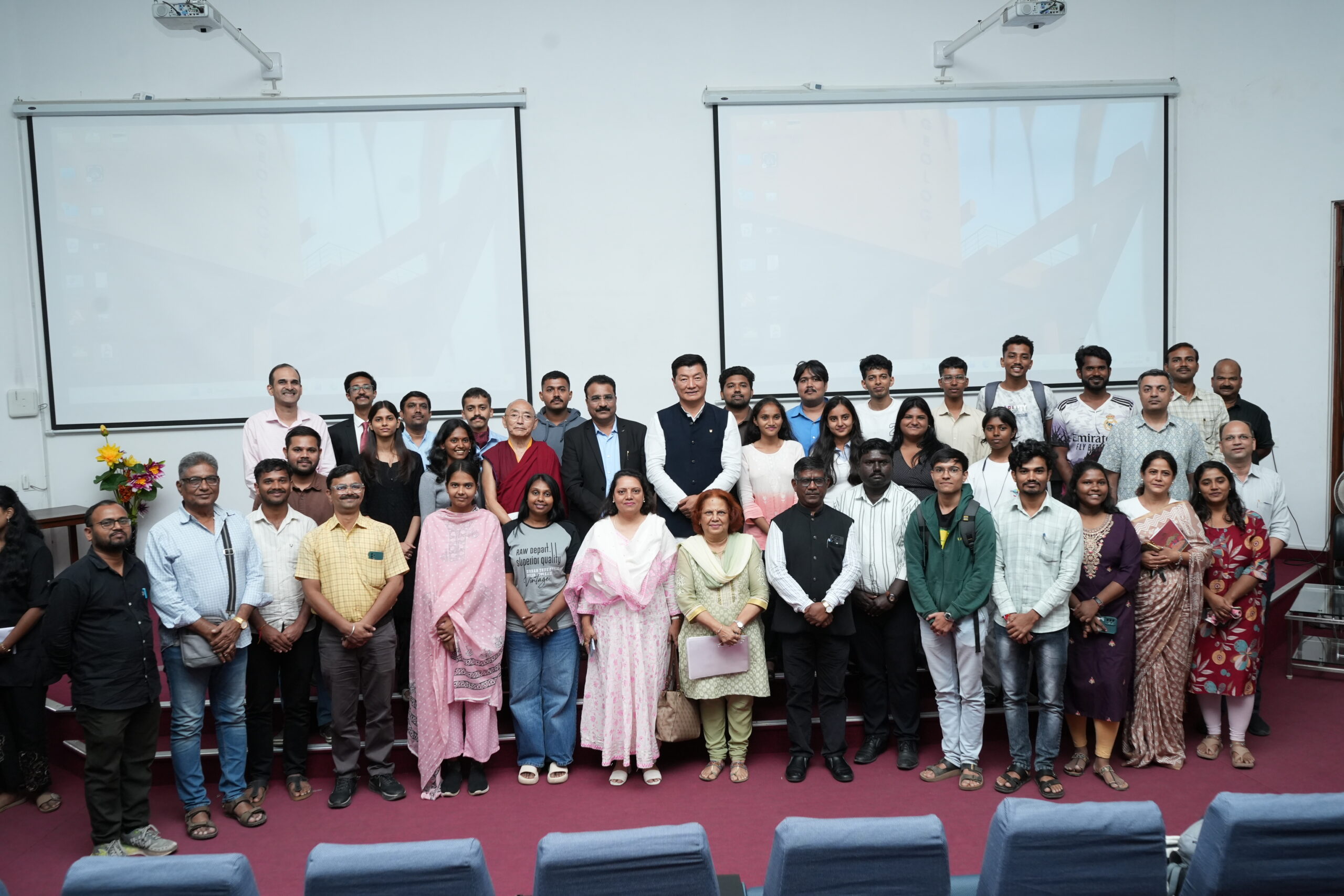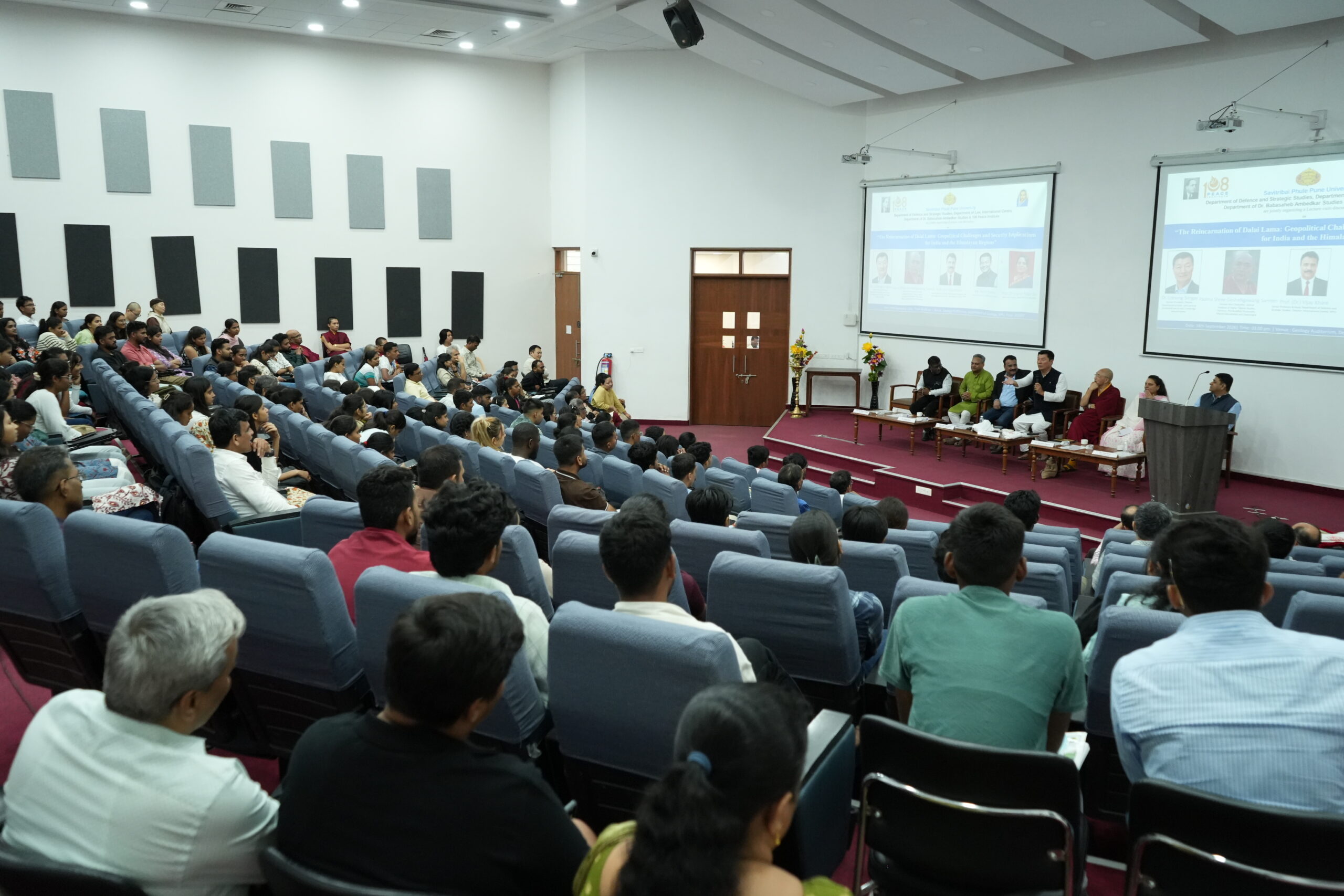
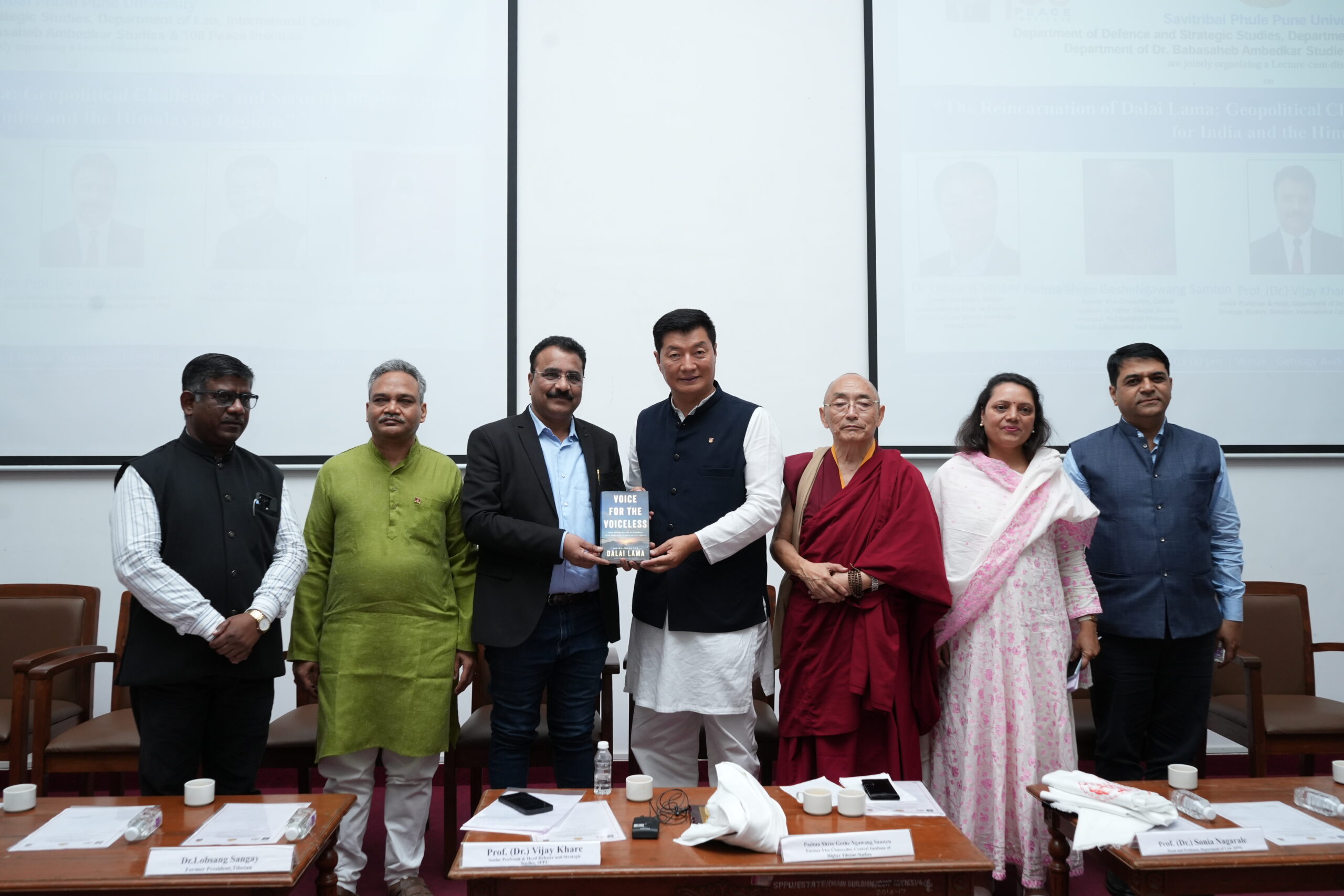
16th September 2026: The 108 Peace Institute, in collaboration with the Departments of Defense and Strategic Studies, Dr. B. R. Ambedkar Studies, Pali and Buddhist Studies, Law, and the International Centre at Savitribai Phule Pune University (SPPU), organised a lecture-cum-discussion on “The Reincarnation of the Dalai Lama: Geopolitical Challenges and Security Implications for India and the Himalayan Region.” The session featured Dr. Lobsang Sangay and Padma Shree Geshe Ngawang Samten and was moderated by Dr. Vijay Khare, Professor and Head of the Department of Defense and Strategic Studies.
The programme began with the University song, ceremonial lamp lighting, and the felicitation of the speakers and representatives of 108 PI.
In his opening remarks, Dr. Vijay Khare highlighted SPPU’s global standing and its large student community. He stressed the importance of understanding the Dalai Lama’s reincarnation beyond the question of political asylum, noting that China’s interest in the issue extends into broader geopolitical and geoeconomic dimensions.
Geshe Ngawang Samten on the Buddhist Understanding of Reincarnation
Padma Shree Samten explained that reincarnation is not simply a process of selecting a child from among several candidates. He described it as a distinctive system rooted in the Buddhist understanding of the nature and continuity of mind. According to Mahayana Buddhist philosophy, sentient beings transmigrate from one life and realm to another according to karma, while consciousness continues.
Discussing the identification of the 14th Dalai Lama, Geshe Samten recalled that members of the search committee met the young child disguised as ordinary people. According to him, the child identified members of the group by name despite not having met them previously and recognised objects belonging to the 13th Dalai Lama. He presented this as part of the empirical basis traditionally used in identifying a reincarnation.
Geshe Samten also elaborated on the Buddhist Science of Mind, explaining that consciousness arises through appropriate causes and conditions and exists at subtle, medium, and gross levels. Drawing on the Nalanda tradition, he discussed mental factors, perception, behaviour, and methods for controlling destructive emotions. He noted that while modern science primarily measures physical phenomena, contemporary neuroscientific research is increasingly examining questions about consciousness that Buddhist traditions have studied for centuries.
He argued that rebirth follows from the continuity of mind and is therefore understood within Buddhism as a phenomenon rather than merely a matter of belief. Referring to Buddhist teachings, including the Kalachakra Tantra, he discussed the continuity of subtle mind.
Geshe Samten also addressed China’s involvement in the reincarnation issue. Referring to China’s 2007 regulation concerning “living Buddhas” and the Dalai Lama’s 2011 statement that he would clarify the future of the institution at the age of 90, he noted that Buddhist communities across the Himalayan and Asian regions had requested the continuation of the institution. The Dalai Lama subsequently affirmed that the institution would continue and that responsibility for identifying his reincarnation rests solely with the Gaden Phodrang Trust.
Dr. Lobsang Sangay on Reincarnation and Geopolitics
Dr. Lobsang Sangay acknowledged the heads of the departments for jointly organizing this important session and directly addressed the question of the Dalai Lama’s reincarnation. Referring to the concept of an avatar, he explained that a guru decides to return and that, within the tradition, disciples request their gurus to return continuously to guide them. He noted that, for 14 years, followers of His Holiness the Dalai Lama had faithfully requested the continuation of the institution and its lineage.
Referring to His Holiness the Dalai Lama’s book Voice for the Voiceless, Dr. Sangay stated that His Holiness has indicated that his next reincarnation will be born outside China, rather than inside China, because freedom is necessary to practice religion. He argued that such religious freedom does not exist in China. He noted that possessing a photograph of His Holiness the Dalai Lama in Tibet is prohibited and punishable, while Chinese authorities have continued to criticize him for decades.
Dr. Sangay questioned why the CCP, which he said does not believe in religion, is nevertheless interested in selecting the next Dalai Lama. He argued that while Buddhist followers believe in the reincarnated individual, the CCP seeks to control the institution and influence associated with the Dalai Lama. He highlighted the Dalai Lama’s influence across the Himalayan region, Tibet, Inner Mongolia, Outer Mongolia, Buryatia, Tuva, and Kalmykia, extending from India to Russia. According to Dr. Sangay, His Holiness is regarded as a root guru by Buddhist followers across these regions.
Dr. Sangay further discussed what he described as China’s “Five-Finger Strategy,” in which Tibet represents the palm and Nepal, Bhutan, Arunachal Pradesh, Sikkim, and Ladakh represent the five fingers. He argued that China seeks to expand its influence over these regions and suggested that a future Dalai Lama controlled by Beijing could potentially be used to assert that these five regions are part of China.
He also referred to what he described as China’s expanding “Ten-Finger Strategy,” pointing to China’s growing involvement in countries surrounding India, including Pakistan, Bangladesh, the Maldives, Sri Lanka, and Afghanistan. He argued that China’s ambition to become the world’s number-one power would also involve containing potential competitors, including India.
Dr. Sangay then connected the reincarnation issue with broader geopolitical developments, including Ukraine, Washington, and Delhi. Referring to Prime Minister Narendra Modi’s meetings with Chinese President Xi Jinping, he discussed the 2014 Modi-Xi meeting, the 2017 Doklam standoff, the 2019 informal summit in Tamil Nadu, and the 2020 Galwan clash. He highlighted the strategic significance of Doklam, including its proximity to the Siliguri Corridor or “Chicken’s Neck.”
He also discussed the 1914 Simla Agreement between Tibet and British India and the associated McMahon Line, stating that Tibet had agreed to the border demarcation involving Arunachal Pradesh and Tawang. He referred to the 1954 Panchsheel Agreement, the 1959 events in Tibet, the 1962 India-China war, the 1967 Nathu La clashes, and the 1979 efforts by Atal Bihari Vajpayee to rebuild relations with China.
Dr. Sangay also emphasized Tibet’s importance as a resource-rich region and the “water tower of Asia,” supporting billions of people downstream. He highlighted the approximately 7,900 glacial lakes between India and Tibet and argued for joint studies, research, data sharing, and early-warning systems among neighbouring countries to prevent disasters.
Questioning China’s technological capabilities and response to recent floods, he referred to reports of destruction and disputed death tolls and argued that greater transparency and international cooperation are necessary. He also drew a parallel with the COVID-19 pandemic, questioning the lack of access for international investigators into China seeking to study its origins and asking whether China would ever allow neighbouring countries to jointly study glacial lakes and flood risks.
Returning to the reincarnation issue, Dr. Sangay argued that Beijing’s interest is primarily connected to the influence of the Dalai Lama. He suggested that China may seek to establish its own Dalai Lama who would support Beijing’s position. On religious freedom, Dr. Sangay argued that the situation in China is worsening and referred to the demolition of monasteries, mosques, and churches. He also discussed the agreement between China and the Vatican concerning the appointment of bishops and argued that religious leaders are expected to promote patriotism on behalf of the CCP.
He concluded by questioning China’s interest in controlling the reincarnation of the Dalai Lama and remarked that, if China is genuinely interested in the reincarnation process, it should first consider applying the same process to Mao Zedong. He further stated that, in China, people can criticize God but cannot criticize Xi Jinping, which he presented as part of what he described as China’s effort to build a Chinese world order. He also emphasized that without understanding Tibet, India will never understand China.
The lecture cum discussion, which was attended by more than 150 participants, saw an engaging discussion with the speakers on the future of the Dalai Lama’s Institution, Taiwan’s stance on Tibet, China’s demographic decline, China’s debt economy, Indian medicine as a soft power, the middle way approach, and Tibet studies programs in Indian Universities.