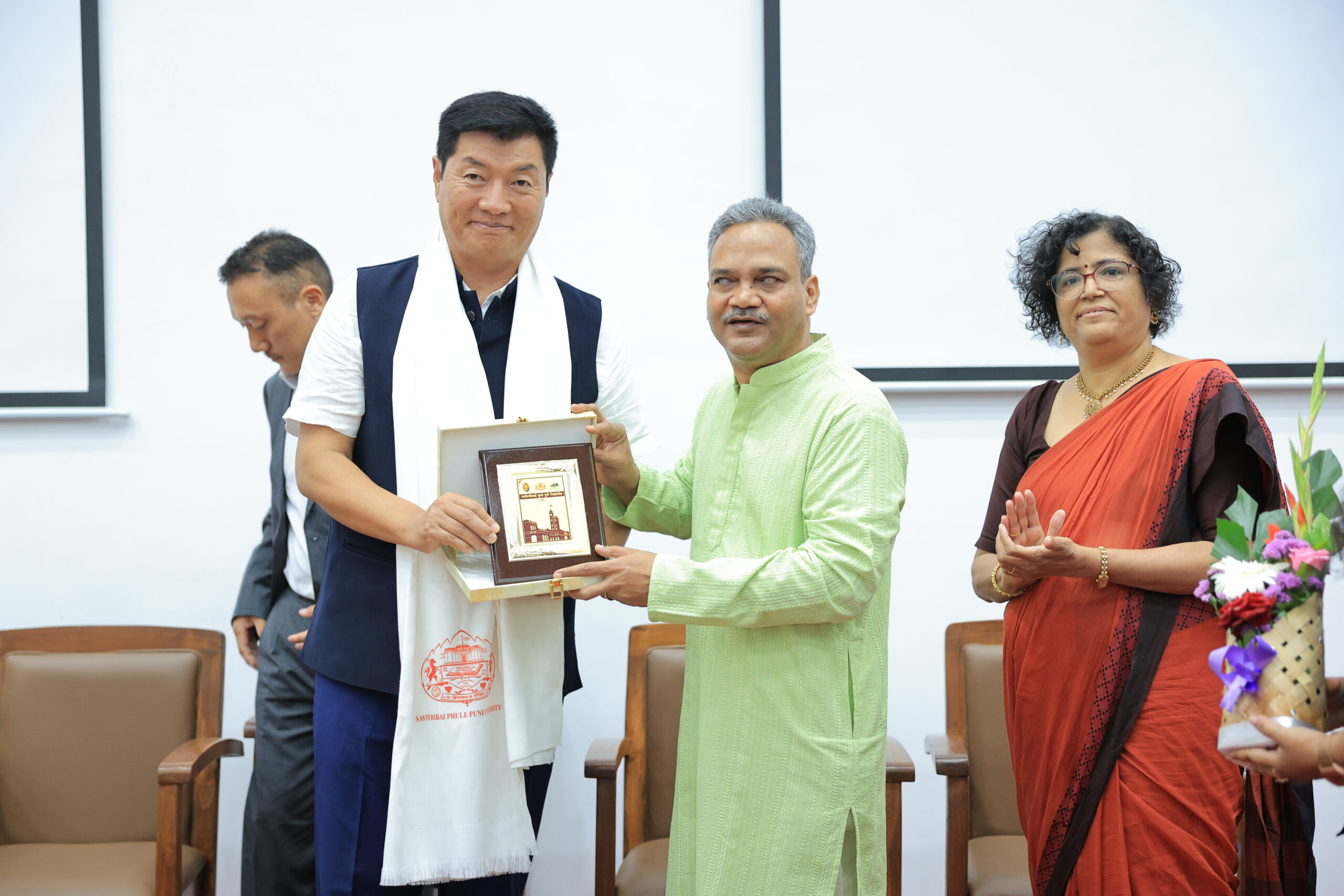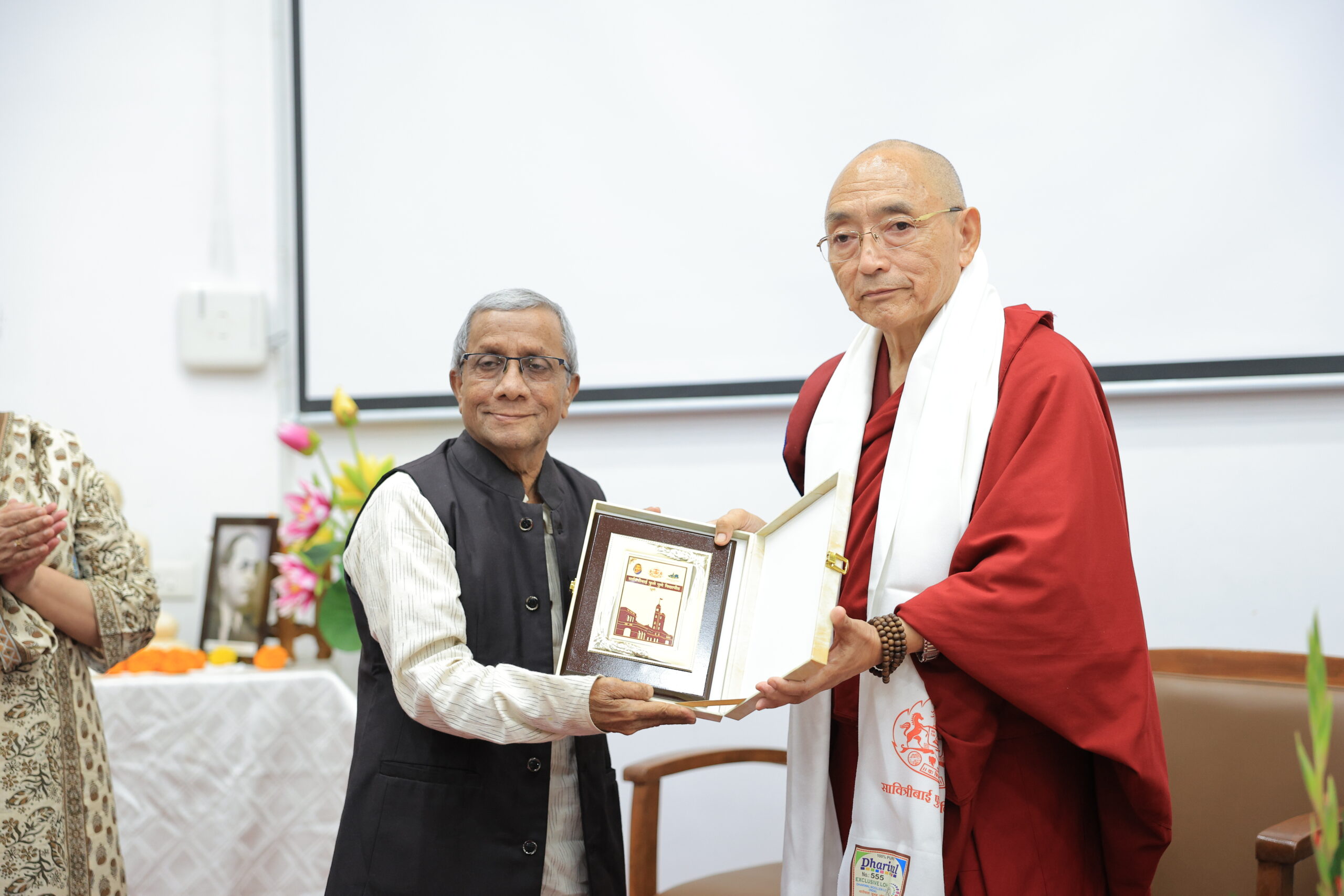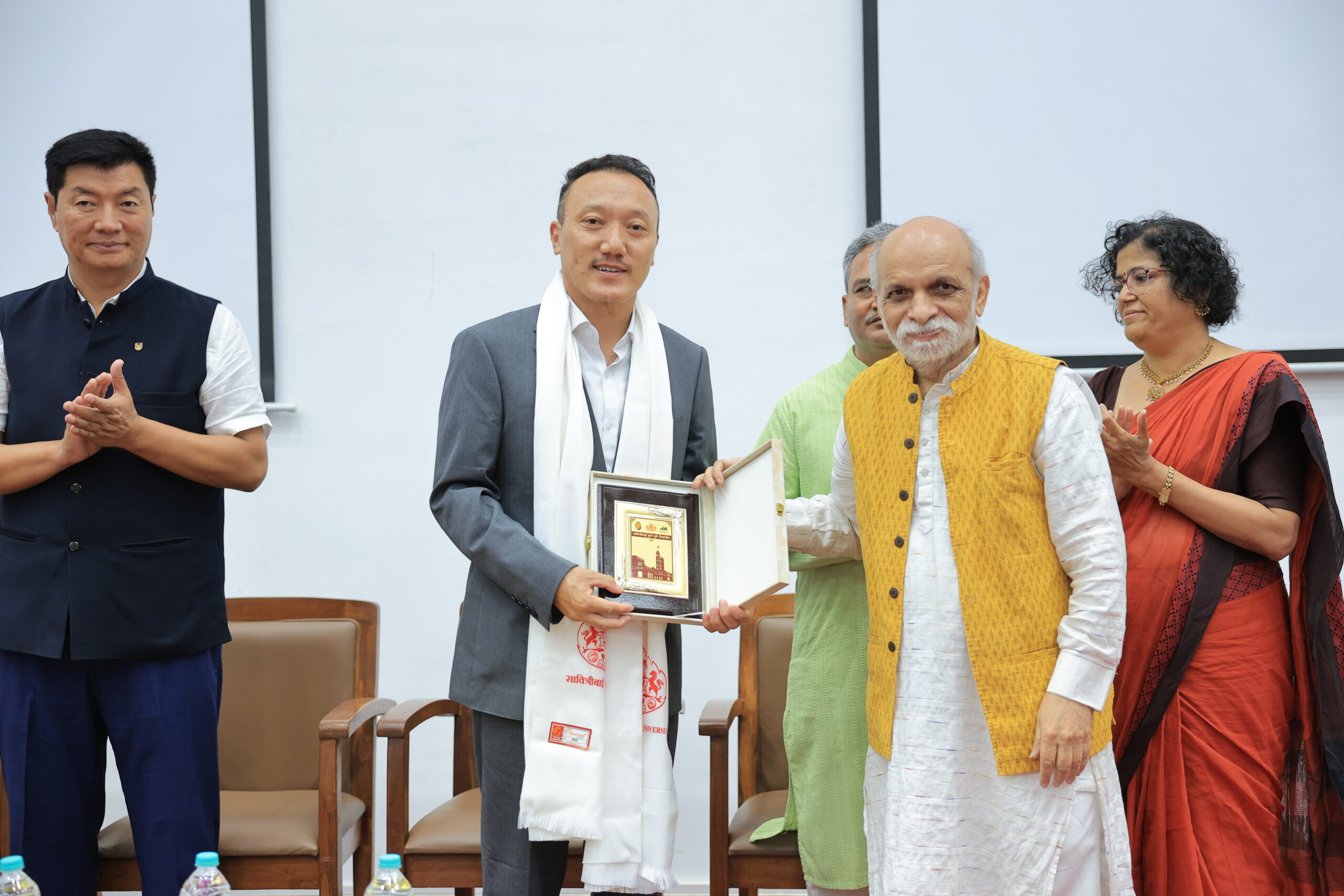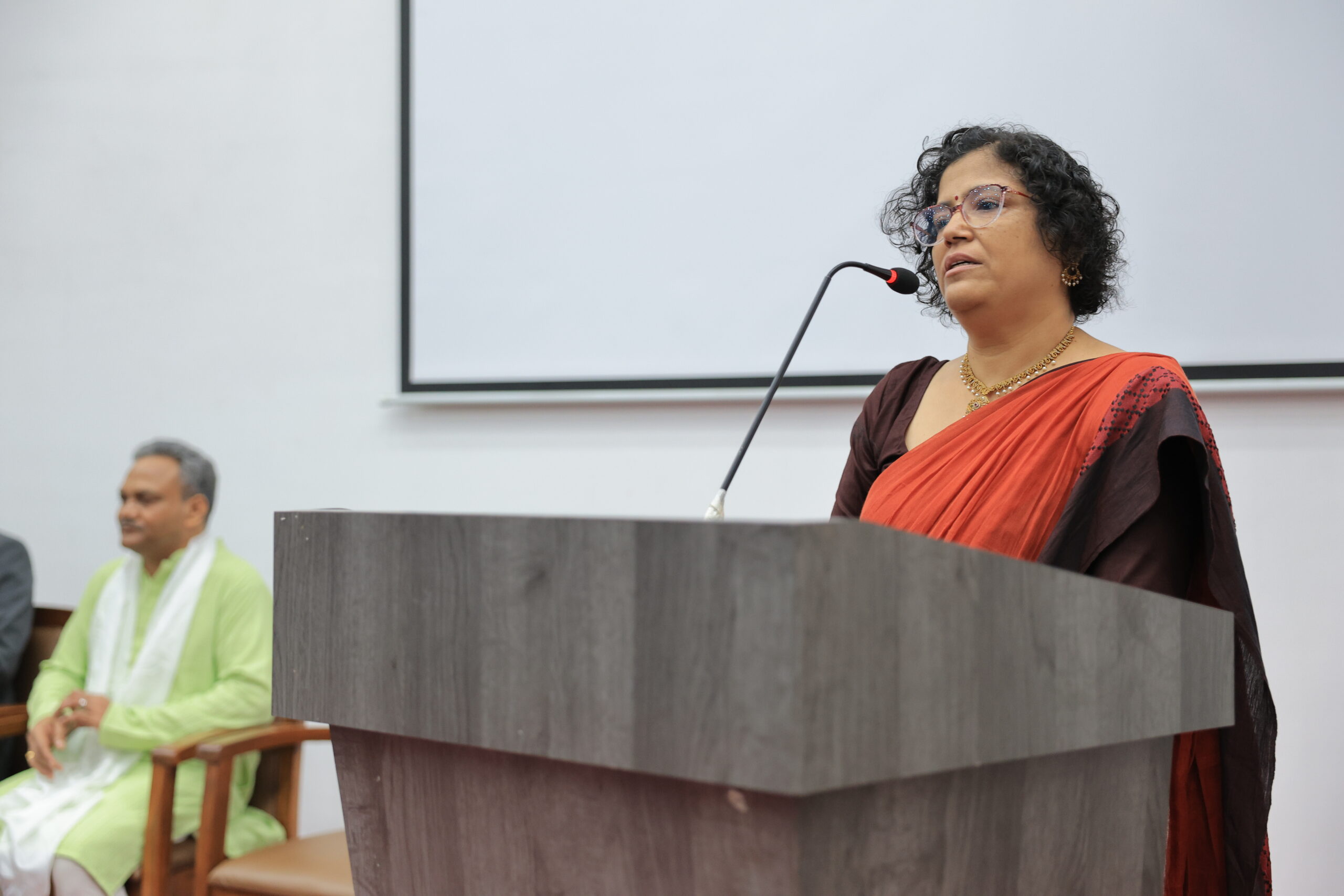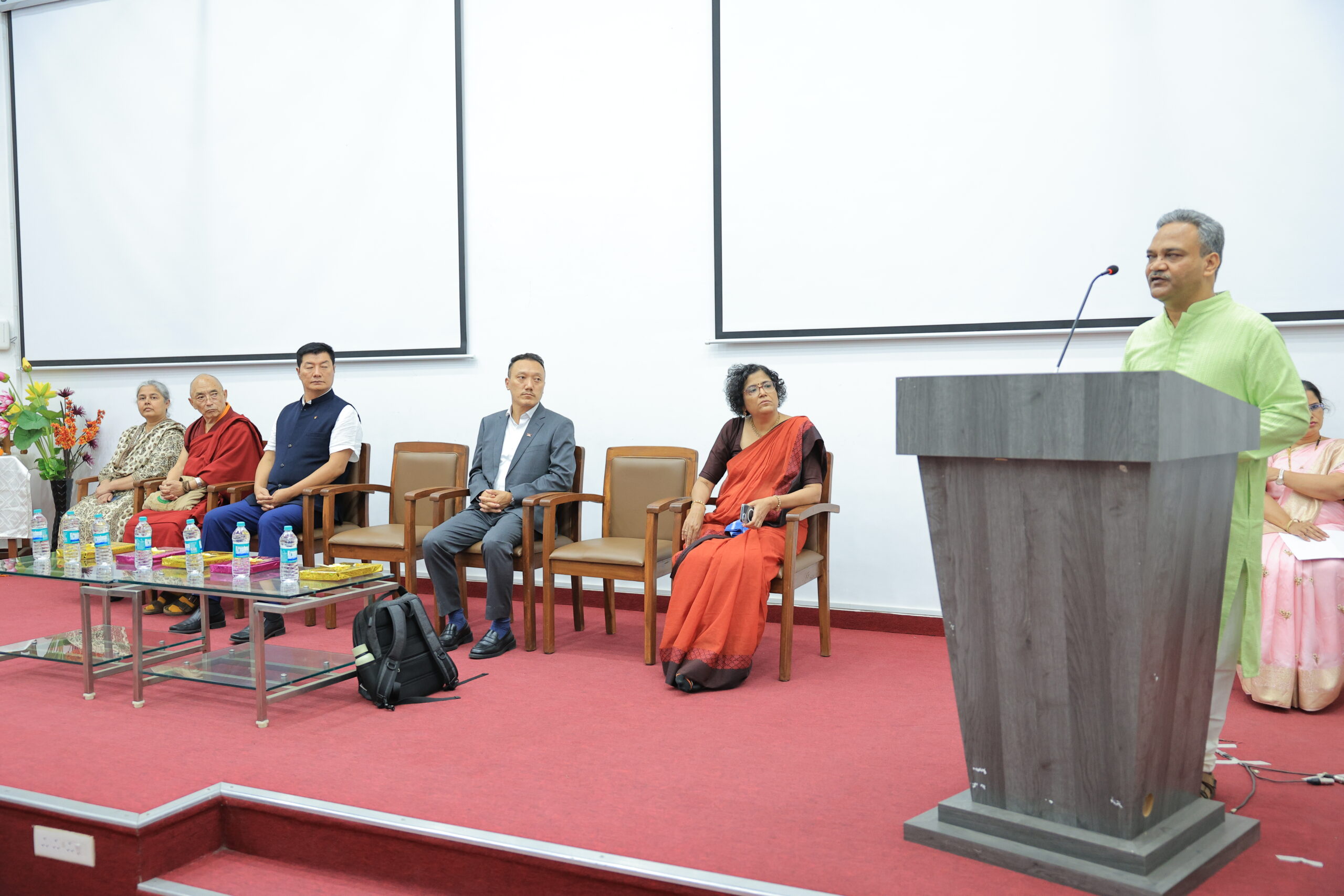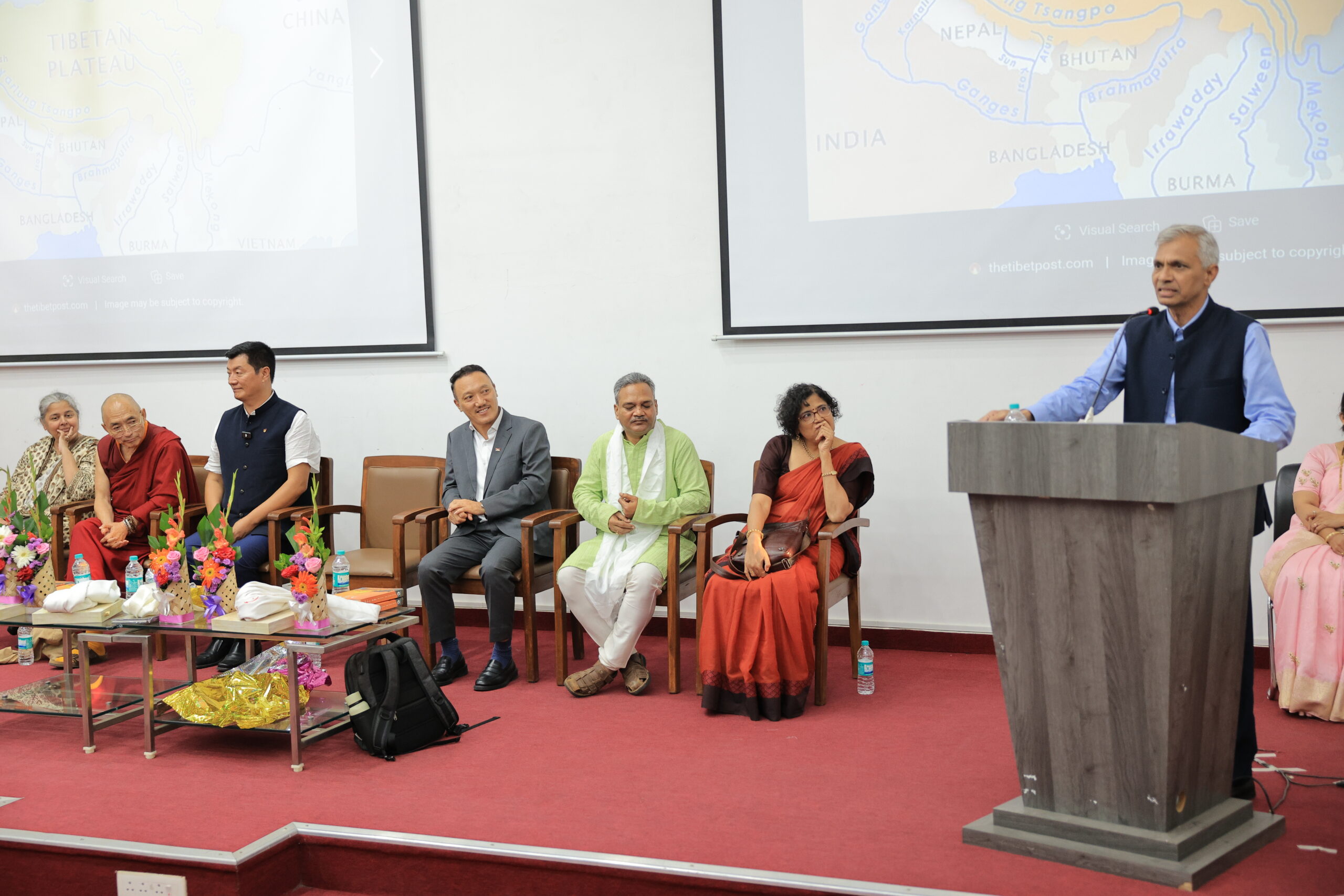
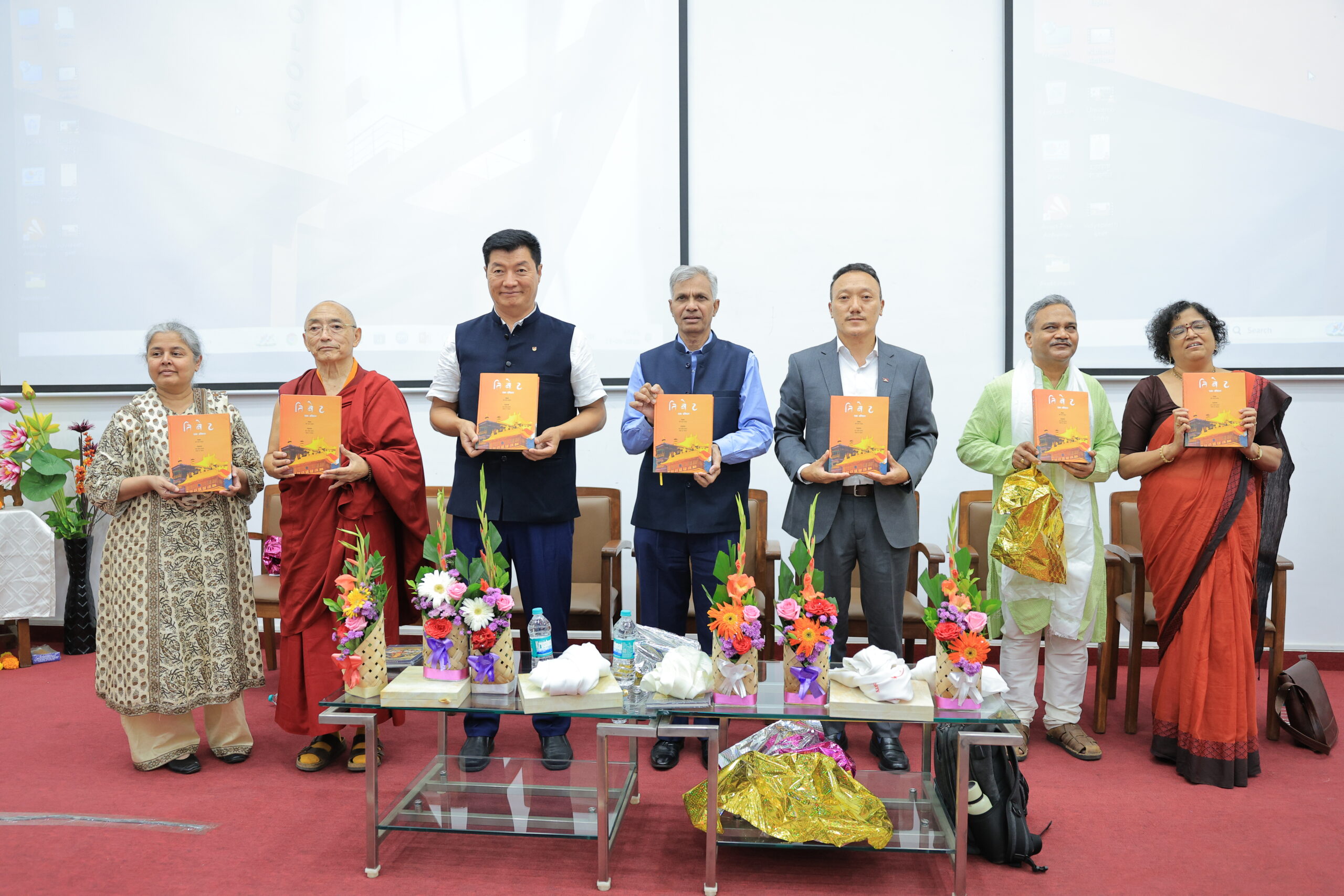
On 15 September 2026, Dr. Lobsang Sangay, Founding President of the 108 Peace Institute, graced the launch of Tibet – Ek Itihās, the first Marathi translation of Dr. Sam van Schaik’s acclaimed book Tibet: A History, originally published by Yale University Press in 2011. The book provides a historical account of Tibet from the seventh-century Tibetan Empire to the present, including Tibet’s relationship with China, the development of Tibetan Buddhism, the Dalai Lamas, and the events of the twentieth century.
The event was organized by the Department of Pali and Buddhist Studies, Savitribai Phule Pune University, in collaboration with the Deshana Institute of Buddhist and Applied Studies and the Department of History. The book was formally released in the presence of University Vice Chancellor Dr. Gosavi, Padma Shri Geshe Ngawang Samten, and Mr. Tempa Gyaltsen Zamlha, Joint Secretary, Department of Information and International Relations, Central Tibetan Administration.
Featuring a foreword by His Holiness the 14th Dalai Lama, the Marathi edition represents an important effort to make Tibet’s history, culture, religion, and political experience accessible to Marathi-speaking readers. The translation is the result of the dedicated work of Dr. Mahesh Deokar, Professor and Head of the Department of Pali and Buddhist Studies at Savitribai Phule Pune University, and Dr. Lata Mahesh Deokar, Adjunct Professor in the same department.
In his guest address, Dr. Sangay used the book as a framework to discuss what he described as nine key “Ms” in Tibet’s history: Marriage, Mongols, Manchus, the McMahon Line, Maoism, mass uprising and destruction, migration and mining, mass mobilization and monasteries, and the Middle Way Approach associated with His Holiness the 14th Dalai Lama.
Discussing the historical relationship between Tibet and China, Dr. Sangay examined the Chinese argument that the marriage between a Tibetan king and a Chinese princess established a claim that Tibet belonged to China. He questioned the use of marriage alliances as a basis for determining sovereignty, noting that royal intermarriages occurred across Europe and Asia without establishing that one kingdom thereby became part of another. He explained that such marriages were often diplomatic arrangements intended to maintain peace and political relations.
Dr. Sangay further discussed the Tang, Song, Yuan, Ming, and Qing periods, emphasizing the need to distinguish between different historical relationships rather than treating them as a continuous relationship of Chinese sovereignty over Tibet. He said that China also argued that Tibet was part of the Mongol Empire because the Mongols ruled Tibet and, therefore, claimed that Tibet became part of China. However, as Dr. Sangay pointed out, China itself was ruled by the Mongols during the Yuan period; it was not the other way around. He argued that this historical relationship should not be used to establish a Chinese claim over Tibet.
Dr. Sangay noted that Kublai Khan’s favorite consort was a Buddhist and that, during Kublai Khan’s time, the priest-patron relationship between Tibet and the Mongols was particularly strong compared with the relationship under successive Mongol rulers. He described Tibetan Buddhist lamas as spiritual teachers and imperial rulers as patrons, emphasizing that such relationships did not necessarily imply political ownership. Similarly, the Manchu emperors Kangxi and Qianlong, who were interested in Buddhism, maintained priest-patron relationships with Buddhist monks during the middle period of the Qing dynasty.
On the McMahon Line, Dr. Sangay highlighted the 1914 Simla Convention between British India and Tibet and its significance for the India-Tibet border, particularly Arunachal Pradesh and Tawang. He noted the historical connections between Tawang and Tibet, including the role of Tibetan authorities in the administration of Tawang Monastery before 1951. He argued that the Simla Convention and the McMahon Line are central to understanding the contemporary border dispute. He further stated that if India did not accept the McMahon Line as the demarcated border between India and Tibet, China would have greater grounds to claim Arunachal Pradesh as “southern Tibet.” He added that when the Simla Convention was signed between British India and Tibet, Tibet agreed to the demarcation of the region, including Tawang, with British India.
Turning to the period of Maoist rule, Dr. Sangay discussed the Chinese takeover of Tibet, the 1959 Tibetan Mass uprising, the escape of the Dalai Lama to India in March 1959 through the present-day Arunachal Pradesh region, and the subsequent destruction of monasteries and disruption of Tibetan religious and cultural institutions. He highlighted the rebuilding of Tibetan monasteries and institutions in India and the establishment of the Tibetan democratic administration in exile by Mahaguru His Holiness the 14th Dalai Lama. He also discussed the Middle Way Approach, which seeks a negotiated resolution to the Tibet-China dispute while emphasizing non-violence and drawing inspiration from the principles of Mahatma Gandhi.
Dr. Sangay also addressed recent developments in China, including the Law on Promoting Ethnic Unity and Progress, which came into effect on 1 July 2026. Chinese authorities describe the law as strengthening national unity and cohesion among the country’s ethnic groups, while Tibetan representatives and other critics have expressed serious concerns about its implications for Tibetan language, culture, religion, and identity. Under this Ethnic Unity Law, he shared, Zhejiang Province of China saw 400 Christian crosses demolished, and priests had to preach government rules and regulations before beginning the sermons.
The lecture further examined India-China relations and Himalayan geopolitics. Dr. Sangay discussed the Galwan Valley, Doklam, Sikkim, Nepal, Arunachal Pradesh, Pakistan, Sri Lanka, the Maldives, and Bangladesh in the context of what he described as the expansion of China’s strategic influence beyond the traditional “Five Fingers” framework. He argued that developments in the Himalayan region have wider implications for India’s security and regional strategy.
Reflecting on the history of India-China relations, he referred to key developments including the 1954 Panchsheel period, the 1959 Tibetan uprising, the 1962 India-China war, the 1967 clashes in Sikkim, Prime Minister Atal Bihari Vajpayee’s 1979 visit to China, the 2017 Doklam standoff, and the 2020 Galwan clash. He also referred to the 2019 informal summit between Prime Minister Narendra Modi and President Xi Jinping in Tamil Nadu. Dr. Sangay observed that whenever India attempted to improve its relationship with China, it had, on many occasions, experienced what he described as setbacks or betrayals. He also stated that China’s declared policy is to become the world’s number-one power by 2049 and argued that, as part of this ambition, China would seek to contain potential number-two powers, including India.
The book launch event offered students, scholars, and faculty a rare opportunity to engage with Tibet’s history, India-Tibet relations, China’s evolving policies, and the broader geopolitical significance of the Himalayan region. Through the launch of Tibet – Ek Itihās, the organizers also underscored the importance of making scholarship on Tibet accessible to a wider Indian-language readership.