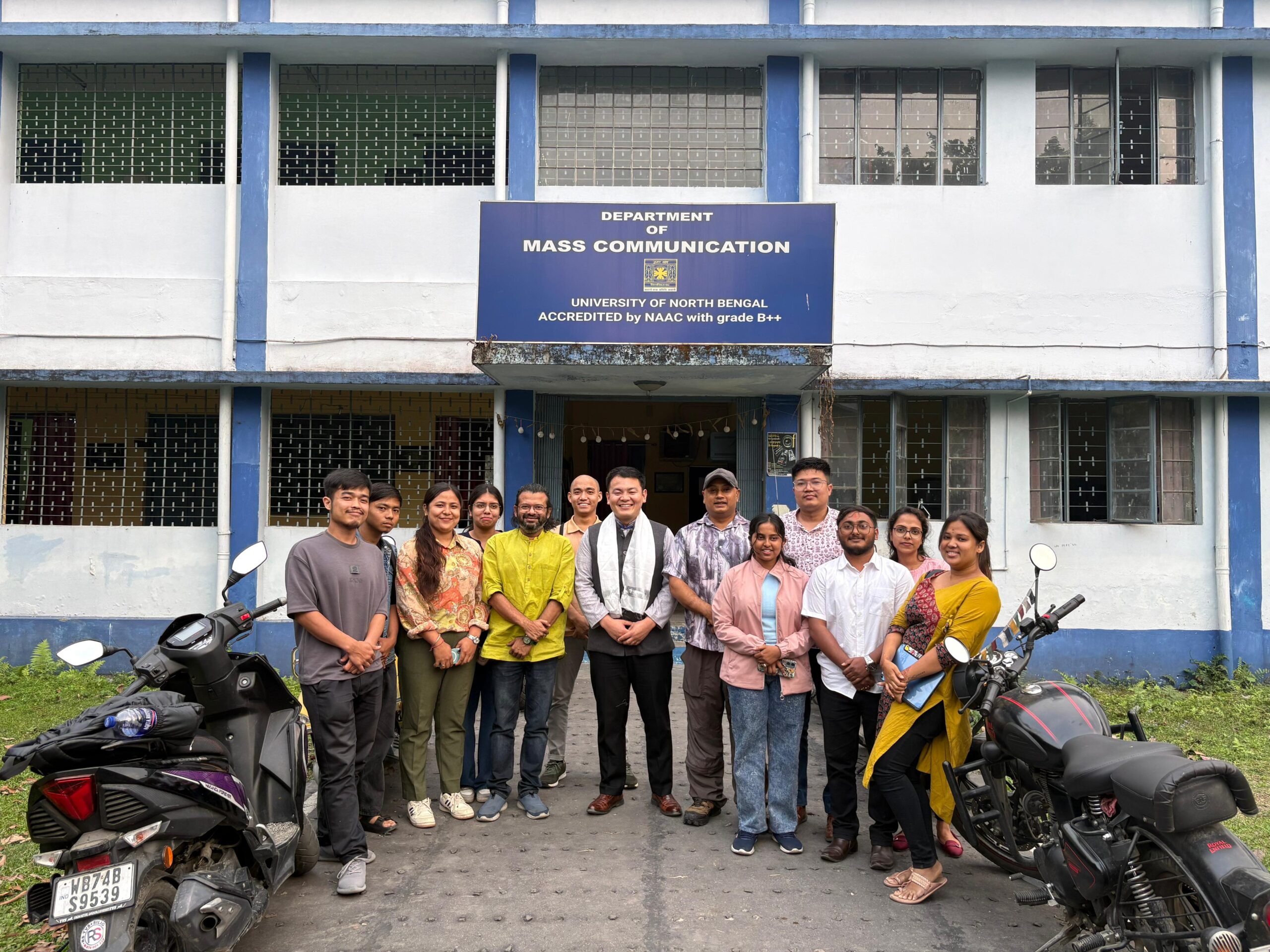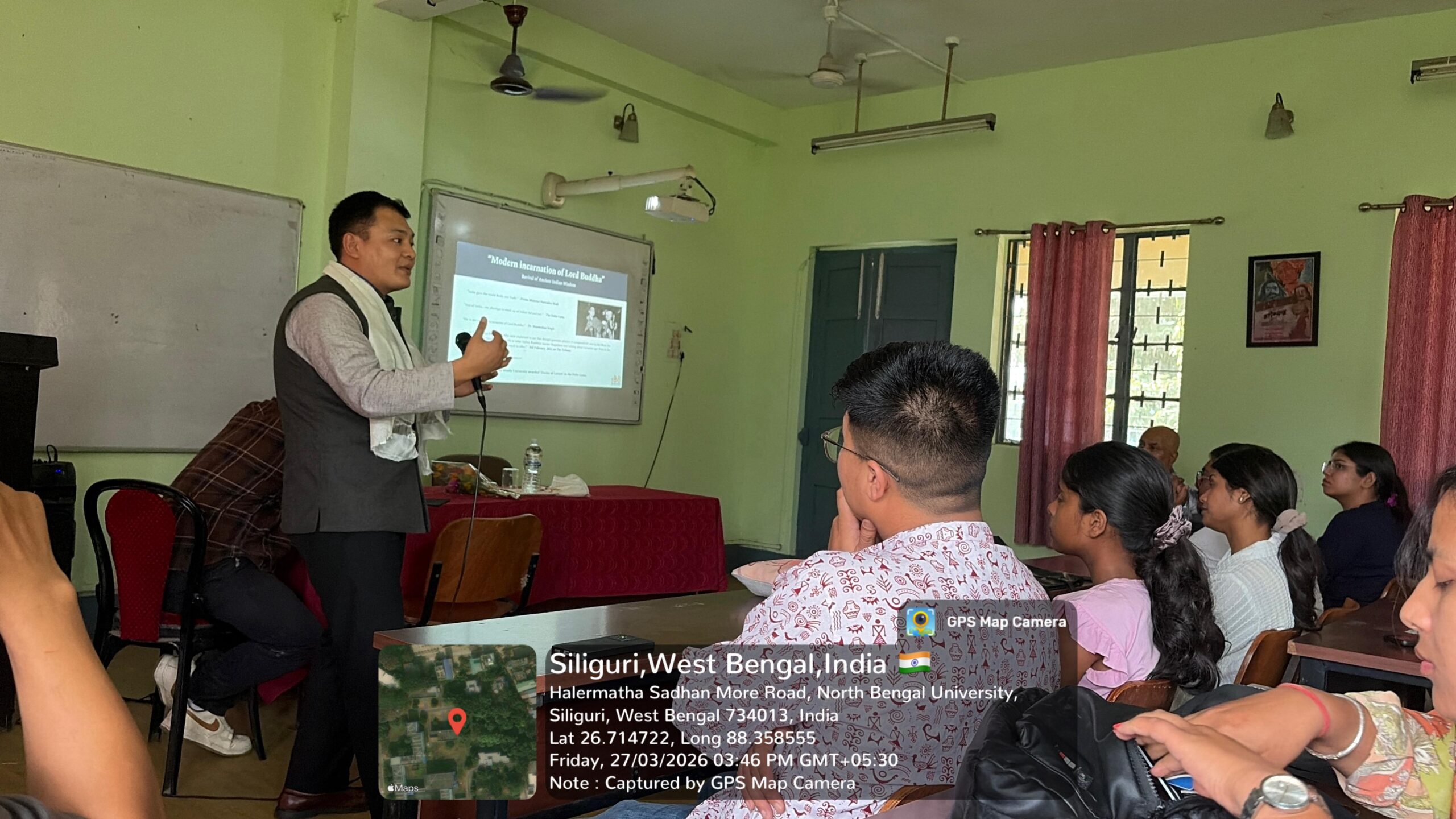
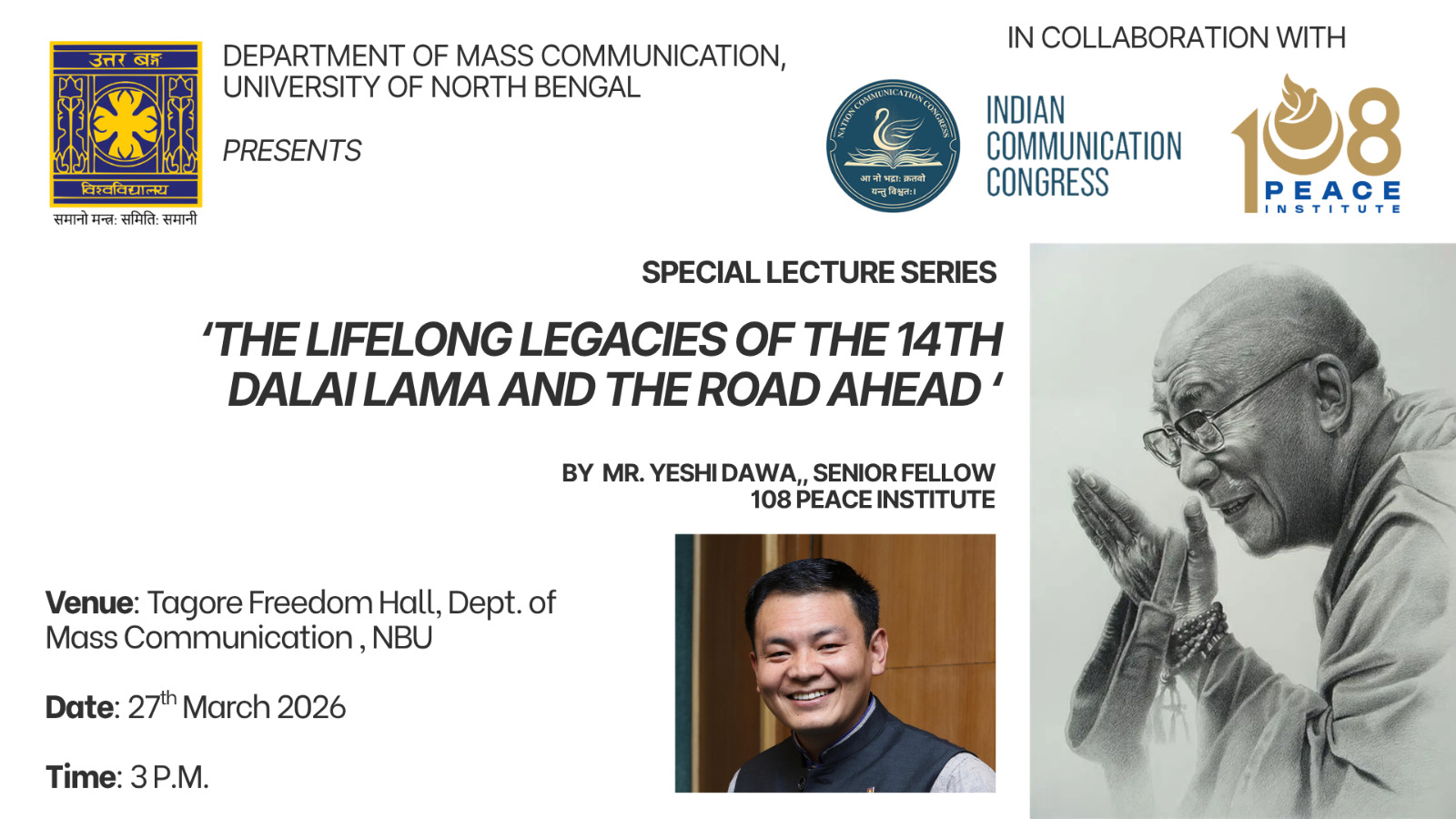
March 27, Siliguri: The 108 Peace Institute, in collaboration with the Department of Mass Communication at North Bengal University, organised a talk titled “The Lifelong Legacies of the Dalai Lama and the Road Ahead,” delivered by Mr. Yeshi Dawa, a senior researcher at the 108 Peace Institute. The talk was attended by more than 20 students and faculty members.
Mr. Dawa began by stressing the importance of the four principal commitments of the 14th Dalai Lama and their relevance to the promotion of basic human values such as compassion, love, and kindness. He emphasised that the fourth commitment—the revival of ancient Indian wisdom—has a significant role to play in fostering a better world for future generations. He also highlighted the personal relationship between the 14th Dalai Lama and India, noting that India is grateful for his contributions as an ambassador of ancient Indian wisdom. Additionally, Mr. Dawa underscored the invaluable role of the 14th Dalai Lama in promoting an environment conducive to religious harmony. Overall, he outlined the lifelong legacies of the 14th Dalai Lama for the world, and for India in particular, as well as the relevance of the institution of the Dalai Lama beyond religion.
Mr. Dawa then spoke about the paradoxical claims of the Chinese Communist Party regarding the selection of the next Dalai Lama. He traced the historical track record of the Chinese Communist Party in its approach towards the 14th Dalai Lama and Tibetan Buddhism in particular. He quoted the notorious remark of Mao Zedong, the founding leader of the Chinese Communist Party, who said that “religion is a poison.” He further discussed the recent record of the destruction of Tibetan monasteries in Tibet and the tightening grip on religious freedom in the region. Mr. Dawa questioned the legitimacy of the Chinese Communist Party in choosing the next Dalai Lama, asking why it appears less interested in the 14th Dalai Lama and more focused on the 15th. His remarks highlighted what he described as the underlying intentions of the Chinese Communist Party in the matter of succession.
Mr. Dawa concluded the talk by discussing the geopolitical ramifications if the Chinese Communist Party were to succeed in choosing the next Dalai Lama. He raised questions about how the Party might use the office of the Dalai Lama in the future to influence Buddhist nations and Buddhist communities in India, and how India might respond to the issue of the 14th Dalai Lama’s reincarnation.
The talk was followed by a Q&A session, during which students asked questions related to the history of Tibet and the 14th Dalai Lama. Later, Mr. Dawa also interacted with the local digital news platform Lohagrah News regarding the talk.
Mr. Dawa acknowledged the warm hospitality and contributions of Dr. Barun Roy and Dr. Tsewang Dorji in making the talk possible. As a token of gratitude, a copy of Voice of the Voiceless was presented to the Head of the Department of Mass Communication at North Bengal University, Siliguri.