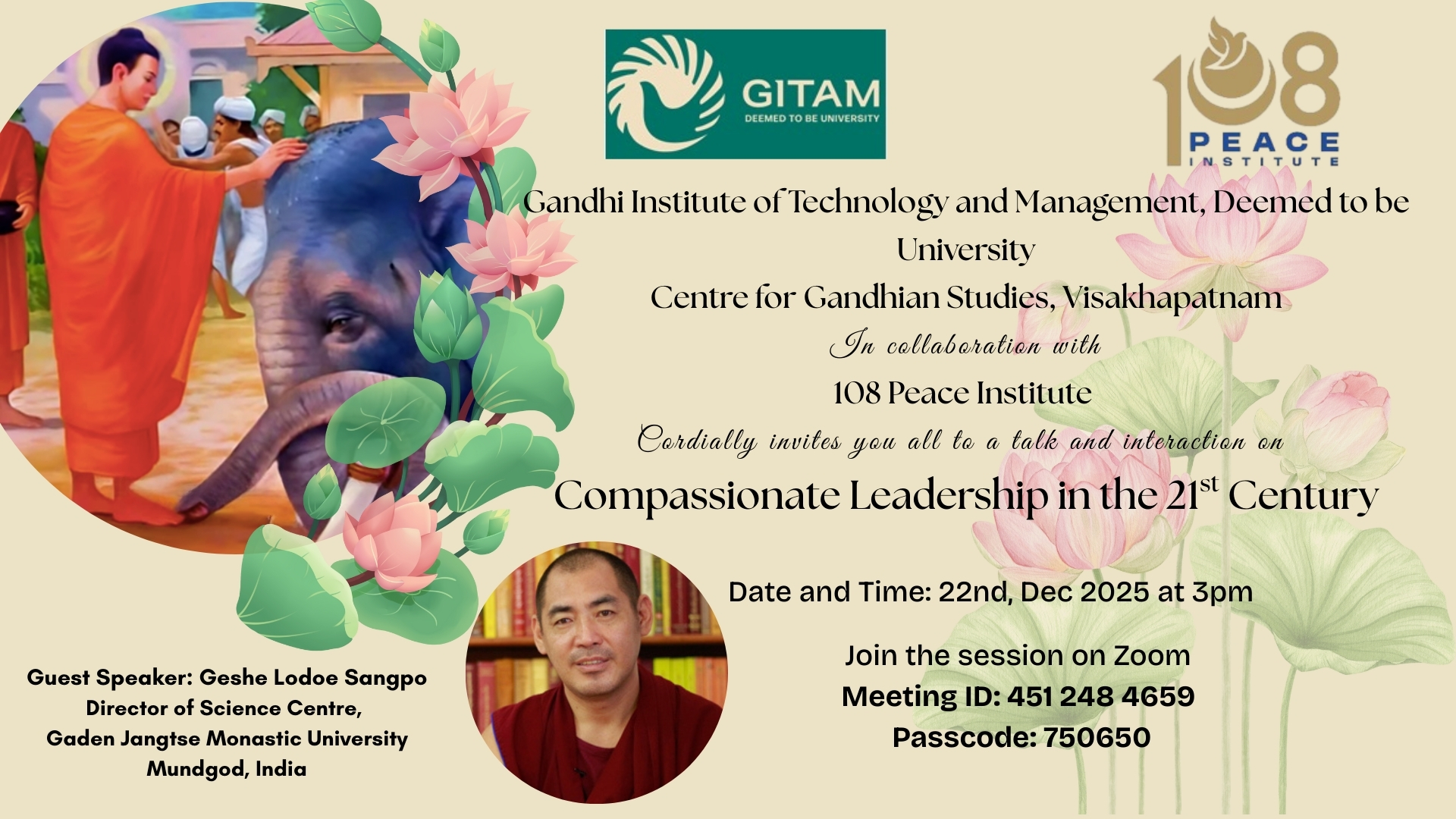
22 December 2025: The 108 Peace Institute, in collaboration with the Centre for Gandhian Studies and the GITAM School of Humanities and Social Sciences, organized a virtual session titled “Compassionate Leadership in the 21st Century.” The session featured Geshe Lodoe Sangpo, Director of the Science Centre at Gaden Jangtse Monastic University.
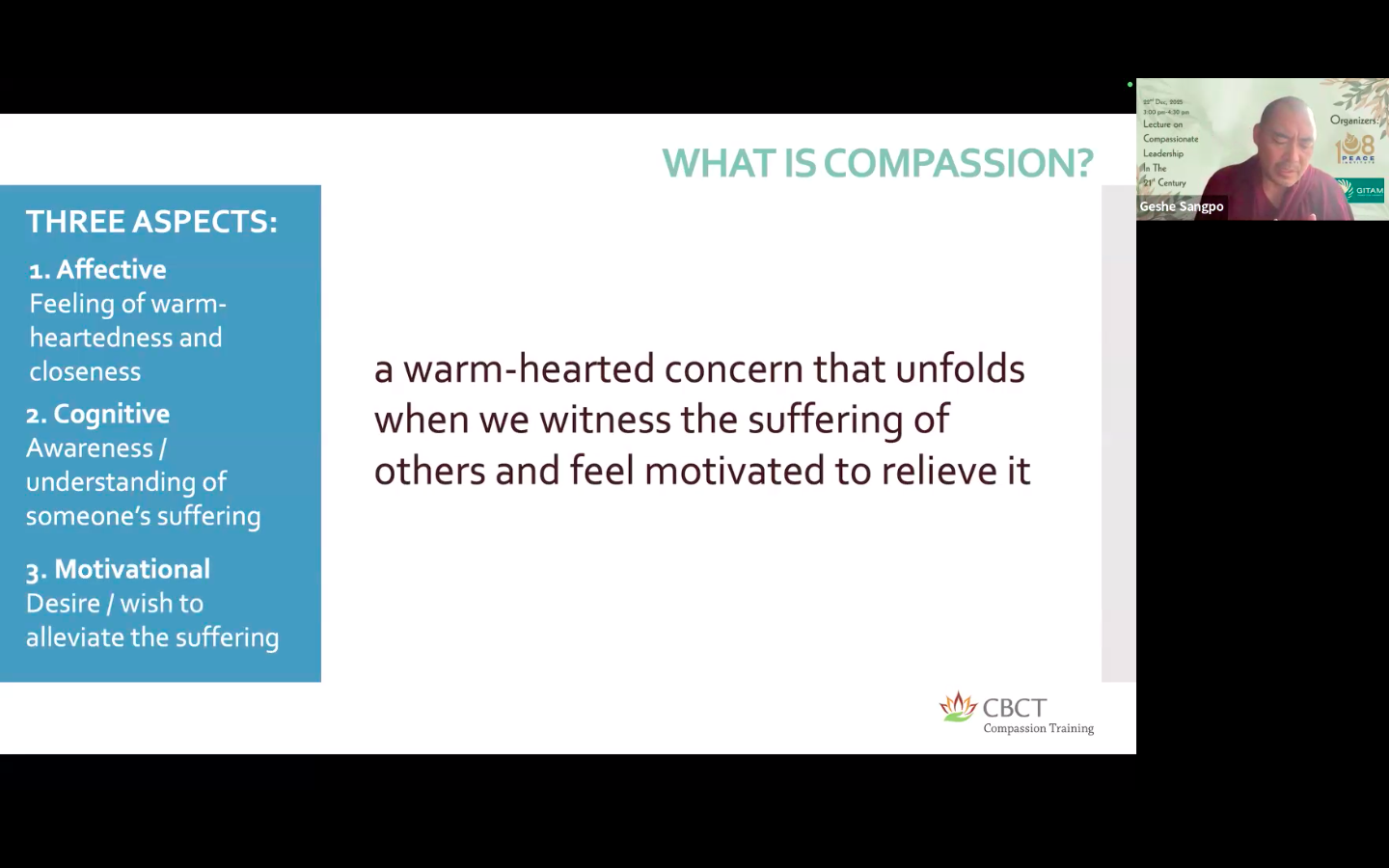
In his lecture, Geshe explained the meaning of compassion and its fundamental importance in personal and societal well-being. He elaborated on compassion as comprising three essential components: (1) a feeling of warm-heartedness and closeness, (2) awareness and understanding of another’s suffering, and (3) the genuine desire to alleviate that suffering. Emphasizing compassion as a source of happiness, Geshe Lodoe quoted His Holiness the 14th Dalai Lama, who frequently reminds his disciples: “If you want others to be happy, practice compassion. If you want to be happy, practice compassion.”
Geshe further shared a teaching attributed to the Buddha, who, when asked which single value encompasses all others, replied that it is the Great Compassion. He described compassion as the magnet that attracts all virtues and as the foundation for the development of ethical values in the process of alleviating the suffering of sentient beings. Without compassion, he cautioned, self-centeredness becomes the driving force of life and the source of many forms of suffering.
He also reflected on how shifting the purpose of life can transform one’s perspective. In this context, Geshe shared an insightful interaction between Dr. Aaron Beck (widely recognized as the father of Cognitive Behavioral Therapy and a leading researcher in psychopathology) and His Holiness the 14th Dalai Lama. Dr. Beck recounted the case of a physics professor who became deeply depressed after failing to win a Nobel Prize after years of hard work in the field of Physics. His professional success was more important to him than his family. Through reflective questioning with Dr. Beck, the professor realized that, much like his own father, he had neglected time with his children due to his work. This realization prompted him to re-evaluate his priorities, recognizing that his family now constituted the greater part of his life’s meaning. He immediately chose to spend more time with them and subsequently overcame his depression. His Holiness described this process as a form of analytical meditation, highlighting how re-examining situations analytically can have a profound and pragmatic impact on overcoming negative emotions and mental disturbances.
Geshe Lodoe emphasized that compassion is not merely an emotional response but also involves understanding situations from multiple perspectives, accompanied by a sincere motivation to reduce suffering. He further noted that the world faces numerous complex problems, but attempting to solve them all at once is unrealistic. However, persistent positive action at the individual level can gradually lead to meaningful change. Moreso, when many individuals engage in compassionate action, their collective efforts create a powerful ripple effect, suggested the speaker. He stressed that this motivation to contribute within one’s own capacity is a vital quality of compassionate leadership.
The lecture concluded with a discussion addressing doubts on the relevance of compassionate leadership in a world marked by conflict, religious diversity, and intolerance. The session was attended by more than 20 participants, including faculty members via Zoom from the Centre of Gandhian Studies, who expressed keen interest in deepening their understanding of compassionate leadership.