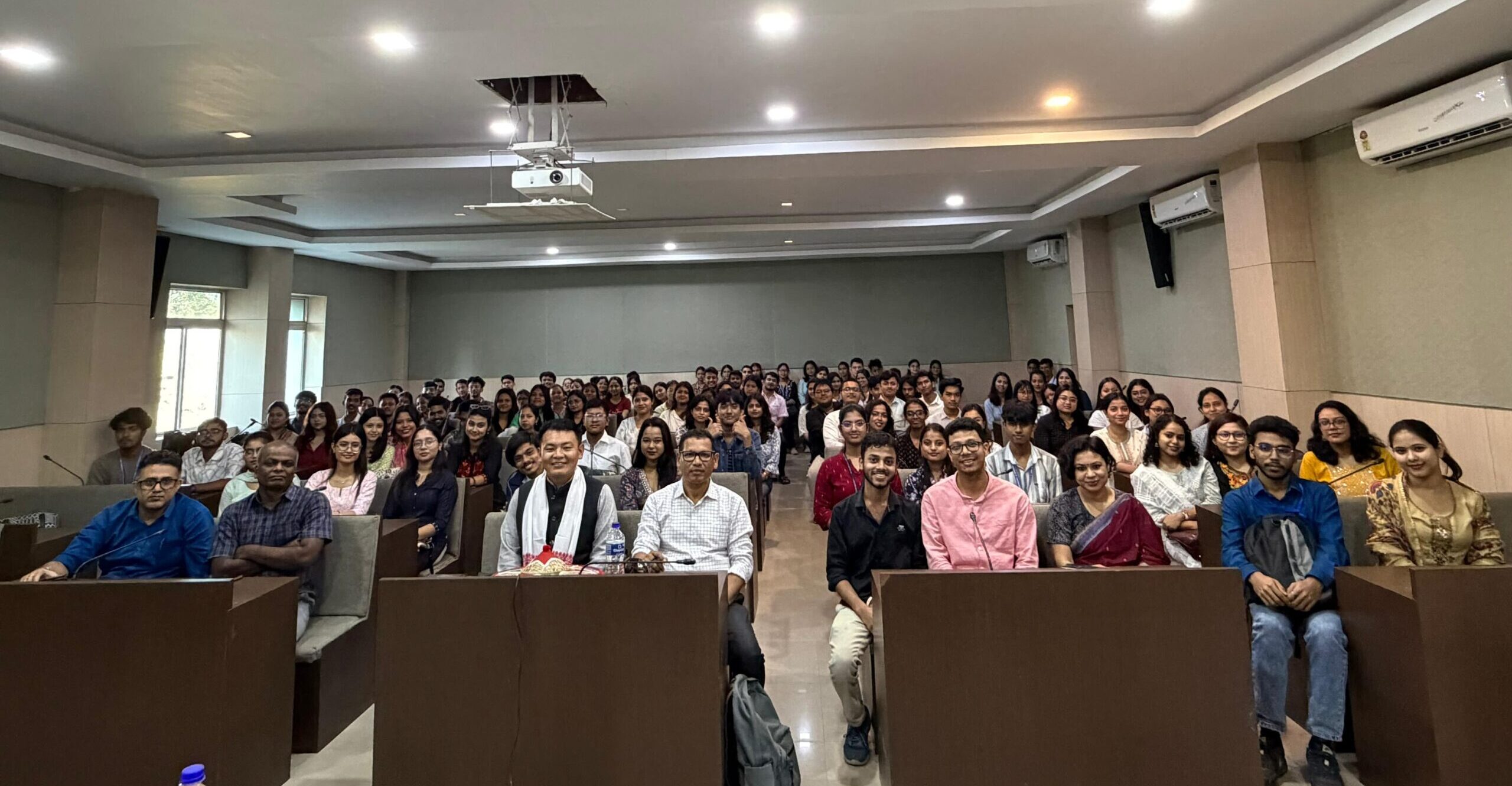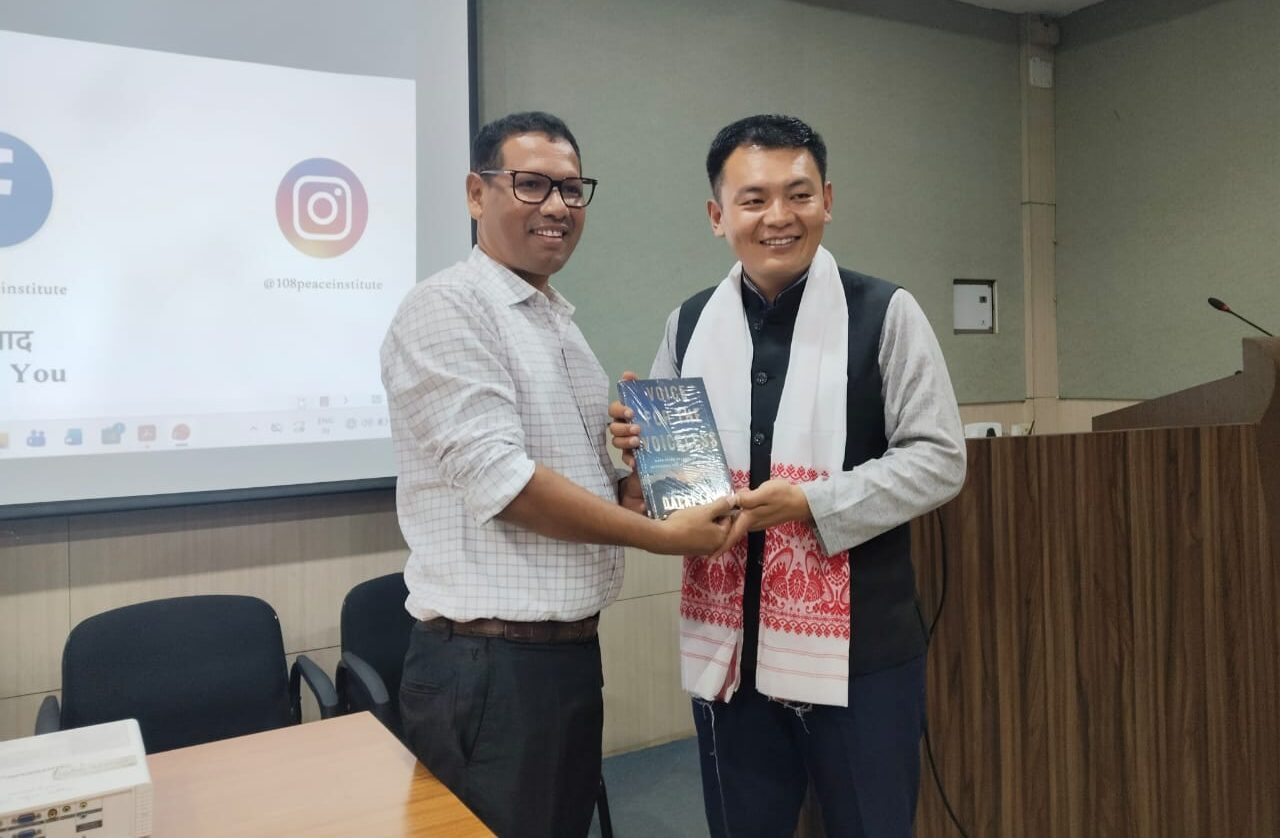
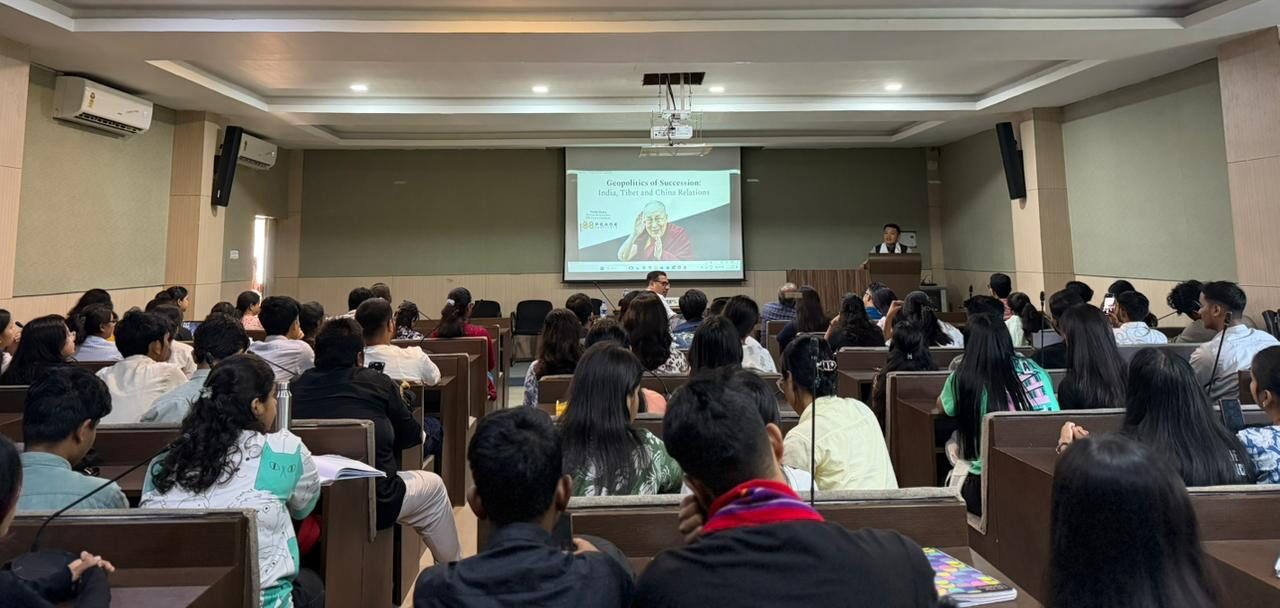
17 November 2025: The 108 Peace Institute, in collaboration with the Department of Political Science, Cotton University, Guwahati, organized a lecture and interactive session on “Geopolitics of Succession: Implications for India, Tibet, and China.” The session featured Mr. Yeshi Dawa, Senior Researcher at the 108 Peace Institute.
Mr. Yeshi opened the lecture by reflecting on the life and legacy of His Holiness the 14th Dalai Lama, highlighting His Holiness’s lifelong commitment to human values, religious harmony, and the preservation of Tibetan culture. Turning to the lecture’s theme, he underscored that the institution of the Dalai Lama will continue, citing His Holiness’s July 2025 announcement. Mr. Yeshi quoted His Holiness:
“In particular, I have received messages through various channels from Tibetans in Tibet making the same appeal. In accordance with all these requests, I am affirming that the institution of the Dalai Lama will continue.”
He further noted that in His Holiness’s recent book, Voice for the Voiceless, the Dalai Lama clearly states that he will be born in a free country outside China, and he entrusts the Gaden Phodrang Trust with the responsibility of recognizing the 15th Dalai Lama. His Holiness is expected to leave clear written instructions regarding the process of identifying his successor, said the speaker.
Addressing the sacred Tibetan tradition of recognizing reincarnate lamas, Mr. Yeshi critiqued the paradoxical Chinese claims and debunked the misinformation circulated by the Chinese state. He recalled Mao Zedong’s statement to the Dalai Lama during his 1954 visit to Beijing that “religion is poison,” and referenced the assassination attempt mentioned in His Holiness’s memoir, Freedom in Exile. Today, even possessing the Dalai Lama’s photograph is a crime in Tibet, and monks are compelled to sign documents denouncing him as their spiritual teacher.
Mr. Yeshi highlighted the CCP’s attempt to control Tibetan religious traditions through Order No. 5 (2007), aimed at regulating the recognition of “living Buddhas.” Yet, despite this repression, Tibetans inside Tibet courageously celebrated His Holiness’s 88th birthday by circulating a symbolic graphic featuring his holy hat and the number 88.
He emphasized that although the Chinese Communist Party rejects the current Dalai Lama, it is strategically invested in controlling the next one. The CCP, an atheist institution, claims that the reincarnation must follow its administrative procedures, including the Golden Urn system. Mr. Yeshi clarified that the Golden Urn is not equivalent to spiritual prophecy. The current Dalai Lama was recognized based on visions seen in the sacred lake Lhamo Lhatso, w ithout using the Golden Urn introduced by the Chinese.
Citing Arjia Rinpoche, who fled Tibet in 1998 and witnessed Golden Urn ceremonies, he explained that the process was manipulated, with candidates already pre-selected by authorities. He further pointed to the case of the Chinese-appointed Panchen Lama, Gyaltsen Norbu, chosen through the manipulated Golden Urn system, while the 11th Panchen Lama, Gedun Chokyi Nyima, endorsed by the Dalai Lama, remains abducted and missing since 1995.
He also noted that the Chinese-appointed Panchen Lama has met Xi Jinping three times and has been directed to promote “patriotism,” adapt Tibetan Buddhism to socialist ideology, and support national unity, illustrating how Buddhism is being weaponized to consolidate political control.
Mr. Yeshi warned that the issue of succession affects not only Tibetans and Tibetan Buddhists. Given the Dalai Lama’s global stature, any attempt by China to control the reincarnation would have far-reaching implications for India and the world.
For India, especially the Himalayan belt where communities practice Tibetan Buddhism, the Dalai Lama remains a central spiritual figure. A China-appointed Dalai Lama would give Beijing strategic influence in these border regions, with serious ramifications for security, cultural ties, and India’s moral leadership. Globally, such a move could politicize Buddhism and influence Buddhist-majority countries and the 300 million Buddhists worldwide, undermining peace and spiritual autonomy.
Mr. Yeshi also highlighted geopolitical concerns closer to home, particularly the construction of the world’s largest hydropower dam on the Brahmaputra River, Assam’s lifeline, by China at an estimated cost of $1.24 billion. Quoting Prof. Brahma Chellaney, he emphasized: “For India, the dam represents more than just a hydrological threat. It is a potential geopolitical stranglehold.”
The session, attended by over 120 students and faculty members, concluded with an engaging Q&A segment, marked by thoughtful questions and insightful responses from the speaker.