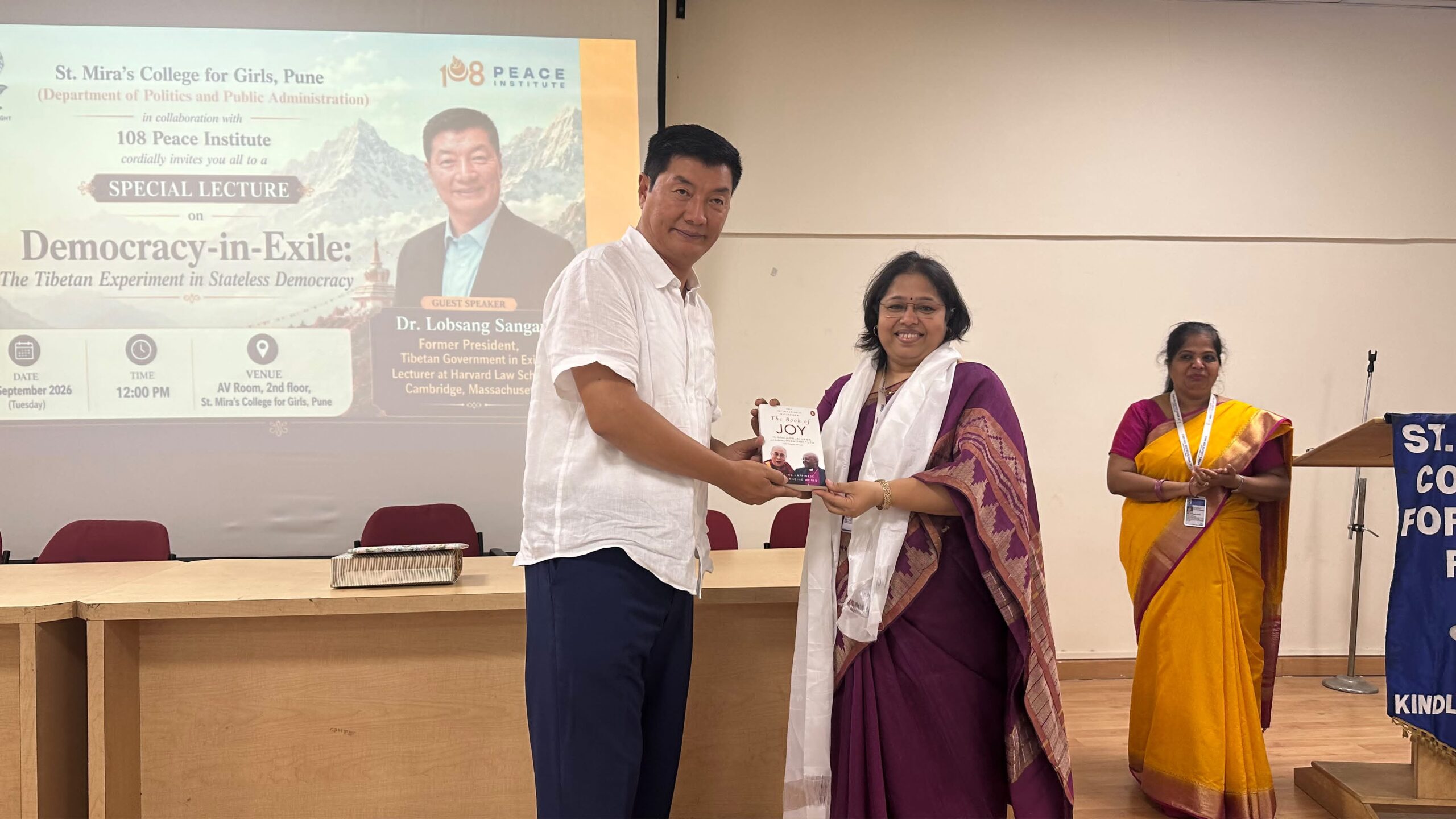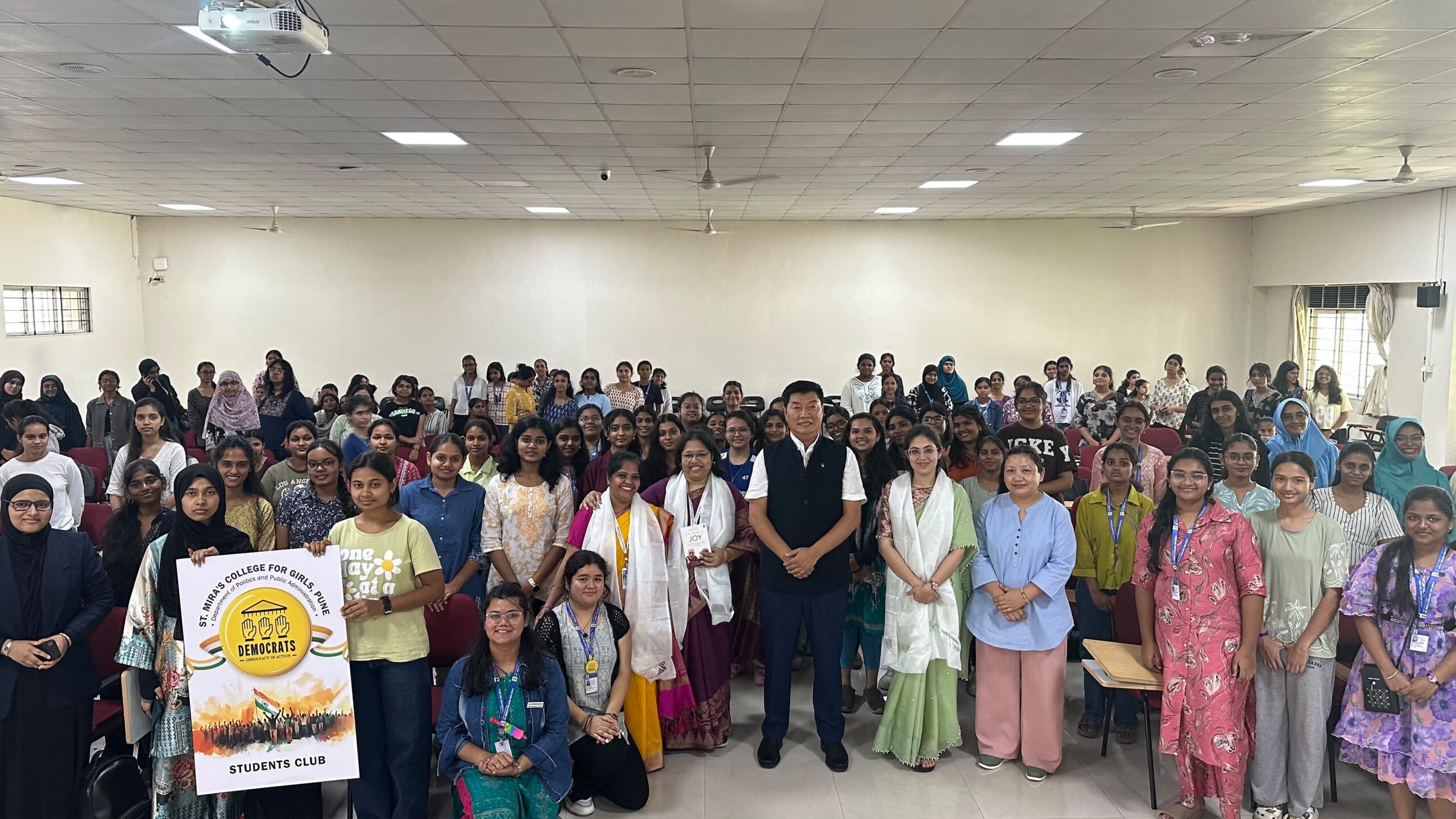
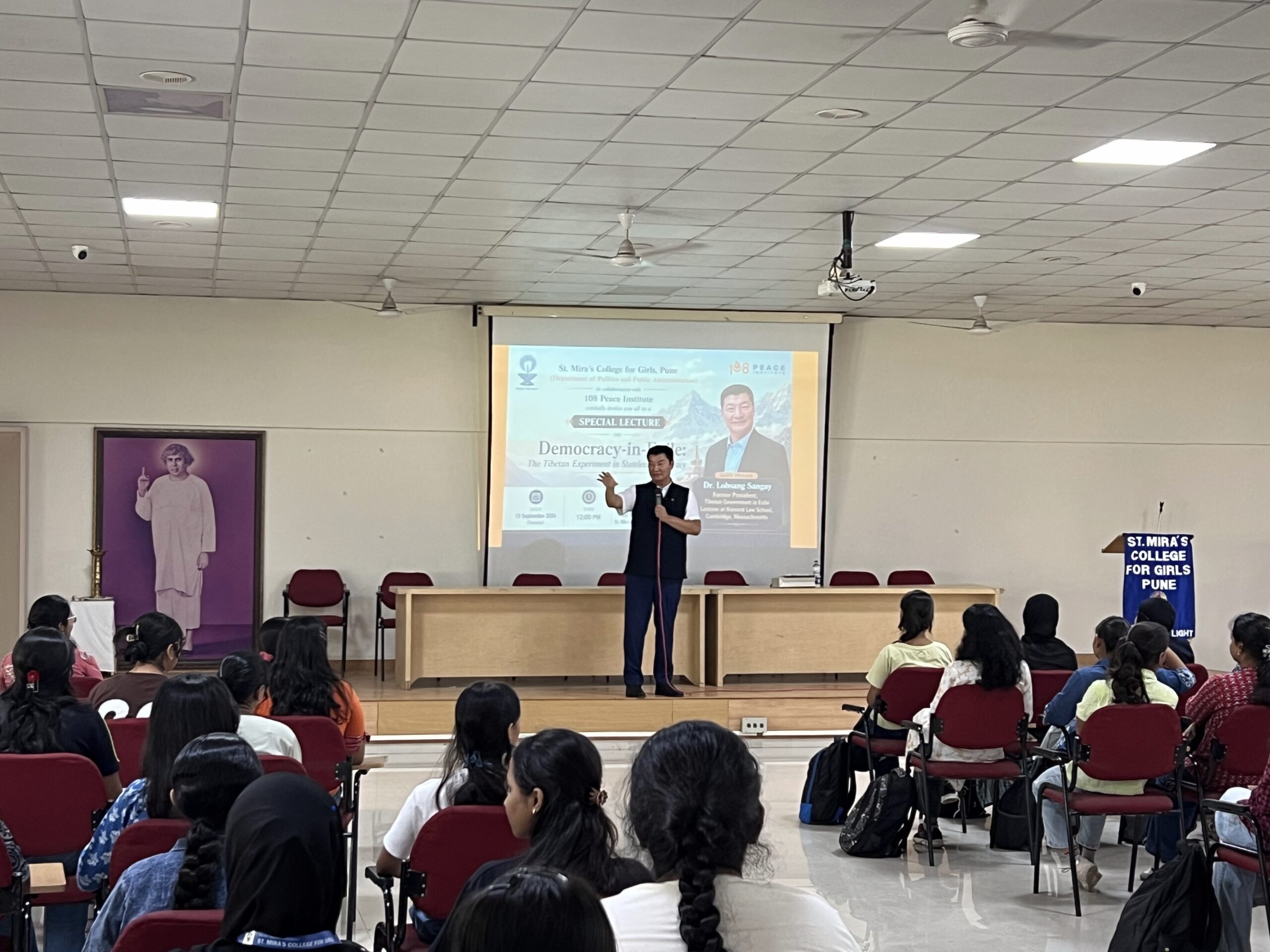
On 15 September 2026, the 108 Peace Institute, in collaboration with St. Mira’s College for Girls, Pune, hosted a talk titled “Democracy-in-Exile: The Tibetan Experiment in Stateless Democracy.” The session featured Dr. Lobsang Sangay, Former President of the Central Tibetan Administration and Lecturer at Harvard Law School, and was attended by around 200 students from the Departments of Political Science and Business Administration, along with faculty members.
Dr. Sangay spoke about the growing political engagement of younger generations and the challenges of transforming political movements into effective governance. Referring to recent youth-led movements in countries such as Bangladesh, Sri Lanka, and Nepal, he noted that removing established leaders or political systems does not automatically result in better governance. He emphasized that political change must be accompanied by leadership preparation, institutional capacity, and a clear vision for governance.
Encouraging young people to consider public leadership, Dr. Sangay urged them to ask themselves why they want to become leaders. He argued that leadership should not be driven primarily by power or personal recognition, but by a commitment to a cause, community, and country. Drawing on more than four decades of activism, he emphasized that leaders should “walk with the people, not in front of them.” He also highlighted the importance of compassion and courage, arguing that anger-driven leadership may generate short-term mobilization, while compassion-based leadership can provide the resilience required for sustained public service. He further stressed the importance of compassion toward oneself and maintaining mental and physical well-being.
Reflecting on global democratic trends, Dr. Sangay expressed concern about democratic backsliding and the expansion of authoritarian governance in several parts of the world. He argued that democracy must not only be advocated for but also practised, including by communities living in exile. Referring to exile communities from countries such as Iran and Venezuela, he highlighted the difficulties of building representative institutions and credible leadership outside one’s homeland.
Dr. Sangay presented the Tibetan experience as an example of democratic institution-building in exile. Following the Tibetan exodus in 1959, the Tibetan community in India developed democratic institutions in Dharamsala, including the Tibetan Parliament and executive administration, alongside schools, healthcare institutions, and other community services. He noted that this experience demonstrates how democratic institutions can be developed and sustained even without a sovereign state. He proudly stated that the Tibetan Government in Exile is one of the most dynamic, functioning, and successful governments in exile. Dr. Sangay thanked India for its pivotal role in the establishment and sustenance of this democratic institution.
The discussion also examined challenges faced by exile movements, including leadership, political legitimacy, relations with host countries, and security concerns. He also noted that several historical exile movements, including those associated with Namibia, Poland, the Philippines, and Yugoslavia, played important roles in political transformations in their respective countries.
Dr. Sangay further addressed contemporary geopolitical issues, including China’s “Five-Finger” strategy, the Galwan Valley and Doklam border confrontations, China’s control over the Tibetan Plateau, and the consequences for downstream countries.
The session concluded with an interactive exchange, allowing students and faculty to engage with Dr. Sangay on democracy, leadership, exile politics, and the Tibetan experience of democratic governance.