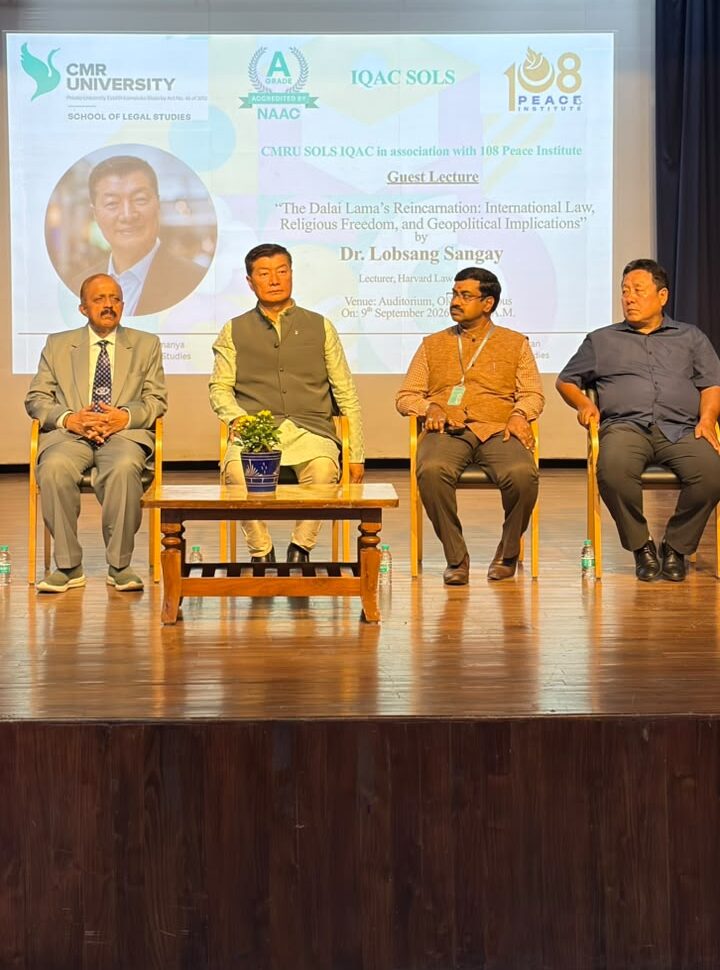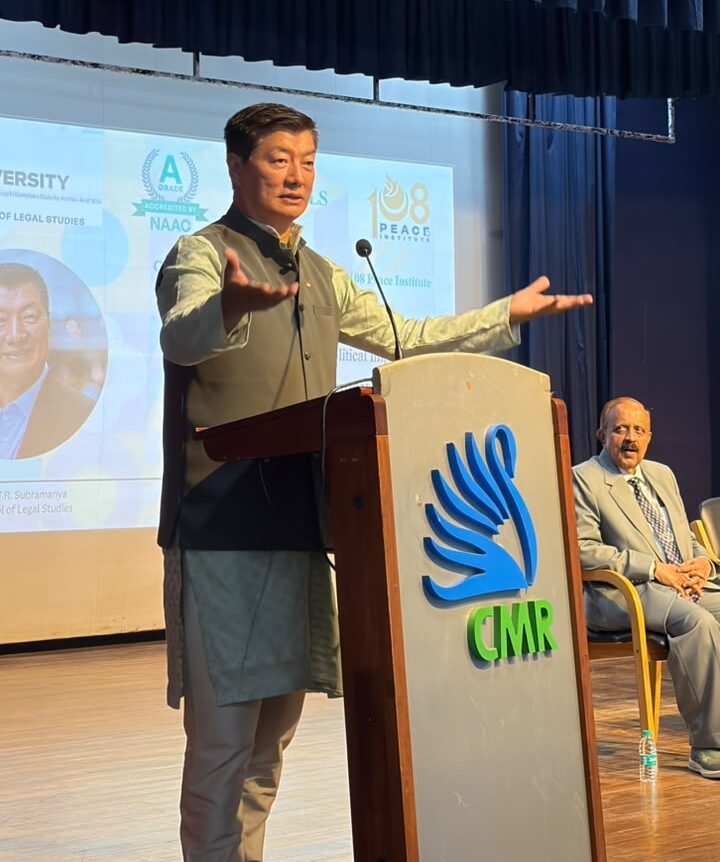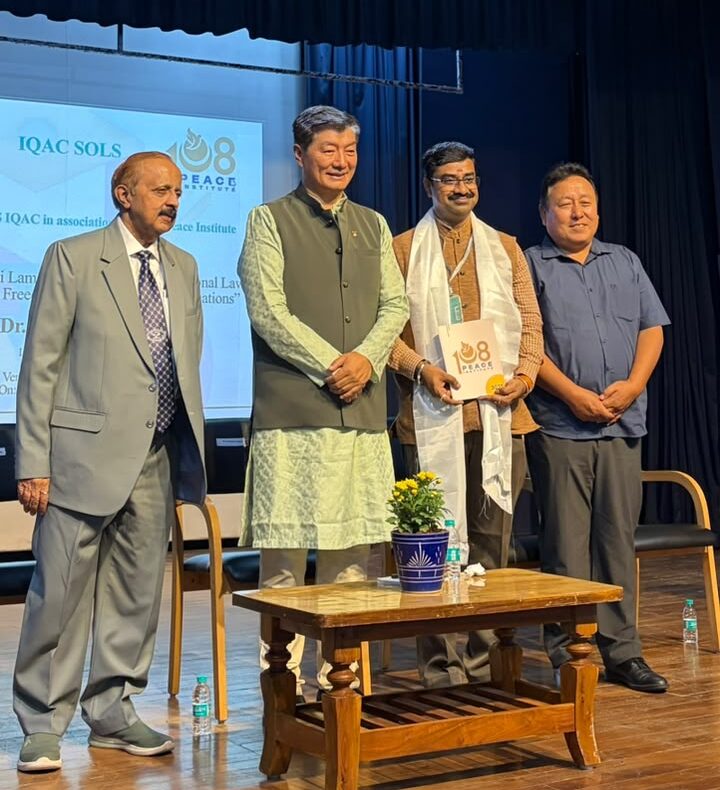
September 09, 2026: The 108 Peace Institute, in collaboration with the School of Legal Studies, CMR University, Bangalore, hosted a talk on “The Dalai Lama Reincarnation: International Law, Religious Freedom and Geopolitical Implications” at CMR University, Bangalore.
International Religious Freedom and the Dalai Lama’s Reincarnation
Dr. Lobsang Sangay began the talk by examining the issue of the reincarnation of the Dalai Lama through the lens of international law, particularly the Universal Declaration of Human Rights (UDHR) and the International Covenant on Civil and Political Rights (ICCPR), arguing that the freedom to follow a religion must include the autonomy of religious communities to determine their own spiritual leadership. Article 18 of the UDHR recognizes the right to freedom of thought, conscience and religion, including the freedom to change one’s religion or belief. Similarly, Article 18 of the ICCPR protects the freedom to have or adopt a religion or belief of one’s choice and to manifest it individually or collectively. Against this legal backdrop, Dr. Sangay questioned the Chinese government’s interference in the reincarnation of the Dalai Lama, arguing that the selection of a spiritual leader should be a matter for the religious community rather than the state.
Drawing attention to the contrast between the Chinese government’s assertion of authority over the reincarnation process and the Tibetan Buddhist tradition, under which the identification of a reincarnated lama is a religious matter, Dr. Sangay emphasized that “the guru is the person, not the office.” He highlighted the distinction between spiritual authority rooted in religious faith and institutional authority controlled by the state. He further argued that a government’s appointment of a religious leader does not automatically command the allegiance of that faith’s followers. Citing hypothetical examples involving the appointment of Hindu religious leaders in India and Catholic leaders in Ireland and Brazil, he illustrated how religious legitimacy ultimately depends on the acceptance by the religious community.
Dr. Sangay Criticized the Communist Party’s interference over the reincarnation despite its officially atheist position. He contended that the issue extends beyond religion to the broader question of whether governments can impose their authority on matters of conscience and belief. He further examined the geopolitical significance of the Dalai Lama’s reincarnation, particularly for India and the wider Himalayan region. Dr. Sangay reiterated that the Dalai Lama commands considerable spiritual influence among Buddhist communities beyond Tibet across parts of the Himalayan region such as Ladakh, Nepal, Bhutan, Sikkim, Arunachal Pradesh, including Uttarakhand and Himachal Pradesh. Control over the reincarnation process therefore have implications for regional influence and political relations. He argued that the Chinese government’s interest in the reincarnation of Dalai Lama must be understood in the context of its wider strategic ambitions in Asia, including its relationship with India and its influence over neighbouring countries. He warned that the fake Dalai Lama chosen by China will be forced to dance to the tunes of CCP’s narrative that all of the northern himalayan belt belongs to China and not India.
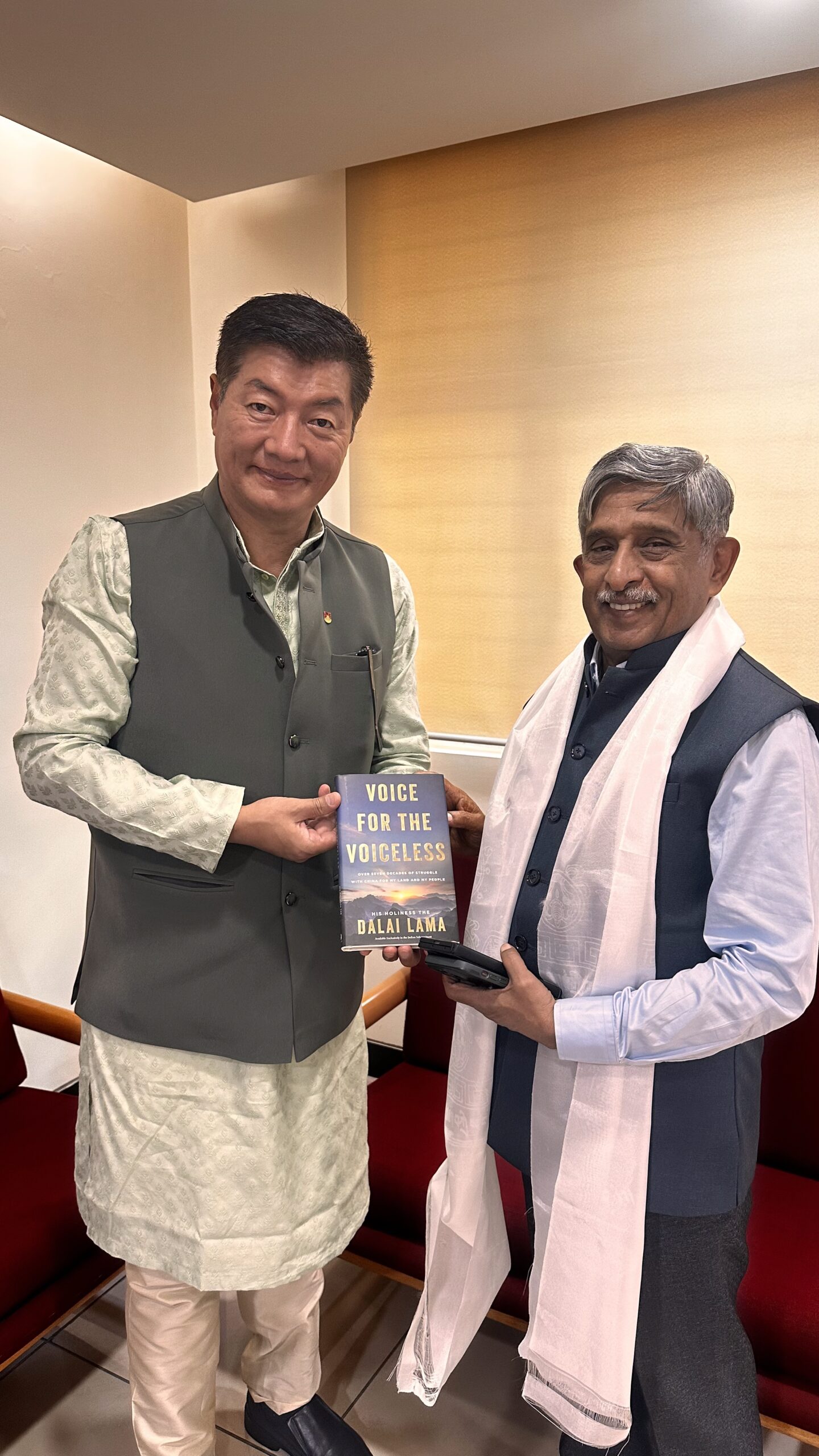
The discussion also highlighted the importance of religious freedom in determining where the reincarnation of the Dalai Lama could be identified and educated. Dr. Sangay reiterated the statement made by the Dalai Lama in his political biography book “Voice for the Voiceless” that he will be reborn in a Free country meaning outside of China. Dr. Sangay said that a religious leader requires an environment in which he has the freedom to practice, teach and interact with followers. Dr. Sangay further emphasized the importance of the Gaden Phodrang Trust, associated with the Dalai Lama’s institution, in the search, identification, and recognition of his reincarnation.
Tibet’s resources and regional security
Moving beyond religious freedom, Dr. Sangay connected Tibet’s strategic importance with its natural resources, river systems, and geographical position. He highlighted the significance of rivers originating on the Tibetan Plateau and their dependence on transboundary water management. He condemned China for refusing to sign international convention on water sharing and raised concerns about the potential consequences for downstream countries, including India and Nepal.
Dr. Sangay highlighted the devastating flash flood in Nepal’s Rasuwa district, which caused widespread loss of life and destroyed thousands of homes, incurring an estimated loss of $5 billion. He questioned the availability and sharing of information from the Chinese side, arguing that China claims to have sophisticated monitoring capabilities in Tibet and they should have been in a position to provide timely information to Nepal. The absence of an adequate warning either reflected shortcomings in China’s monitoring system or a deliberate effort not to share information. He underscored the need for transparency, cooperation and effective information-sharing mechanisms between countries that share river systems.
Expressing concerns over China’s construction of hydropower projects on the Tibetan plateau, Dr. Sangay argues that dams and other infrastructure have environmental and strategic consequences for downstream countries. He particularly highlighted the large hydropower project being developed on the Yarlung Tsangpo, which is known as the Brahmaputra after entering India. This project in the Medog region has attracted considerable attention in India. Its scale and location near the Indian border in Arunachal Pradesh have raised serous border security concerns,
A call for greater awareness and support
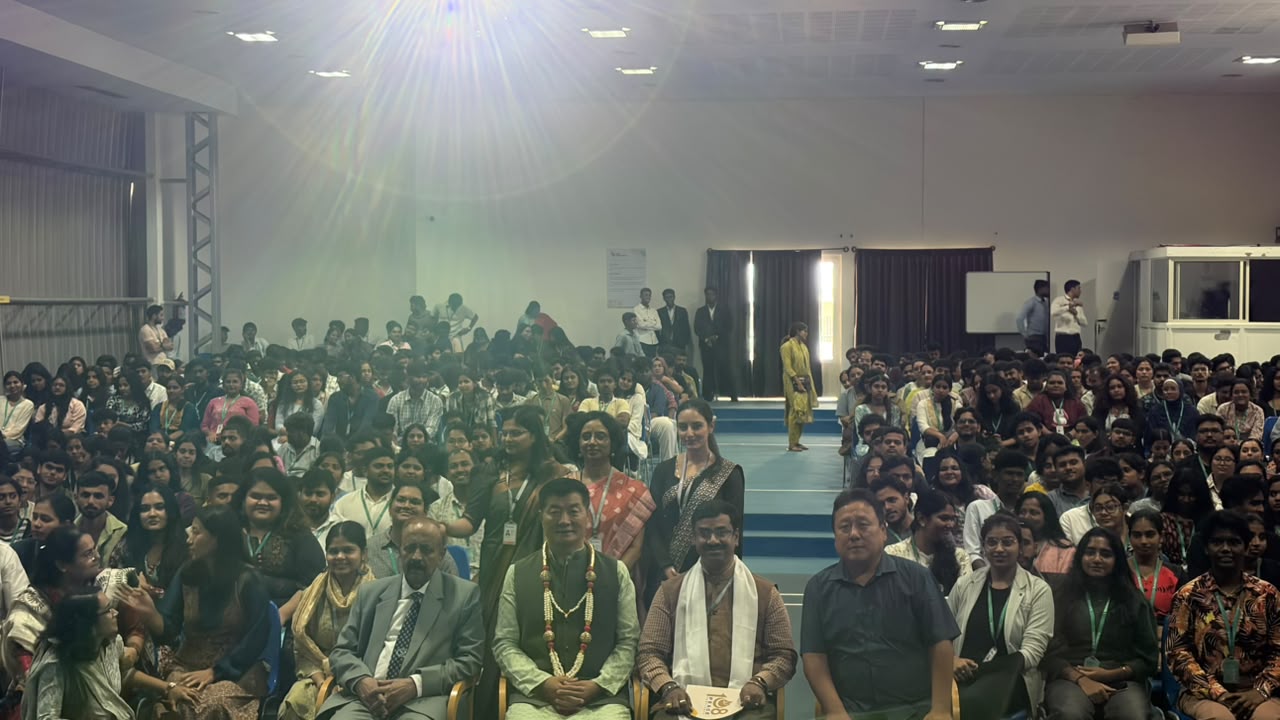
Concluding the lecture, Dr. Sangay urged the Government of India and its citizens to pay closer attention to the issue of the Dalai Lama’s reincarnation and its broader geopolitical implications, calling on them to stand in solidarity with Tibet amid China’s interference. He encouraged law students to explore the intersections of religious freedom, international law, and regional geopolitics, emphasizing that the issue will continue to hold significance in the years ahead. The lecture was attended by approximately 600 students and faculty members and followed by an engaging question-and-answer session.