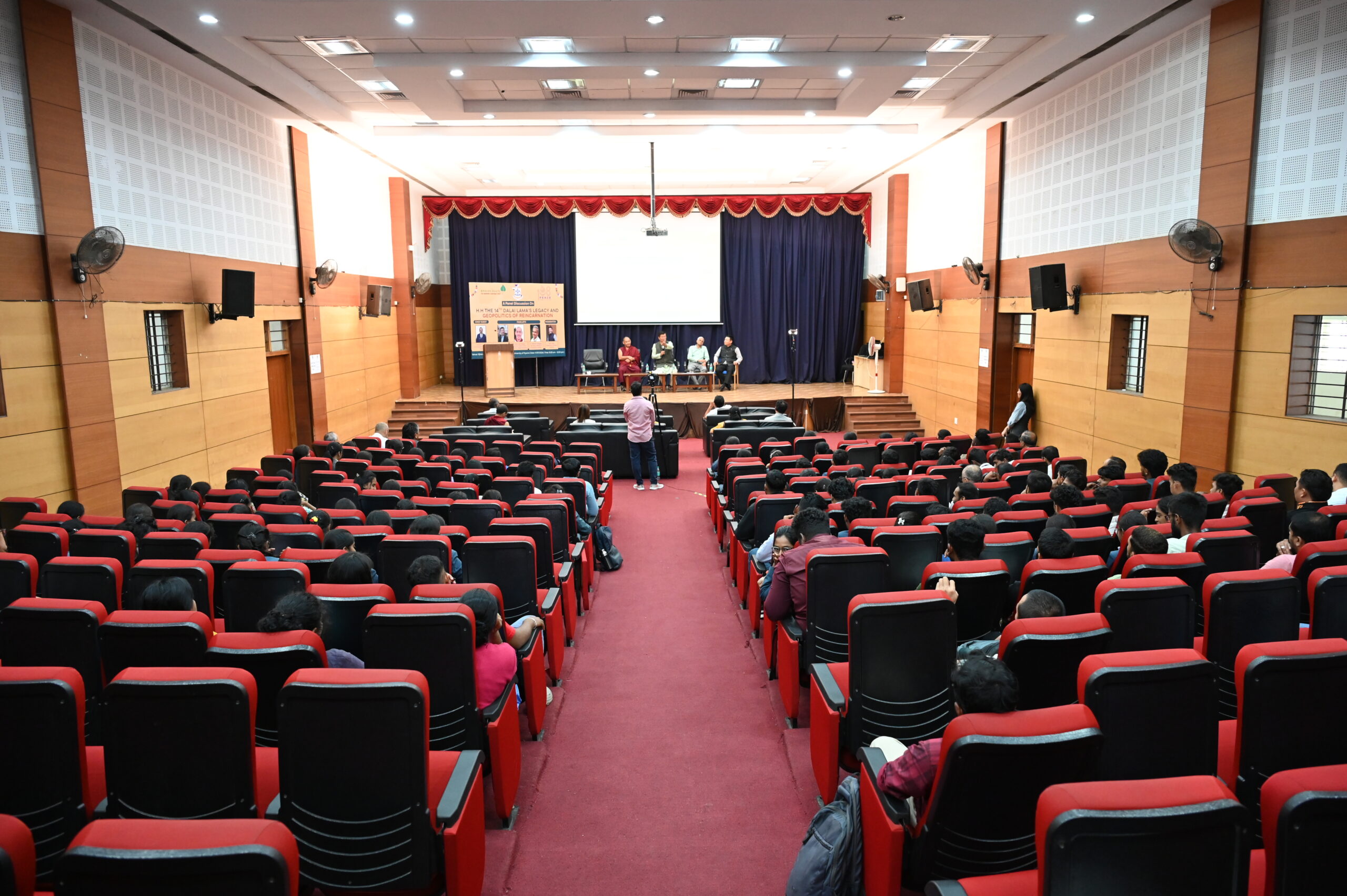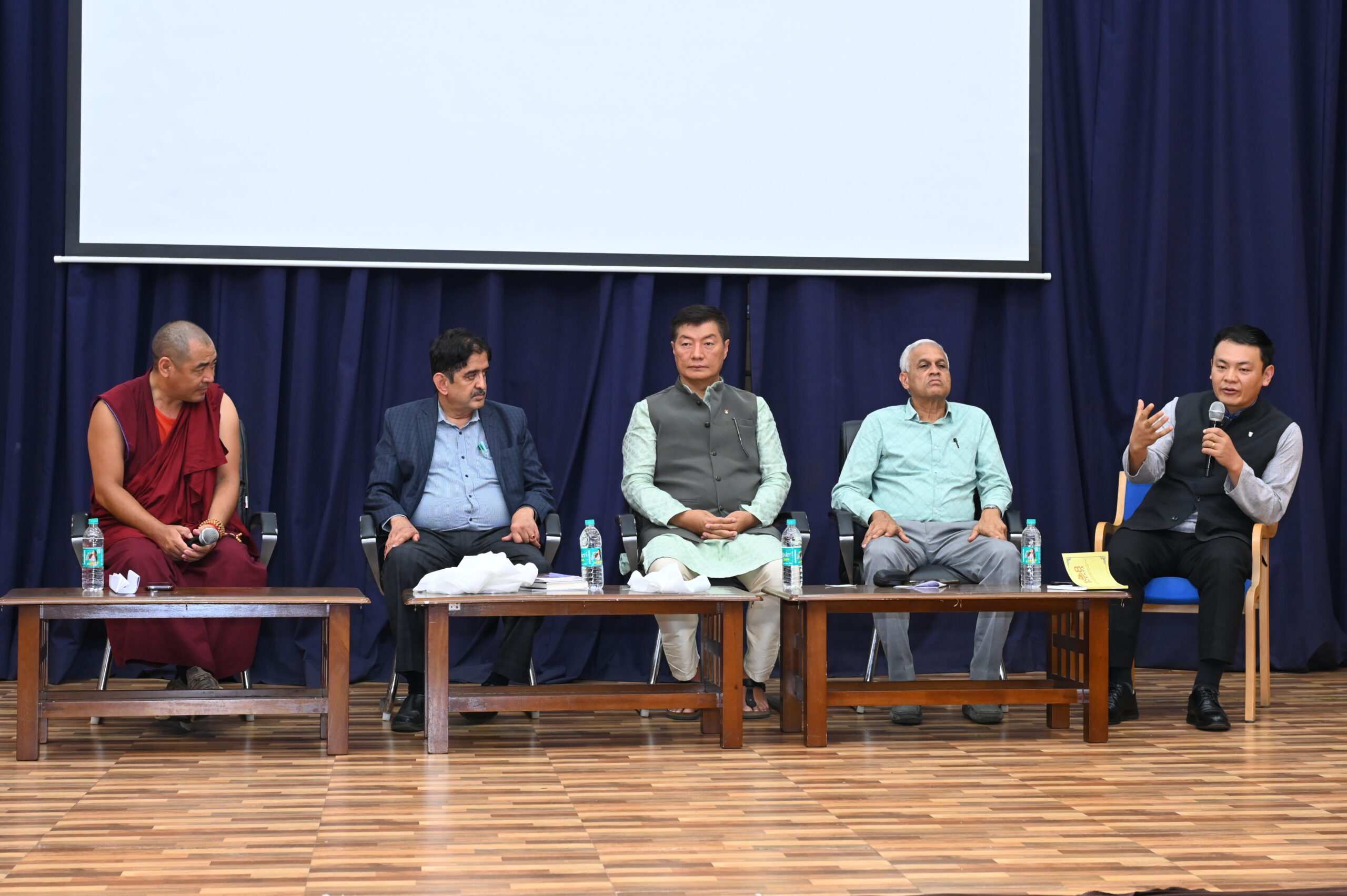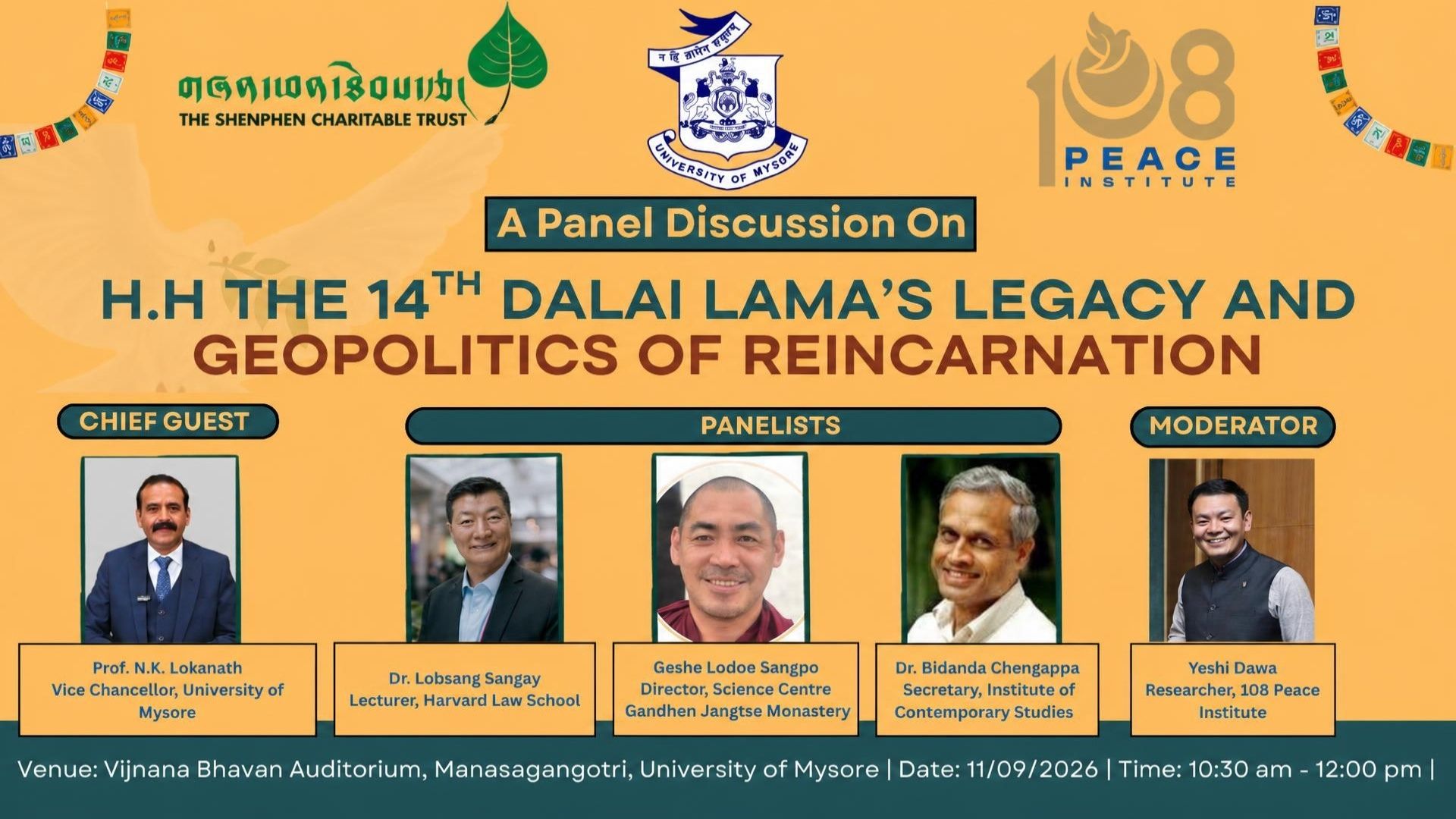
September 11, 2026: The 108 Peace Institute, in collaboration with the University of Mysore and Shenphen Charitable Trust, successfully hosted a high-level panel discussion on “His Holiness the 14th Dalai Lama’s Legacy and Geopolitics of Reincarnation” at Vijnana Bhavan, University of Mysore, Mysore.
The event commenced with a welcome address by Prof. S. J. Manjunath, Registrar, University of Mysore. The panel featured distinguished speakers Geshe Lodoe Sangpo, Director, Science Centre, Gadhen Jangtse Monastery; Dr. Bidanda Chengappa, Secretary, Institute of Contemporary Studies; and Dr. Lobsang Sangay, Lecturer, Harvard Law School and former President of the Tibetan Government-in-Exile. Mr. Yeshi Dawa, Senior Researcher, 108 Peace Institute, moderated the discussion.
The Spiritual and Scientific Context of Reincarnation
Geshe Lodoe Sangpo laid the philosophical foundation for the discussion by distinguishing reincarnation from ordinary rebirth in Tibetan Buddhist thought. He explained that ordinary rebirth is driven by karmic forces and afflictions. At the time of death, accumulated karmic causes and conditions influence the circumstances of the next birth. This continuing process is described in Buddhism as samsara, the cycle of existence.
Reincarnation, in contrast, was presented as the return of a highly realized being who has attained liberation and can return deliberately, motivated by compassion rather than being compelled by karma and afflictions. In this understanding, reincarnation is associated with freedom, choice and compassion, with the principal purpose of benefiting and serving other sentient beings. Geshe la identified compassion as the principal motivation behind the return of a lama or tulku.
Connecting this explanation with His Holiness the 14th Dalai Lama, Geshe la observed that His Holiness’ compassion is expressed not merely as an abstract religious principle but through his engagement with people and communities around the world. From this Buddhist perspective, he suggested that His Holiness’ compassionate activity provides an important context for understanding the continuation of his work through reincarnation.
The Geopolitical Dimension and India’s Security
Dr. Bidanda Chengappa argued that the question of the Dalai Lama’s reincarnation cannot be understood solely as a religious matter. From his perspective as a scholar of international relations and strategic studies, the issue encompasses religion, history, geography, security and international politics.
He referred to the events of the 1950s, including the suppression of Tibetan Buddhist institutions and the flight of His Holiness the Dalai Lama to India in 1959, accompanied by a large number of Tibetans. He noted that India subsequently became home to a substantial Tibetan community and the Tibetan administration in exile. Dr. Chengappa further discussed the Tibetan diaspora and its role in preserving Tibetan culture and identity.
Turning to the future of the Dalai Lama institution, he emphasized that the reincarnation question has international implications because of its intersection with Tibetan identity, India–China relations and the wider Himalayan security environment. He also referred to continued United States engagement with Tibetan issues, including the Tibetan Policy and Support Act of 2020 and the appointment of a Special Coordinator for Tibetan Issues. He therefore argued that developments surrounding the Dalai Lama’s reincarnation cannot easily be separated from the broader strategic relationship between Tibet, India, China, and the United States.
Global Legacy and the Question of Legitimacy
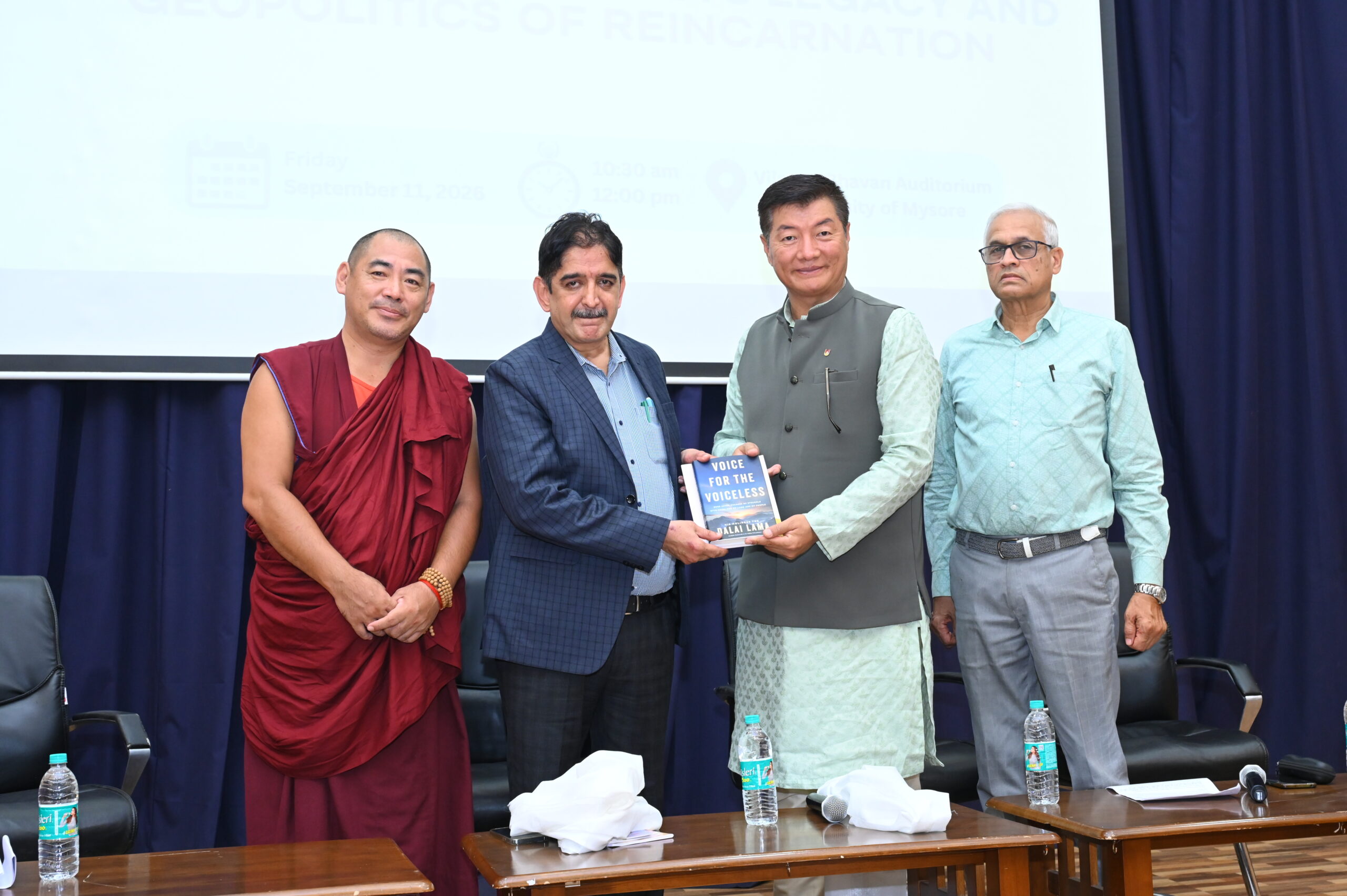
Dr. Lobsang Sangay began his address by highlighting the global legacy of His Holiness the 14th Dalai Lama. He referred to His Holiness’ extensive literary contributions and numerous international honors, including the Nobel Peace Prize, the Templeton Prize and the United Nations environmental award. Dr. Sangay encouraged students to learn more about His Holiness’ life and specifically recommended his latest auto-political biography book Voice for the Voiceless.
Dr. Sangay also emphasized His Holiness’ contribution to SEE Learning. He argued that conventional education tends to emphasize career development, achievement, material success and physical well-being, while insufficient attention may be given to emotional balance, compassion, ethical responsibility and social responsibility. He urged the University of Mysore to consider incorporating such approaches into its educational curriculum.
On the question of reincarnation, Dr. Sangay emphasized the Tibetan Buddhist position that the recognition of a Dalai Lama is fundamentally a matter of religious tradition. He questioned the legitimacy and pointed out the deep irony of an atheist Chinese government attempting to intervene and control a spiritual reincarnation process.
Dr. Sangay warned that competing claims over the Dalai Lama reincarnation could severely impact Himalayan security and regional stability. He urged strong public support for the traditional reincarnation process associated with the Gaden Phodrang institution.
Concluding his address, Dr. Sangay recalled the historic ties between Tibetans and the state of Karnataka, praising the role of former Chief Minister S. M. Nijalingappa in providing land for Tibetan settlements, which established Karnataka as the premier hub for the Tibetan diaspora in India.