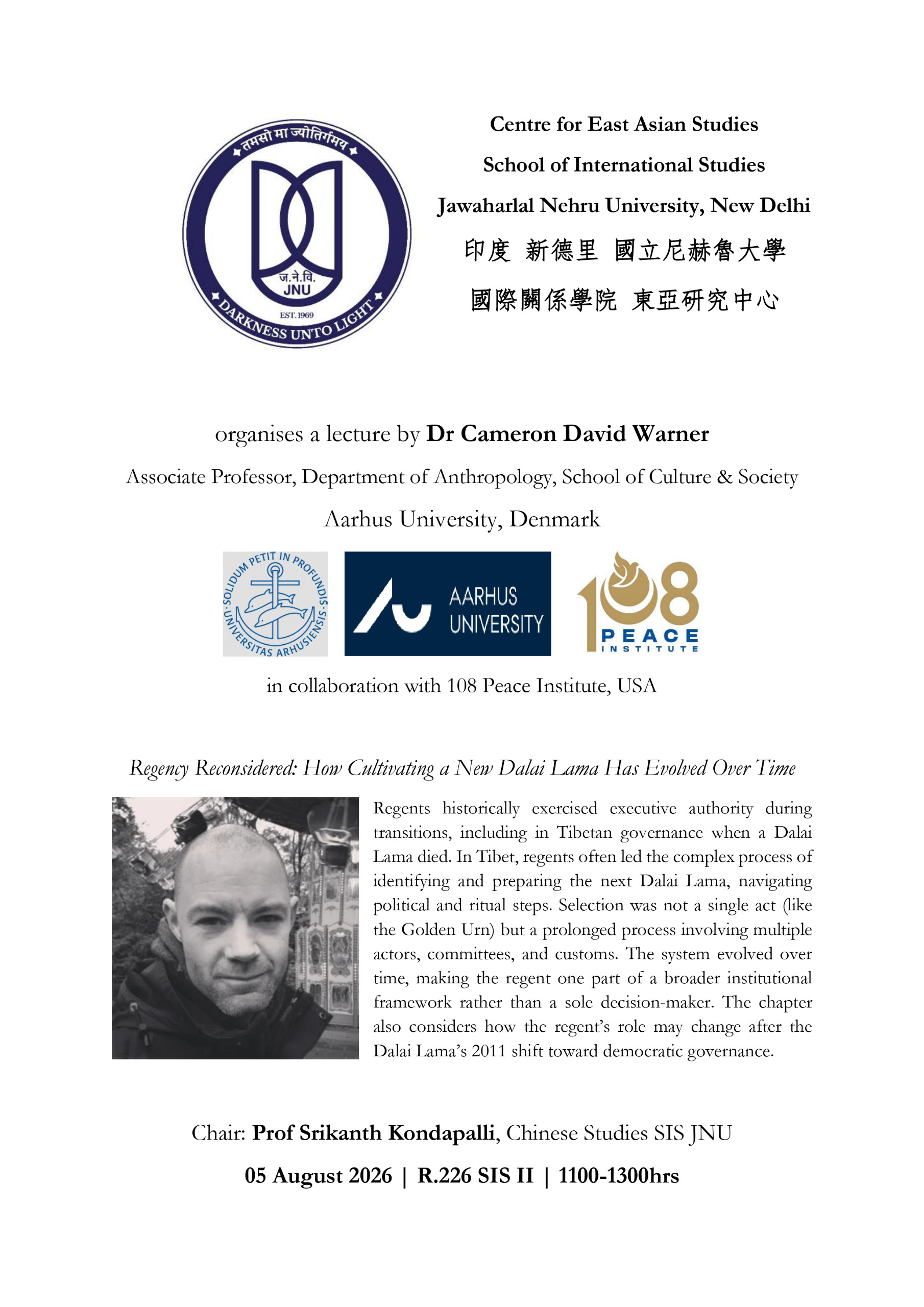
August 05, 2026: The 108 Peace Institute in collaboration with Centre for East Asian Studies, School of International Studies, Jawaharlal Nehru University, New Delhi, organized a talk titled “Regency Reconsidered: How Cultivating A New Dalai Lama Has Evolved Over Time” featuring guest speaker Dr. Cameron David Warner, Associate Professor, Department of Anthropology, School of Culture & Society, Aarhus University, Denmark.
Dr. Srikanth Kondapalli opened the session by highlighting His Holiness the 14th Dalai Lama’s announcement, made on the occasion of his 90th birthday, that the institution of the Dalai Lama will continue and that he will be reincarnated. Wishing His Holiness a long and healthy life, Dr. Kondapalli emphasised that the question of succession represents a crucial phase in the history of the Dalai Lama institution, which was established during the period of Kublai Khan. He noted the important role of regency throughout the institution’s history, as the reincarnated Dalai Lama must be guided and educated in Buddhist philosophy before becoming sufficiently mature to assume the leadership role.
Dr. Cameron began his presentation by providing an overview of the ongoing contest surrounding the selection of the next Dalai Lama. He explained that Trulku has control over when or where they will be reborn. In the summer of 2025, His Holiness the Dalai Lama announced that his reincarnation would take place in a free country, outside China’s control. The Chinese Government, on the other hand, has stated that it will select the next Dalai Lama. The United States Government has enacted legislation supporting the authority of the Dalai Lama’s office in determining his successor, and the European Union has also expressed support for this position. Consequently, the question of the next Dalai Lama has gained a significant geopolitical dimension.
Dr. Cameron noted that, during Dr. Lobsang Sangay’s tenure in 2019, a special general meeting of Tibetans was convened by the Central Tibetan Administration, where in a resolution was passed affirming that the authority to recognise the next Dalai Lama rests with His Holiness. In addition, the 14th Religious Conference reaffirmed its support for His Holiness’ authority concerning his reincarnation.
Historical Evolution of the Recognition Process
Dr. Cameron provided a detailed analysis of how successive Dalai Lamas have been identified and recognised, demonstrating that the process has never followed a single, uniform procedure. Rather, several processes and practices have been followed at different points in history, and the system of identifying the Dalai Lama has evolved over time and continues to evolve.
The first four Dalai Lama’s reincarnation were mainly chosen among royal families. The Sixth Dalai Lama was chosen under the sole authority of the regent Desi Sangye Gyatso. In the case of the Seventh Dalai Lama, identification involved non-human agents, including deities and spirits. Following the Eighth Dalai Lama, the Qianlong Emperor introduced the Golden Urn system, under which the names of candidates were placed in an urn and one name was picked. Dr. Cameron observed that this method had similarities with Tibetan divination practices and was therefore not necessarily an entirely new method of selection.
In the case of the Ninth Dalai Lama, two candidates were considered, and the candidate favoured by the personal attendant of the Eighth Dalai Lama, someone who had known him closely was ultimately selected. The Golden Urn was not used. This illustrates that personal knowledge and testimony could play an important role in the recognition process.
For the Tenth Dalai Lama, six candidates were eventually considered. The candidate selected was favoured by an oracle, and both the officials and the regent accepted the oracle’s choice. Once again, the process involved a group of individuals and multiple sources of authority rather than a single decision-maker. There remains a difference in historical accounts regarding the use of the Golden Urn, with Qing records asserting that the system was used, while Tibetan accounts suggest that its application was delayed and that it was not actually used.
The Eleventh and the Twelfth Dalai Lamas were recognised through the Golden Urn system, although both died at a relatively young age.
The recognition of the Thirteenth Dalai Lama demonstrates another distinct process. The physical position of the previous Dalai Lama’s body was interpreted as significant: his corpse repeatedly turned towards the southeast, which was understood as an indication of the direction in which the search should be conducted. The search and recognition process also involved the Eighth Panchen Lama and the Nechung Oracle. The Nechung Oracle reportedly provided the names of the future Dalai Lama’s parents. Subsequently, the regent appointed an abbot who travelled to Lhamo Lhatso Lake, where he experienced a vision interpreted as directing the search party towards the location of the future Dalai Lama’s birth. The boy was subsequently identified and his name was submitted for confirmation to the last Qing Emperor and the system did not produce two or more boys and Golden Urn was not used.
The Fourteenth Dalai Lama was identified through a combination of traditional practices and multiple sources of guidance. The Thirteenth Dalai Lama’s head was said to have turned towards the northeast, which was interpreted as an indication of the direction in which the search should proceed. The regent also visited Lhamo Lhatso Lake and reported receiving visions that provided further guidance in the search. The Ninth Panchen Lama also played an important role, reporting the existence of three miraculous boys in Eastern Tibet and indicating that the search party should investigate the region. The search party included Kewtsang Rinpoche, a personal attendant of the Thirteenth Dalai Lama who had known him closely. When the search party encountered the young candidate, objects belonging to the previous Dalai Lama were presented to him. He correctly identified the objects associated with his predecessor. This object-recognition test subsequently became one of the recognised practices associated with identifying a reincarnation.
However, Dr. Cameron pointed out that even this practice has not been consistently followed. For instance, the Fifth Dalai Lama reportedly acknowledged in his autobiography that he himself had failed the test involving objects belonging to his predecessor.
A Multifaceted and Evolving Process
Emphasising that there is an internal acceptance within the Tibetan Buddhist tradition that none of these individual customs is, by itself, decisive Dr. Cameron mentioned that the various practices do not necessarily have to be followed in exactly the same manner each time. Rather, the search committee gathers information from multiple sources and attempts to interpret the overall picture emerging from that evidence.
With the exception of the Sixth Dalai Lama, in whose case the regent Desi Sangay Gyatso is understood to have exercised particularly significant individual authority, the recognition of successive Dalai Lamas has generally involved a group of people. The process has therefore historically been collective rather than the decision of a single individual.
From Recognition to Training
Dr. Cameron emphasised that becoming the Dalai Lama involves far more than identifying and recognition of a child as the reincarnation of his predecessor. Following recognition, the process continues through religious education which includes the tonsure ceremony, the conferring of a new name, the taking of novice monastic vows, extensive Buddhist education, and the conferring of higher monastic vows. In the case of the last two Dalai Lamas, this education ultimately included an advanced level of study in Buddhist philosophy. Only after these stages of recognition, training, and education, would the institution have a fully prepared next Dalai Lama.
The complete cultivation of a new Dalai Lama is not a single ritual act, like divination with a Golden Urn or some other method, but a long process involving various committees, rituals, and customs that begins before a Dalai Lama’s passing away and continues for years after the successor has been found.
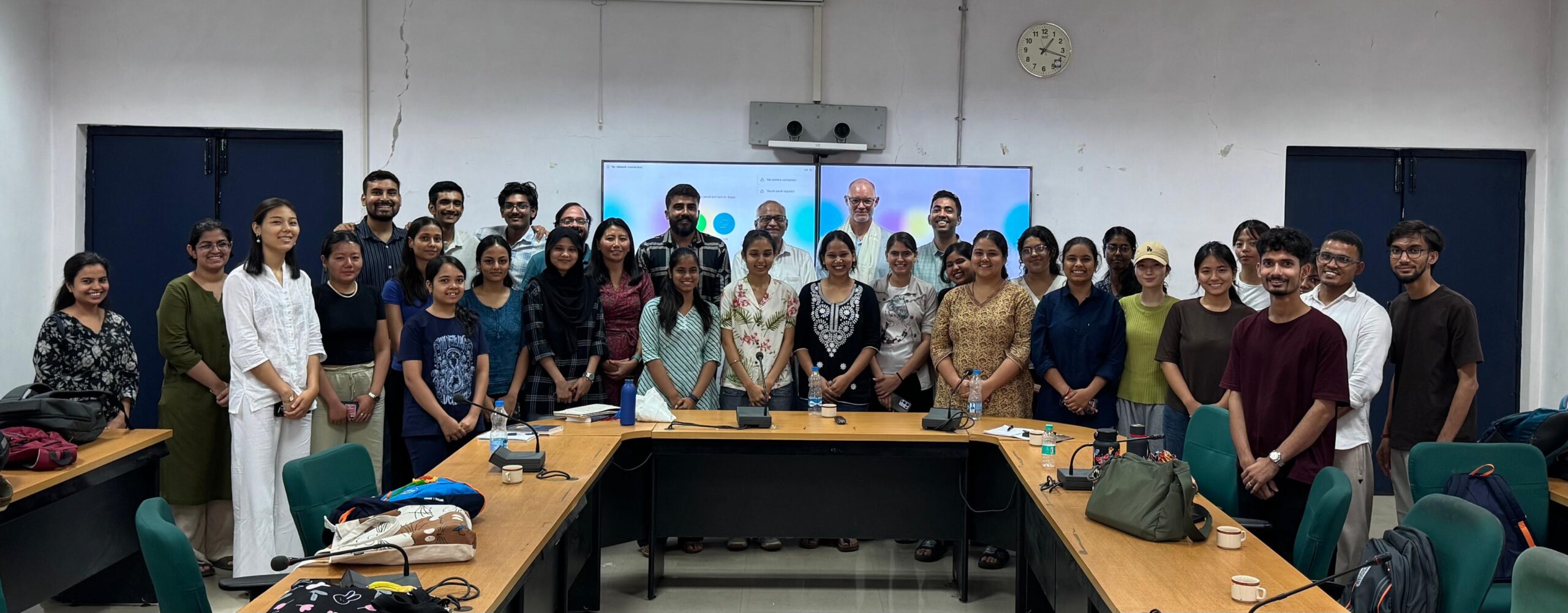
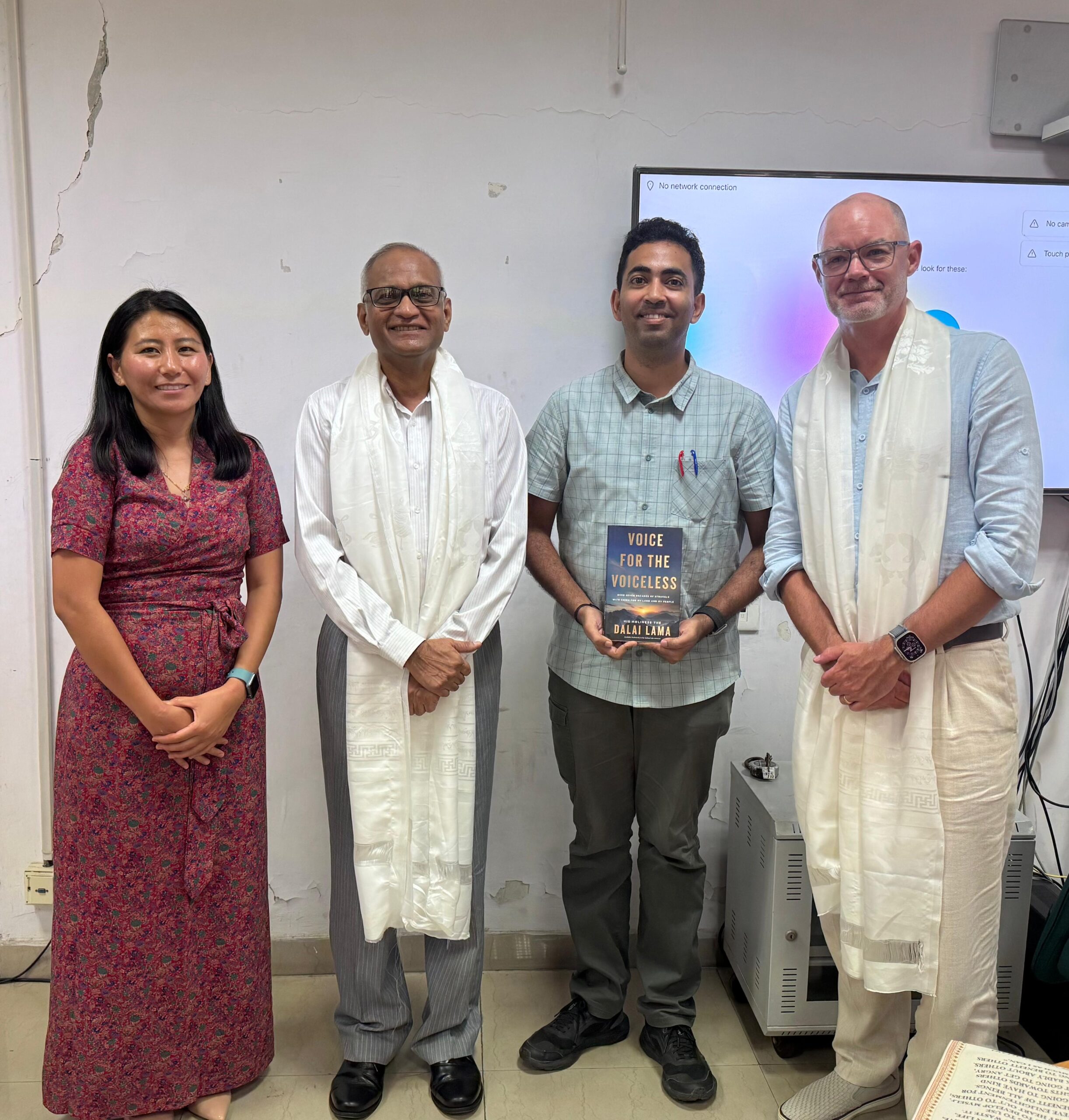
The talk was followed by a vibrant question-and-answer session, with around 40 participants, including faculty members, attending the programme. The event concluded with the felicitation of the speaker, moderator, and academic coordinator.