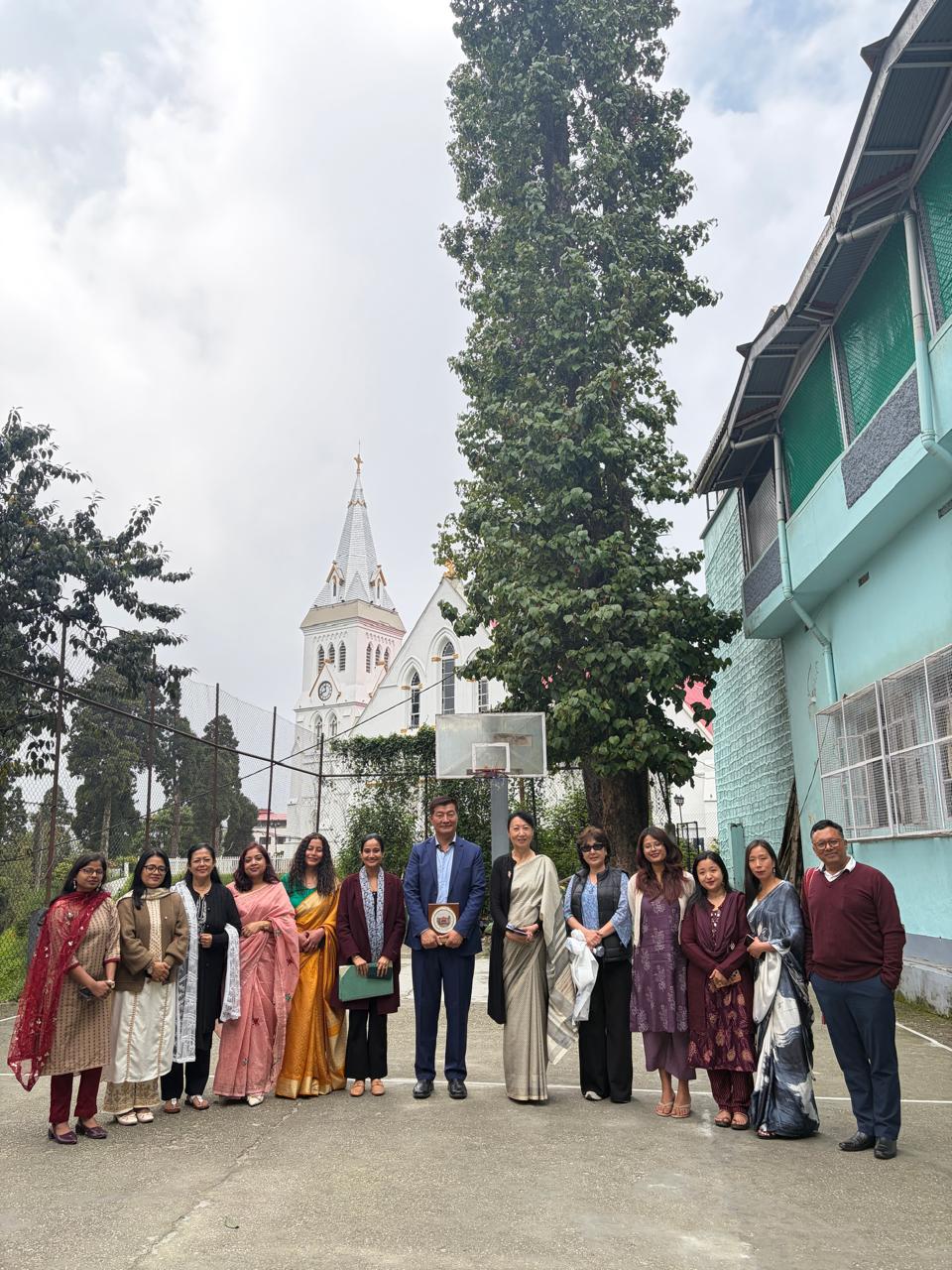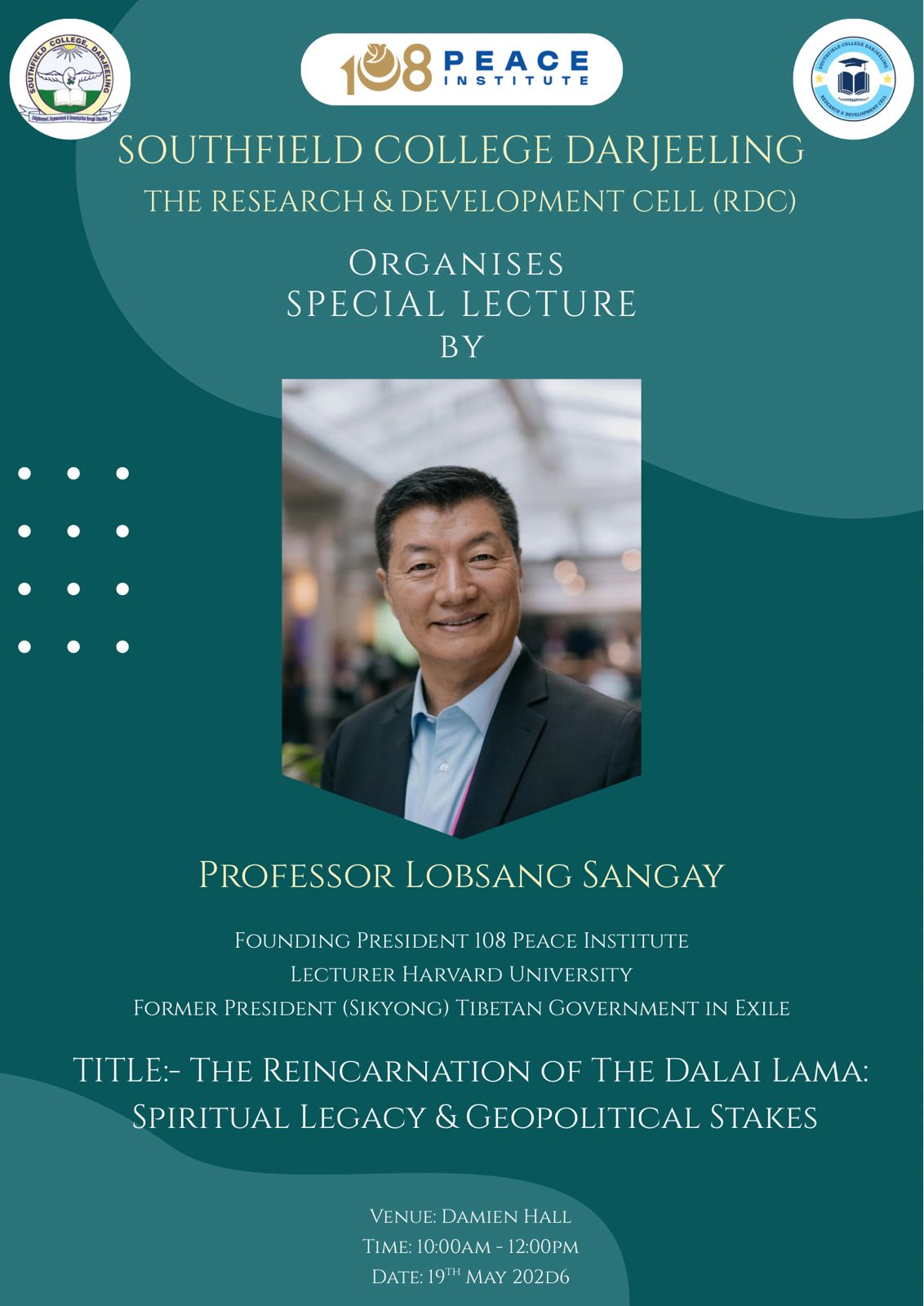
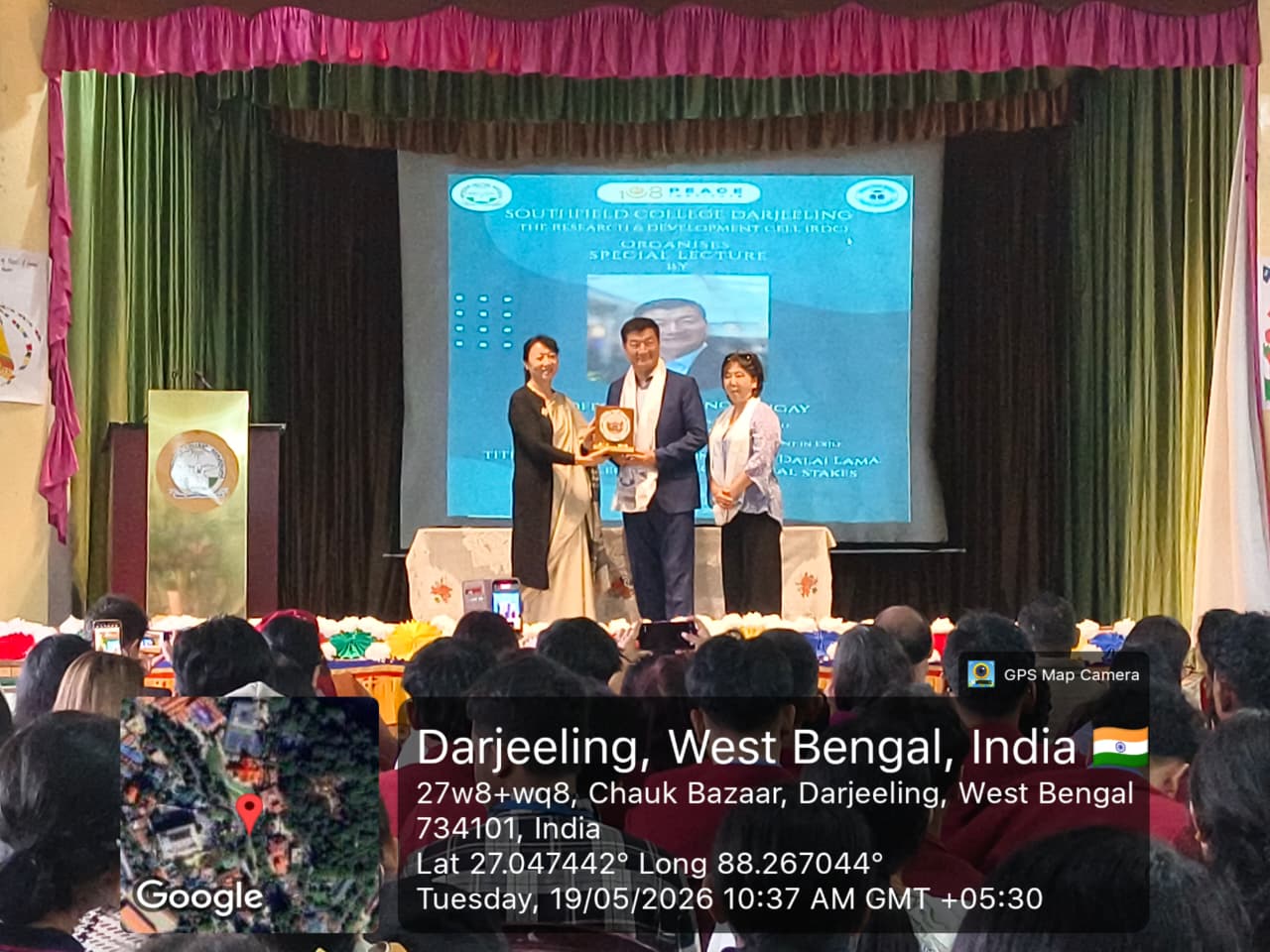
May 19, 2026: The 108 Peace Institute in collaboration with the Research and Development Cell (RDC), Southfield College Darjeeling, hosted a lecture session on “The Reincarnation of the Dalai Lama: Spiritual Legacy and Geopolitical Stakes.” The Lecture session featured Dr. Lobsang Sangay, founding president of 108 Peace Institute.
Dr. Lobsang Sangay delivered an insightful address examining both the spiritual and political dimensions of the reincarnation of His Holiness the 14th Dalai Lama. He began by emphasizing the Dalai Lama’s profound spiritual influence, which extends well beyond Tibet and reaches Buddhist communities across Mongolia, the Russian republics of Tuva, Buryatia, and Kalmykia, as well as the Himalayan regions of Ladakh, Nepal, Bhutan, Sikkim, Arunachal Pradesh, and Himachal Pradesh. Revered as the “Root Guru” by many followers, the Dalai Lama serves as a unifying spiritual figure for Buddhist communities spanning from India to Russia.
Dr. Sangay referred to His Holiness’ recent public statement confirming that the institution of the Dalai Lama will continue through reincarnation. The announcement followed years of appeals from Buddhist communities around the world seeking clarity on the issue. According to Dr. Sangay, His Holiness has clearly stated that his future incarnation will be born in a free country, a position also expressed in his book Voice for the Voiceless. He further highlighted the Dalai Lama’s criticism of Chinese Communist Party (CCP) attempts to influence the succession process, pointing out the contradiction of an officially atheist government seeking authority over a religious tradition.
During the discussion, Dr. Sangay explained the distinction between rebirth and reincarnation within Tibetan Buddhism and stressed that the recognition of a reincarnated spiritual leader is a sacred matter rooted in religious tradition. He argued that the CCP lacks both the spiritual legitimacy and religious understanding required to participate in such a process. The decision regarding where and how the Dalai Lama will reincarnate, he said, rests solely with His Holiness. Dr. Sangay also noted the inconsistency of the Chinese government’s long-standing criticism of the Dalai Lama while simultaneously expressing interest in selecting his successor.
Elaborating on the traditional process of identifying a reincarnation, Dr. Sangay stated that a regency or search committee authorized by the Dalai Lama would oversee the search after his passing. Such a committee would be composed of trusted individuals familiar with His Holiness and would conduct a series of tests to determine the authenticity of potential candidates. He emphasized that the procedure is deeply spiritual and follows centuries-old traditions. As an example, he recalled that the 13th Dalai Lama was reportedly recognized by his own cook, who had been involved in the search process.
Dr. Sangay also addressed concerns regarding the 11th Panchen Lama, Gedhun Choekyi Nyima, who disappeared in 1995 after being recognized as the Panchen Lama by the Dalai Lama. Taken into custody at the age of six along with his family, his whereabouts remain unknown. According to Dr. Sangay, the Chinese government has since promoted its own candidate as Panchen Lama, raising concerns that this individual may be used to influence the future recognition of the next Dalai Lama.
He further clarified that Tibetan Buddhist tradition distinguishes between endorsement and recognition. While Dalai Lamas and Panchen Lamas have historically affirmed one another’s spiritual authority, the formal recognition of reincarnations is carried out by separate institutions. The Dalai Lama is traditionally recognized by the Gaden Phodrang, while the Panchen Lama is identified by Tashi Lhunpo Monastery. Dr. Sangay stressed that no Panchen Lama has historically played a direct role in recognizing a Dalai Lama and criticized efforts to alter these traditions for political purposes.
The event drew participation from approximately 100 students and faculty members and concluded with a lively question-and-answer session. Participants engaged in discussions on Tibet’s geopolitical importance, the future of Tibetan Buddhism, and the religious traditions surrounding the Dalai Lama’s reincarnation. The session provided valuable insights into the historical, cultural, and political aspects of the Tibetan issue while encouraging thoughtful dialogue on its global significance.