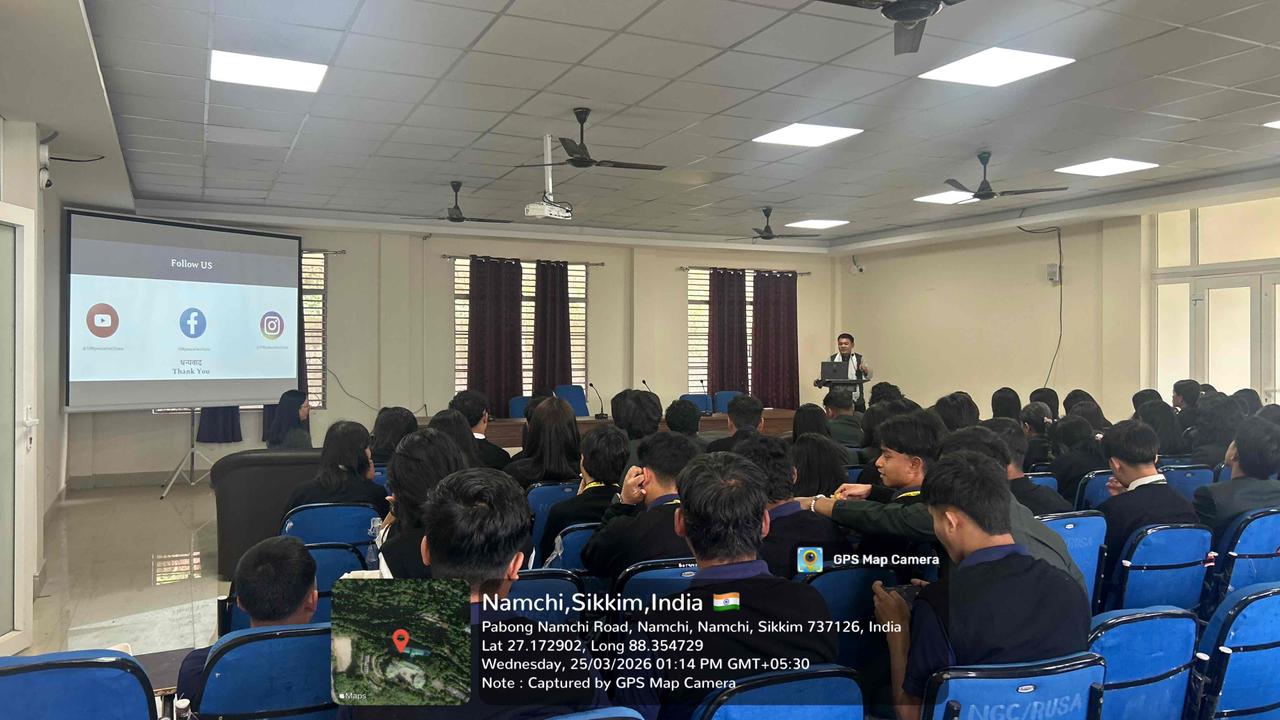
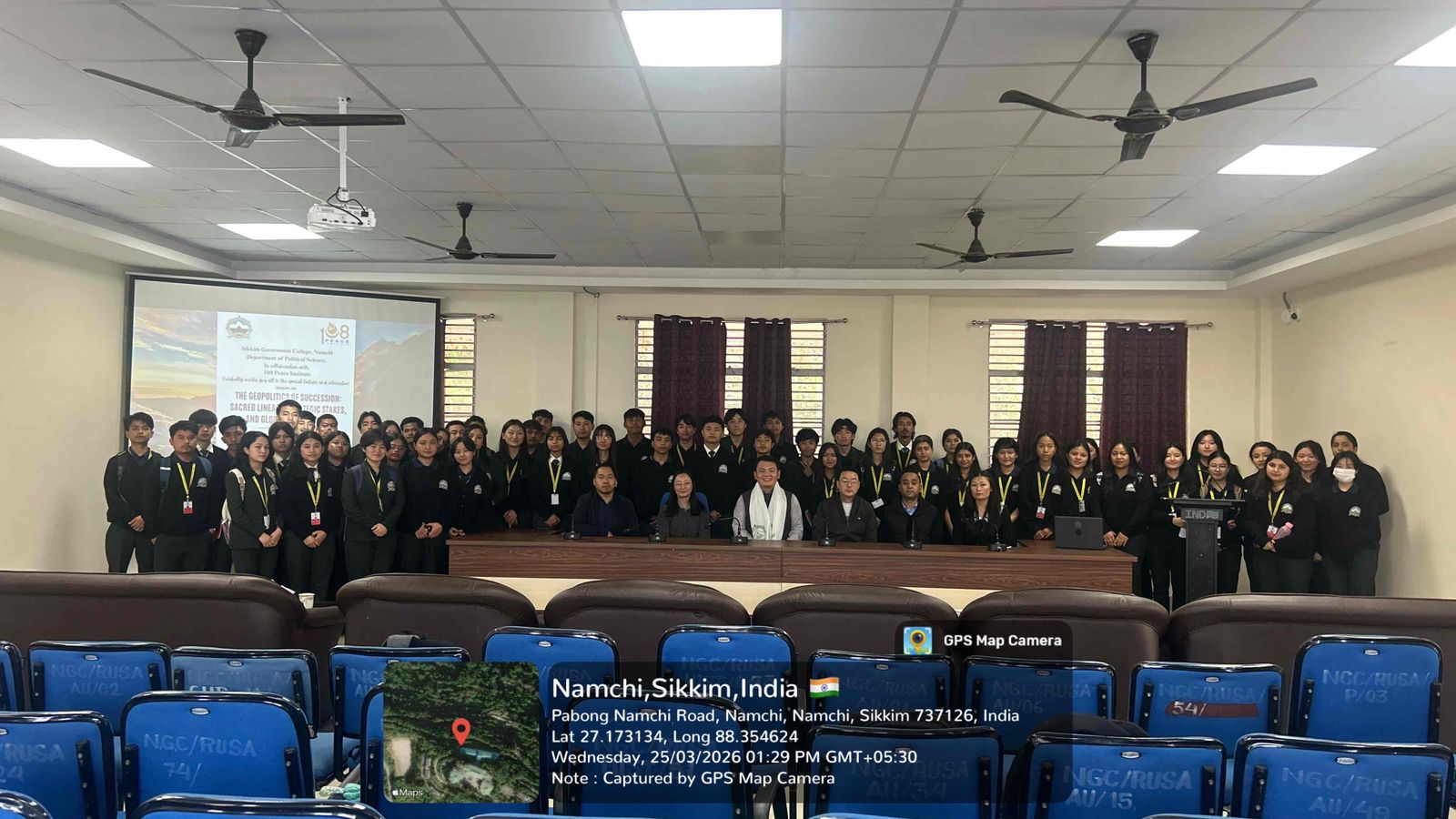
March 25th, Namchi: The 108 Peace Institute, in collaboration with the Department of Political Science of the Sikkim Government College based in Namchi, organised a talk on ‘The Geopolitics of Succession: Sacred Lineage, Strategic Stakes, and Global Implications’ delivered by Mr. Yeshi Dawa, a senior researcher at the 108 Peace Institute. The talk was attended by more than 80 students and the faculty members.
Mr. Dawa began by stressing the importance of the four principal commitments of the 14th Dalai Lama and their relevance to the promotion of basic human values such as compassion, love, and kindness. He emphasized that the fourth commitment—the revival of ancient Indian wisdom—has a significant role to play in fostering a better world for future generations. He also highlighted the personal relationship between the 14th Dalai Lama and India, noting how India is grateful for his contributions as an ambassador of ancient Indian wisdom. Additionally, Mr. Dawa underscored the invaluable role of the 14th Dalai Lama in promoting a conducive environment for religious harmony. Overall, he outlined the contributions of the 14th Dalai Lama to the world, and to India in particular, as well as the relevance of the institution of the Dalai Lama beyond religion.
Mr. Dawa, then, spoke on the paradoxical claims by the Chinese Communist Party to choose the next Dalai Lama. Mr. Dawa traced the historical track record of the Chinese Communist Party towards the 14th Dalai Lama and Tibetan Buddhism in particular. Mr. Dawa quoted the notorious remarks of the founding father of the Chinese Communist Party Mao Zedong where he said that religion is a poison. The recent track record of the destruction of the Tibetan monasteries in Tibet and the iron grip on religious freedom in Tibet. Mr. Dawa questioned the legitimacy of the Chinese Communist Party in choosing the next Dalai Lama. Why is the Chinese Communist Party not interested in the 14th Dalai Lama and more interested in the 15th Dalai Lama? Mr. Dawa’s remarks, therefore, highlighted the real intention of the Chinese Communist Party in the succession matter of the 14th Dalai Lama.
Mr. Dawa concluded the talk by highlighting the ramifications of the geopolitical stakes if the Chinese Communist Party succeeds in choosing the next Dalai Lama. How would the Chinese Communist Party use the office of the Dalai Lama in future to influence the Buddhist nations and the Buddhist states in India? How would India look at the issue of the 14th Dalai Lama’s reincarnation?
The talk was followed by an exchange of Q&A. The students asked questions relating to the history of Tibet and the 14th Dalai Lama.
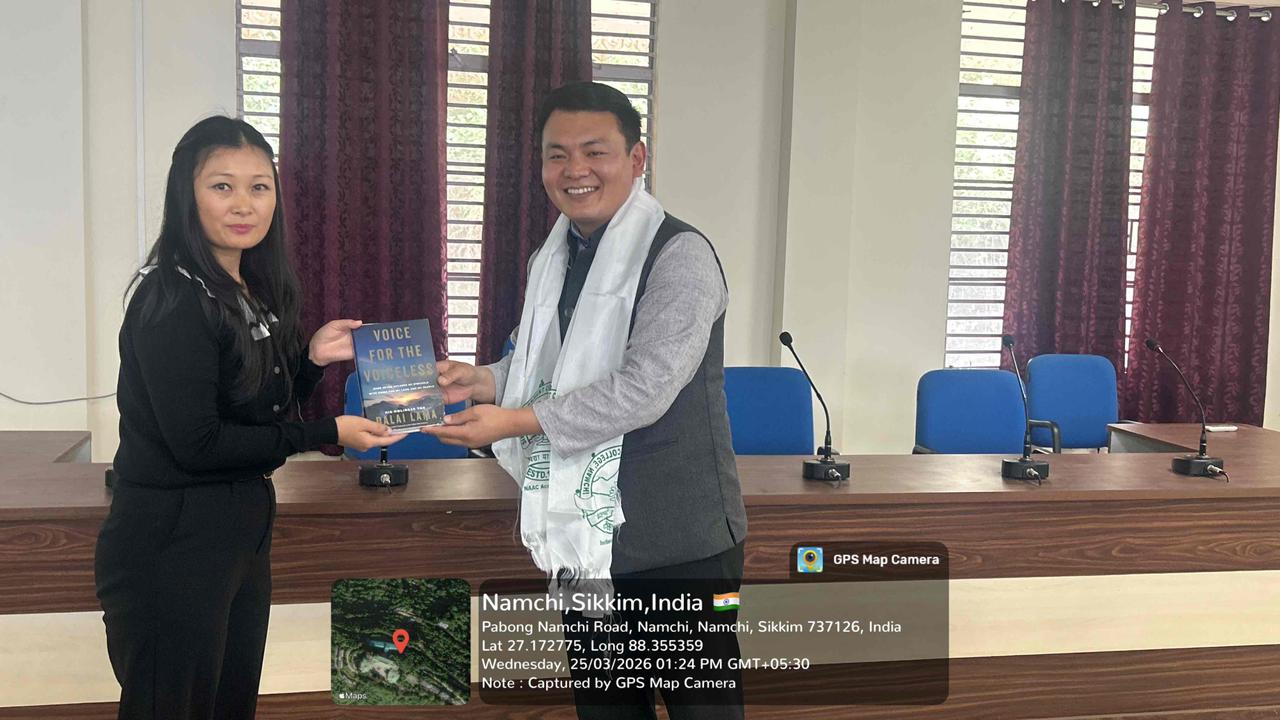
Mr. Dawa acknowledged the warm hospitality and the contribution of Dr. Panu Pazo in making the talk possible. As a token of gratitude, a copy of ‘Voice of the Voiceless’ was presented to the HoD of the Department of Political Science, the Sikkim Government College, Namchi.