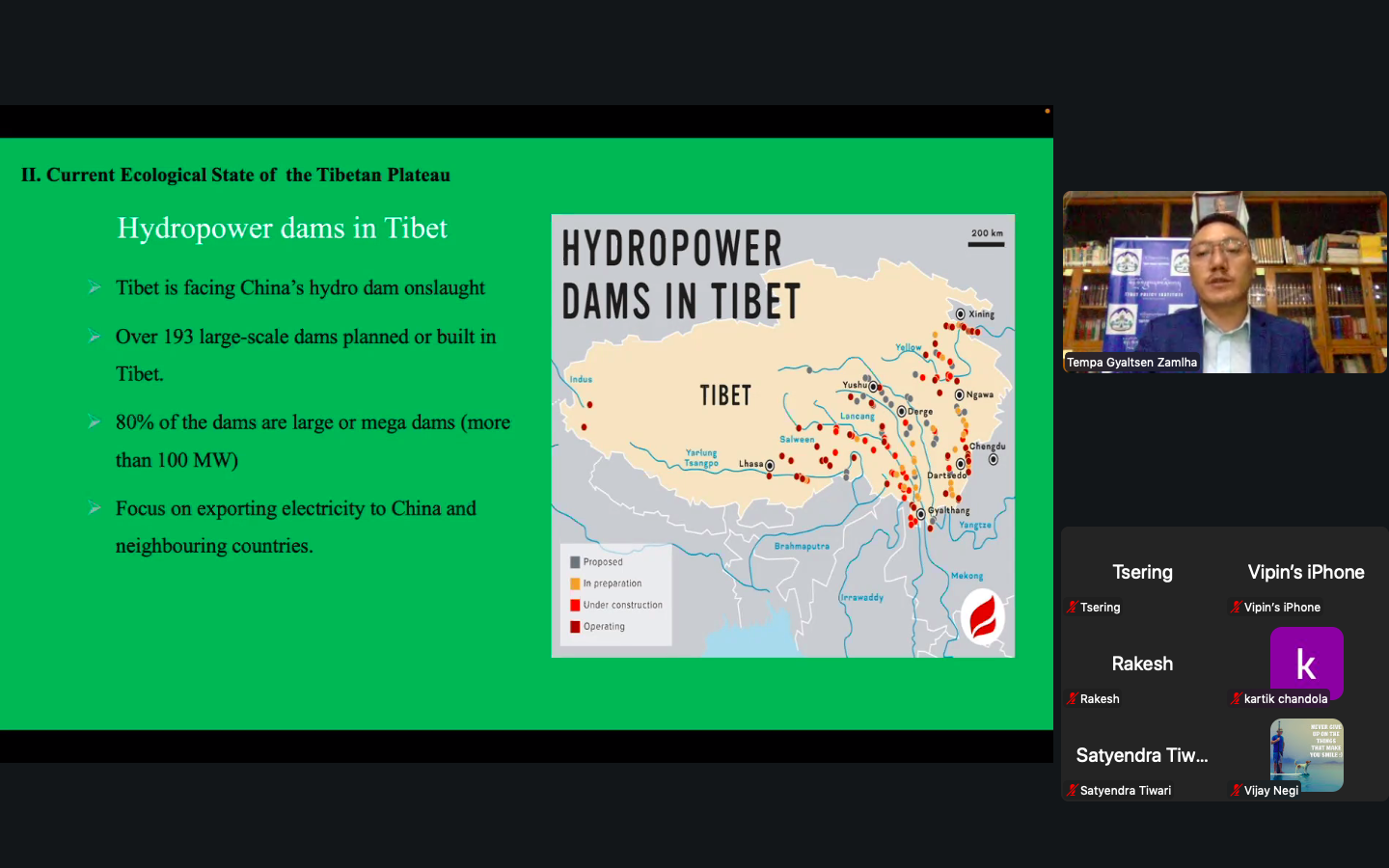

11th March 2026: The 108 Peace Institute, in collaboration with the Department of Political Science and the Directorate of IQAC at Kumaun University, Nainital, successfully organized a virtual lecture on “The Global Importance of the Tibetan Plateau and Its Rivers for Asia.” The session featured environmental scholar Mr. Tempa Gyaltsen Zamlha, Deputy Director of the Tibet Policy Institute, who highlighted the ecological, climatic, and geopolitical significance of the Tibetan Plateau. Around 60 enthusiastic participants attended the lecture from the Department.
Mr. Tempa explained that the Tibetan Plateau, often called the “Roof of the World,” spans about 2.5 million square kilometers and has an average elevation above 4,000 meters, making it the highest and largest plateau on Earth. He adds that it is also referred to as the “Third Pole” due to its approximately 46,000 glaciers, the largest concentration of ice outside the polar regions. These glaciers form a crucial freshwater reserve, making the Plateau one of the most important water sources globally, said the speaker.
The lecture also emphasized the Plateau’s role as Asia’s “Rain Maker,” significantly influencing regional and global climate systems, particularly the Indian monsoon. Alarmingly, temperatures in Tibet are rising at nearly twice the global average, leading to glacier retreat and increasing climate instability. These changes have far-reaching consequences, contributing to extreme weather patterns and disruptions in atmospheric circulation across distant regions.
Known as the “Water Tower of Asia,” the Plateau is the source of major rivers such as the Indus, Brahmaputra, Mekong, Yangtze, and Yellow rivers, said the speaker. He adds that these rivers sustain around 1.8 billion people directly and nearly 40% of the global population indirectly, supporting agriculture, livelihoods, and entire civilizations across Asia.
The speaker highlighted that, for centuries, Tibetans have preserved these ecosystems through deep spiritual reverence for nature, ensuring the free flow of rivers and ecological balance. However, since the occupation of Tibet, this balance has been increasingly disrupted.
At the Paris Climate Conference 2015, the 14th Dalai Lama emphasized the global importance of Tibet’s environment, stating that “this blue planet is our only home, and Tibet is its roof.”
Exploring the current ecological condition of Tibet, Mr. Tempa noted that it is affected by environmental changes, excessive mining, dam construction, and large-scale development activities carried out by China. The Plateau is experiencing increasing incidents of floods, landslides, forest fires, and extreme weather, underscoring its ecological vulnerability.
A significant portion of the lecture focused on infrastructure expansion and resource extraction in Tibet. The speaker shares that over 193 dams are planned or already constructed across the Plateau, with the majority being large hydropower projects aimed at exporting electricity beyond the region. These projects have led to the forced displacement of Tibetan communities, the destruction of villages and monasteries, and the loss of cultural heritage.
The lecture expanded on Lithium mining, which has emerged as another major concern. With vast reserves discovered in Tibet, China now holds a dominant share of global lithium resources, essential for electric vehicles and renewable energy technologies. However, the speaker said that mining activities have caused environmental damage, including river pollution and harm to fragile local ecosystems.
The lecture also highlighted the risks associated with building large dams in a seismically active region. Potential disasters such as earthquakes, dam failures, landslides, and flooding could have catastrophic downstream impacts across multiple countries in Asia.
The speaker pointed out a historical example of the 1975 Banqiao Dam failure in Henan Province, China, where the collapse of the Banqiao Dam caused by a storm led to the cascading collapse of 61 dams constructed in that one particular region. He noted that the region suffered tens of thousands of deaths (26000 to 240000) and widespread destruction. The speaker also warned that similar scenarios could repeat in Tibet, as far too many dams are being built on the Brahmaputra River, which could have a severe impact on low-lying regions such as India, Bangladesh, and Southeast Asia.
Importantly, Mr. Tempa underscored that China’s green energy ambitions are closely tied to the exploitation of Tibetan resources. Projects such as the Kamtok dam have sparked protests by over 300 Tibetans in Dege County and led to the forced relocation of at least two townships and six monasteries, including Upper Wonpotoe and Shipa villages, resulting in the loss of livelihoods, cultural identity, and heritage.
The lecture concluded with a call for scientific collaboration, policy dialogue, and collective action to protect Tibet’s Plateau and raise issues with the government and China. The speaker sent a strong message that the Tibetan Plateau is not only a regional concern but a global imperative. And, sustaining the free flow of rivers, preserving fragile ecosystems, and ensuring responsible development are essential for the well-being of billions of people across Asia and beyond.