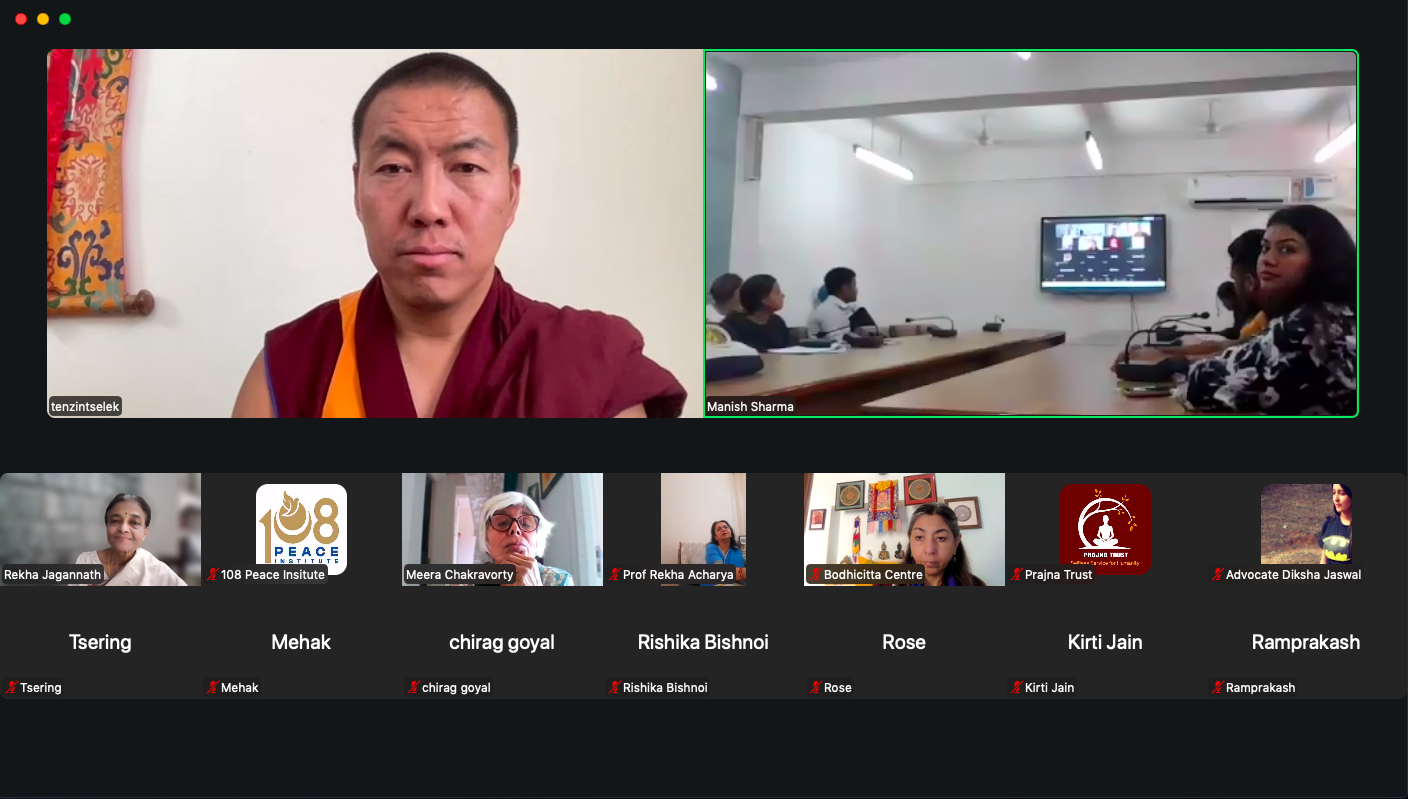
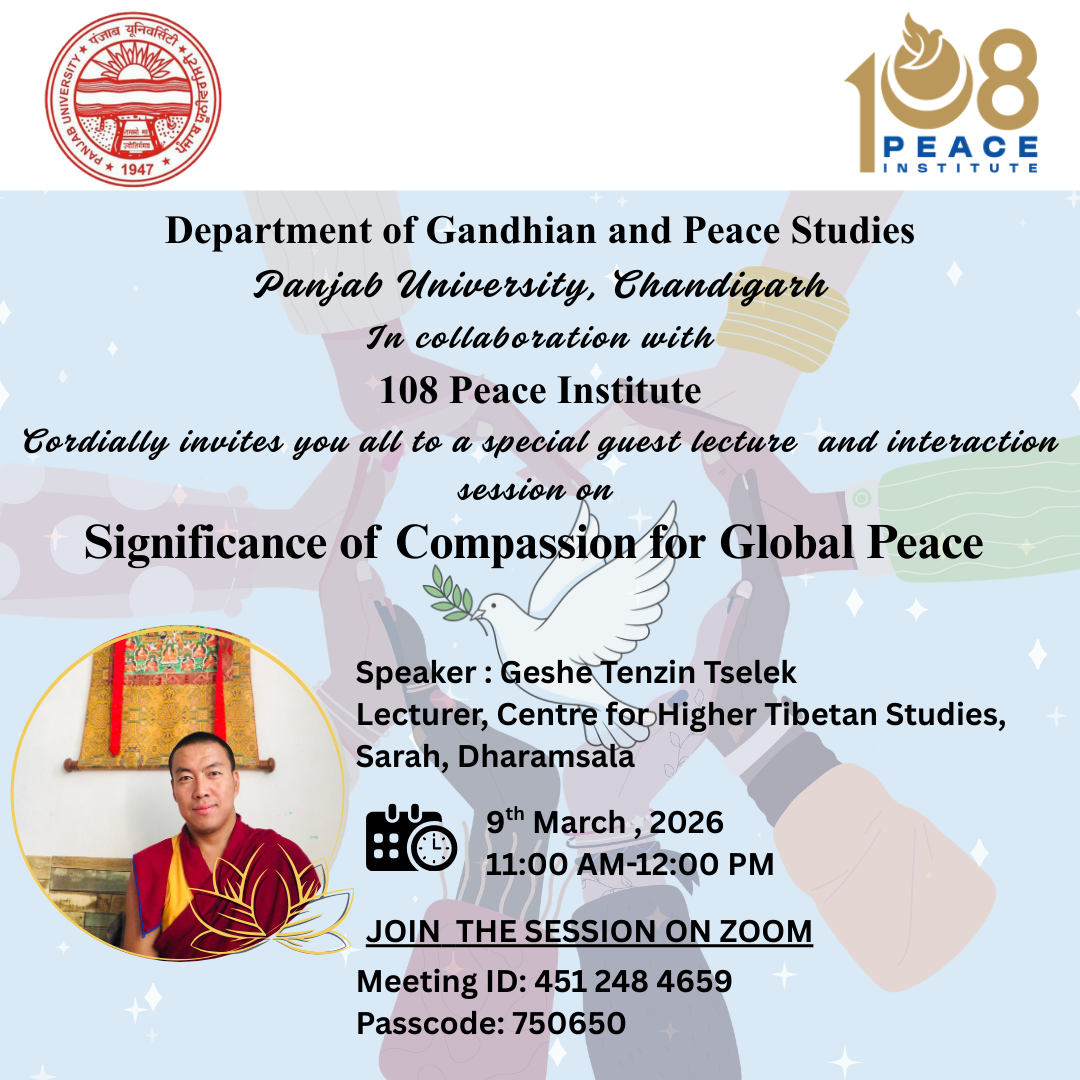
9th March 2026: The 108 Peace Institute, in collaboration with the Department of Gandhian and Peace Studies at Panjab University, organized a virtual lecture titled “The Significance of Compassion for Global Peace.” The session featured Geshe Tenzin Tselek, lecturer at the Centre for Higher Tibetan Studies, Sarah, Dharamsala. The lecture explored the role of compassion in addressing global challenges and promoting a more peaceful and interconnected world.
The lecture was structured around three key questions: Why does compassion matter? Can compassion be cultivated? And how can we cultivate it? Geshe Tenzin Tselek explained that many of today’s pressing global challenges, including poverty and economic inequality, war and armed conflict, climate change, and inter-religious tensions, are often intensified by the human tendency to divide the world into “I” and “they.” Cultivating compassion, he argued, can help overcome these divisions by encouraging individuals to recognize shared human experiences and responsibilities.
From a Buddhist perspective, he said, compassion is defined as a warm-hearted concern that arises when we recognize the suffering of others and feel motivated to alleviate it. Drawing on insights from compassion training frameworks such as Cognitively-Based Compassion Training (CBCT) and Social Emotional and Ethical (SEE) Learning, he explained that compassion consists of three key dimensions: affective (emotional warmth and empathy), cognitive (awareness and understanding of suffering), and motivational (the desire to relieve that suffering).
He emphasized that compassion acts as an antidote to anger and destructive emotions. Rather than merely an external act, compassion is an inner state of mind and a skill that can be cultivated through reflection and practice. Geshe Tenzin Tselek noted that the depth of compassion can be measured by how far it extends beyond one’s immediate circle. While it is natural to feel compassion for family and friends, he said, the highest expression of compassion arises when it can be extended even toward adversaries, turning challenges into opportunities to cultivate patience and tolerance.
He adds that compassion also transforms personal attitudes by shifting attention from narrow self-interest to a broader concern for others, fostering empathy and openness. Referring to the teachings of HH the 14th Dalai Lama, he highlighted that warm-heartedness is the ultimate source of human happiness. While even animals demonstrate basic compassion, human beings possess the unique ability to combine compassion with reason and intelligence, enabling them to extend compassion to all of humanity.
However, Geshe Tselek points out that many people hesitate to cultivate compassion due to certain emotional misconceptions. Some fear that if they are compassionate, others may take advantage of them or become dependent on them. Others worry that showing compassion may make them appear weak, or that people may misinterpret their intentions. In terms of self-compassion, he said, individuals may fear becoming soft or losing strength. Geshe Tenzin Tselek clarified that genuine compassion actually strengthens emotional resilience and helps regulate these fears and negative emotions.
To cultivate compassion in practical and secular ways, he highlighted two key pillars: the oneness of humanity and interdependence. Recognizing the fundamental equality of all human beings helps overcome divisions based on nationality, religion, gender, or economic status, the speaker said. Excessive focus on these secondary differences often leads to discrimination and conflict. By contrast, acknowledging shared humanity provides fertile ground for compassion to grow.
The speaker noted that the principle of interdependence further reminds us that human beings are social by nature and deeply reliant on one another. Our happiness and well-being depend on countless others, including those we may disagree with. He emphasized that recognizing this interconnected reality encourages mutual respect and cooperation.
In his concluding remarks, Geshe Tenzin Tselek reflected on the current global landscape, noting that many political leaders tend to prioritize national interests over global concerns. He encouraged policymakers and societies to approach global challenges from the perspective of shared humanity rather than narrow identities, emphasizing that sustainable peace requires cooperation grounded in compassion and mutual understanding.
The virtual session, attended by 45 participants, saw a lively discussion that reaffirmed the importance of cultivating compassion as a foundation for building a more peaceful and harmonious world. At the participants’ request, the speaker concluded the session with a prayer for peace and resilience in these challenging times marked by war and global uncertainty. He also shared a favorite verse of HH the 14th Dalai Lama:
“As long as space remains,
As long as sentient beings remain,
May I too remain
To dispel the darkness/suffering of the world.”