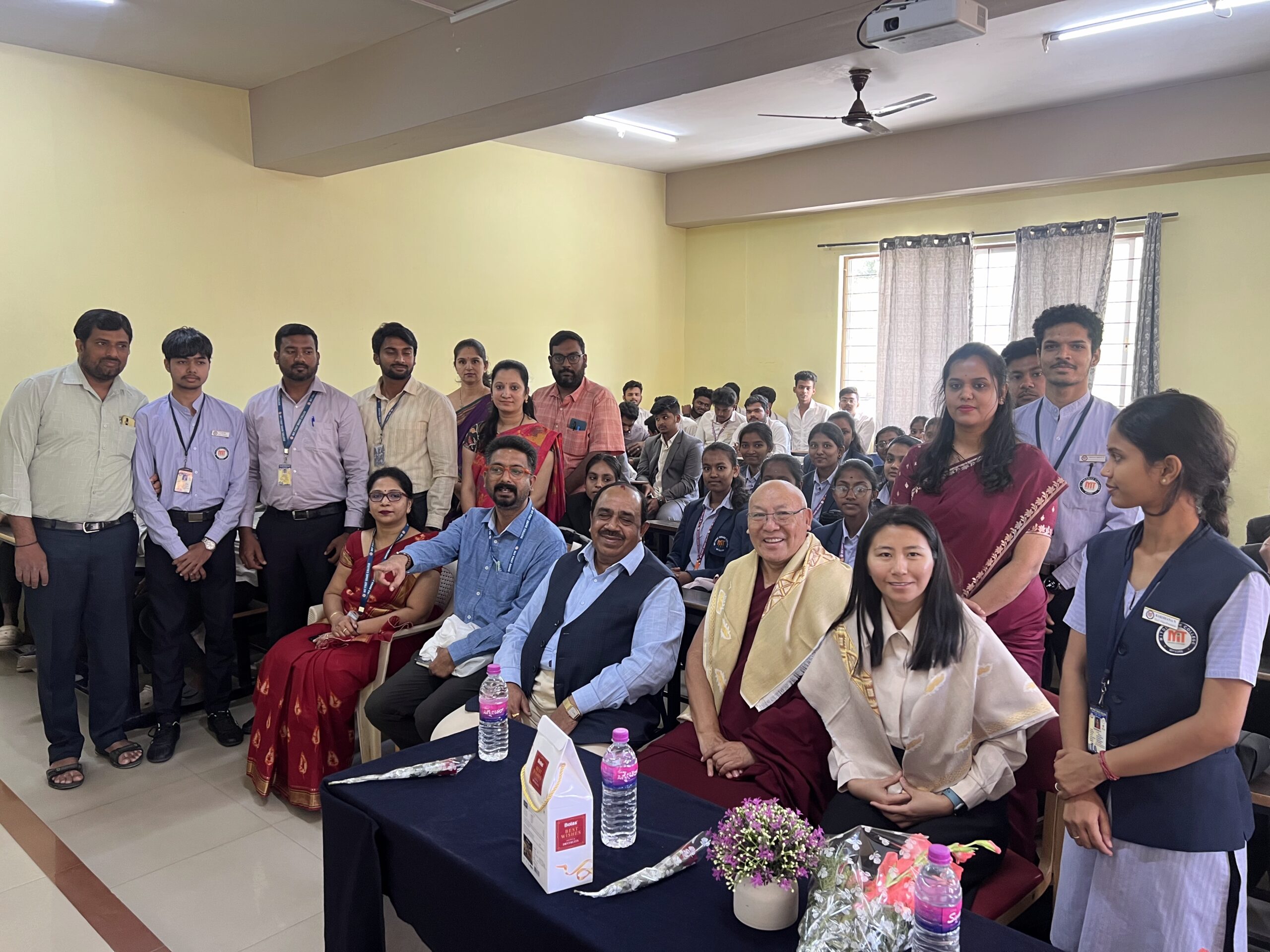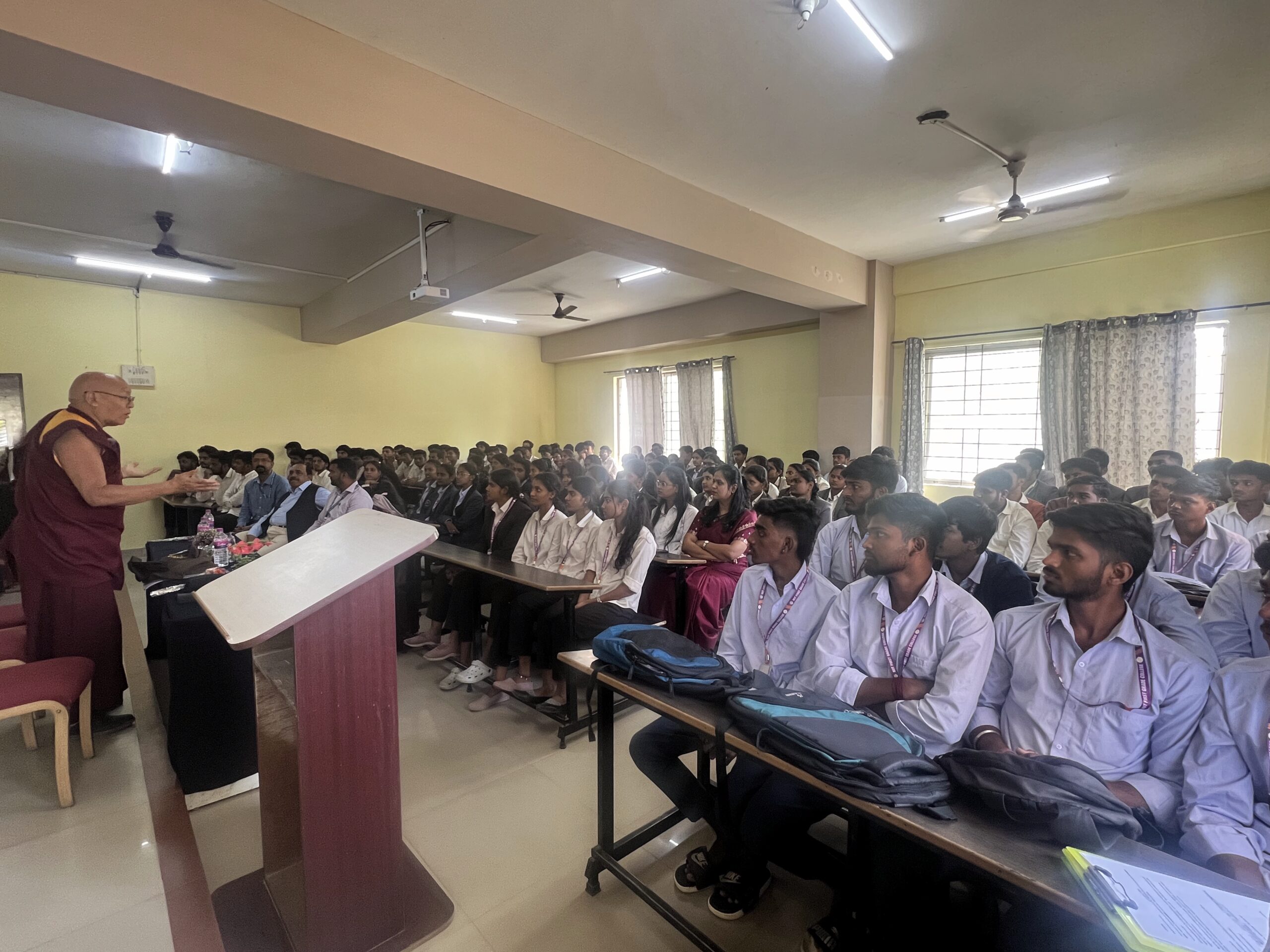
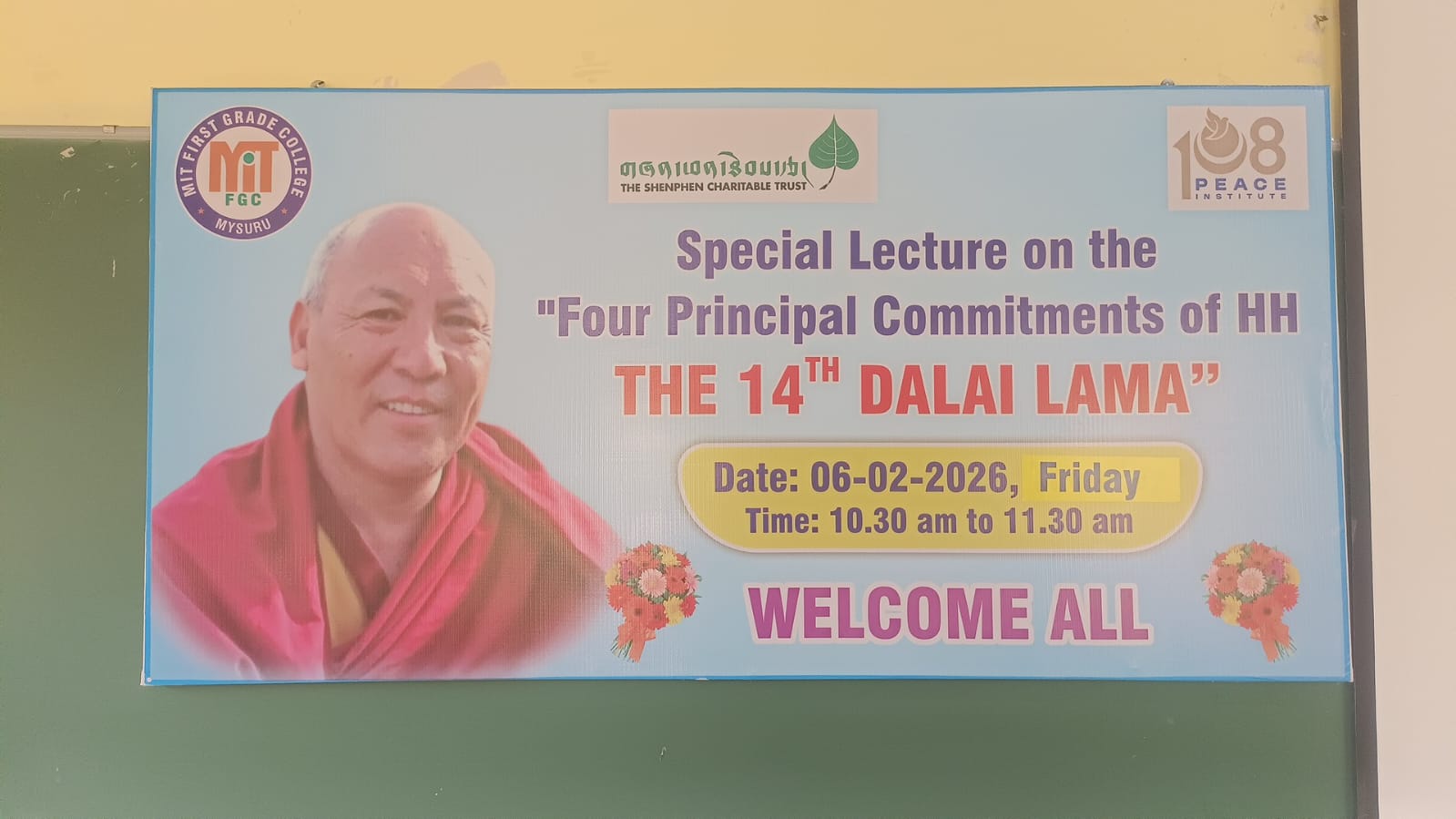
February 6, 2026: The 108 Peace Institute, in collaboration with MIT First Grade College Mysore, and the Shenphen Charitable Trust, Mysore, organized a lecture session titled “Four Principal Commitments of His Holiness the 14th Dalai Lama” featuring Venerable Geshe Lhakdor, a distinguished Tibetan Buddhist scholar and Director of the Library of Tibetan Works and Archives.
Geshe Lhakdor began the talk by reflecting on the source of long-lasting happiness. He emphasized that His Holiness the 14th Dalai Lama, upholds several core commitments, the first of which is the preservation and promotion of universal human values such as loving-kindness, compassion, wisdom, patience, and a sense of responsibility.
He explained that every human being seeks happiness and wishes to avoid suffering. Since all people are interconnected and interdependent, nurturing human values becomes essential for a harmonious society. In this context, he stressed that education should not be limited to reading, writing, and obtaining certificates. Instead, true education should focus on human flourishing, teaching individuals how to live happily with others and avoid feelings of depression and loneliness. He highlighted the importance of cultivating a compassionate mind and maintaining a healthy inner way of thinking. In this regard, Geshe la, reiterated the importance of adopting the Social, Ethical, and Emotional Learning (SEE) curriculum introduced by His Holiness the Dalai Lama in school.
Geshe la also spoke about His Holiness’s second commitment: the promotion of interreligious harmony. Drawing an analogy with medicine, he explained that one cannot declare a single medicine as the best, since different illnesses require different treatments. A medicine may be expensive, but if it does not cure the disease, it is of no use. Similarly, he emphasized that individuals have different mental dispositions and spiritual inclinations, therefore follow different religions according to their interest. Therefore, it is not appropriate to claim that one religion is superior to others. Conflicts often arise when people fight in the name of religion.
Geshe la further noted that His Holiness, being Tibetan, also feels a responsibility to preserve Tibetan culture, language, and environment. He stated that Tibet’s rich cultural and spiritual heritage faces serious challenges due to the illegal occupation by the Chinese Communist Party. Historically, Tibet was an independent and peaceful nation that shared a border with India, and there was little need for military presence along the frontier. However, following the Chinese invasion, thousands of troops now guard the border between India and Tibet. According to Geshe, both Tibet and India have been affected by this situation.
Finally, he spoke about His Holiness’s fourth commitment, the preservation of the Nalanda tradition, the ancient Indian tradition of scholarship and philosophical inquiry. He encouraged students to preserve India’s culture, traditions, and languages while learning from other cultures. While Western knowledge and ideas can be valuable, he cautioned against what he described as “westoxication,” urging students not to forget India’s rich civilizational heritage. He emphasized that India’s long tradition of training the mind through logic, reasoning, and psychology has the potential to make meaningful contributions to the world.
The lecture concluded with an interactive question-and-answer session. Around 100 students and faculty members attended the event.