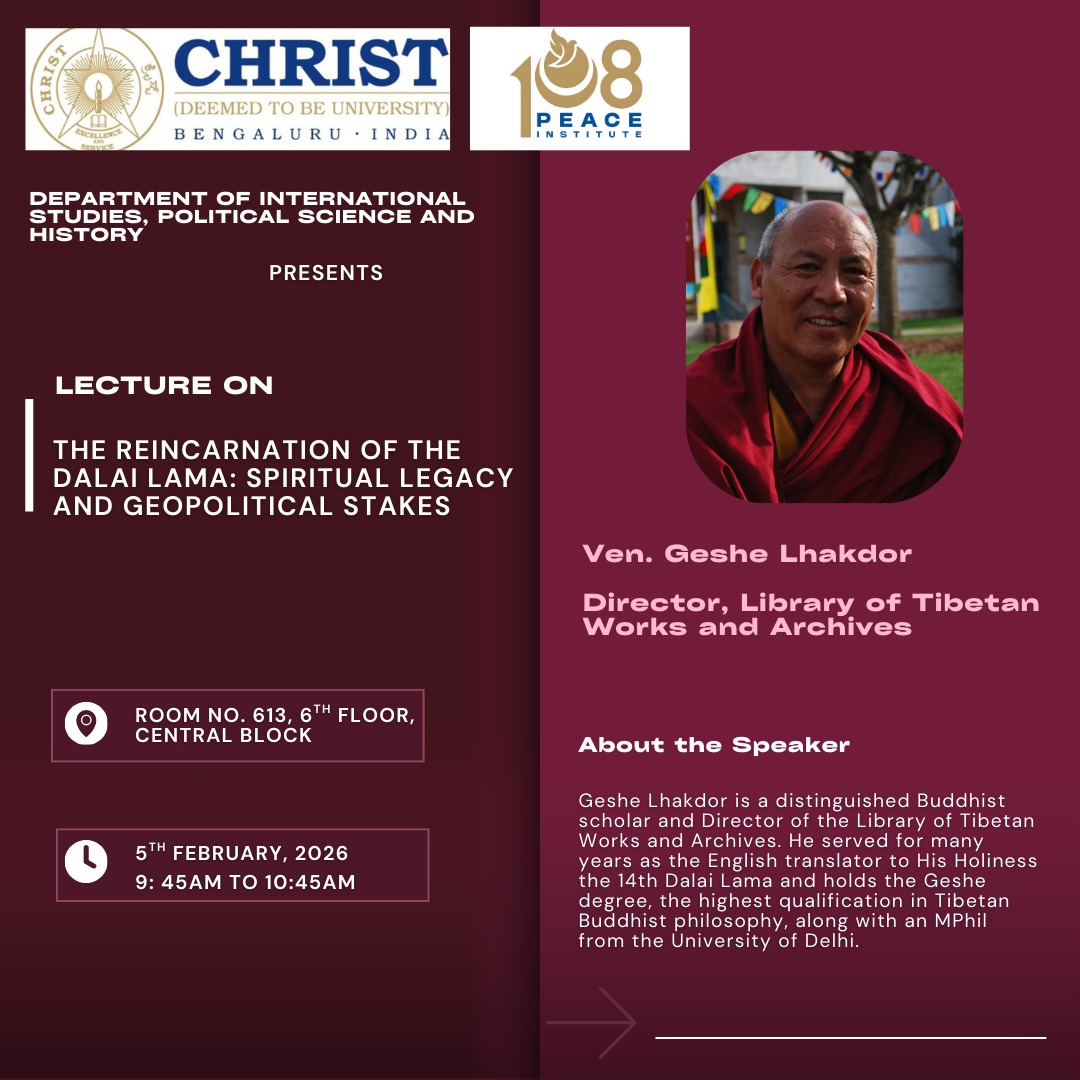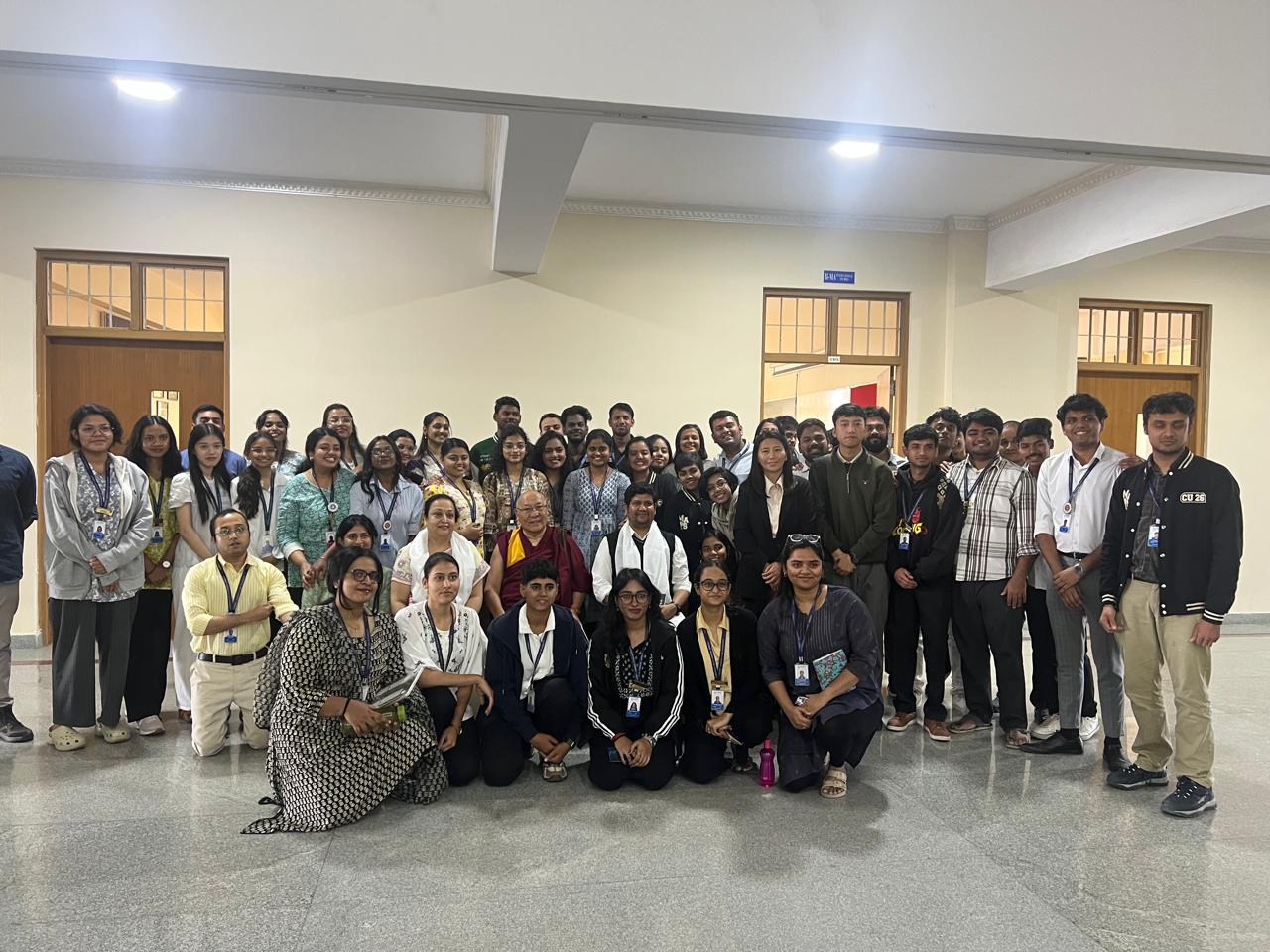
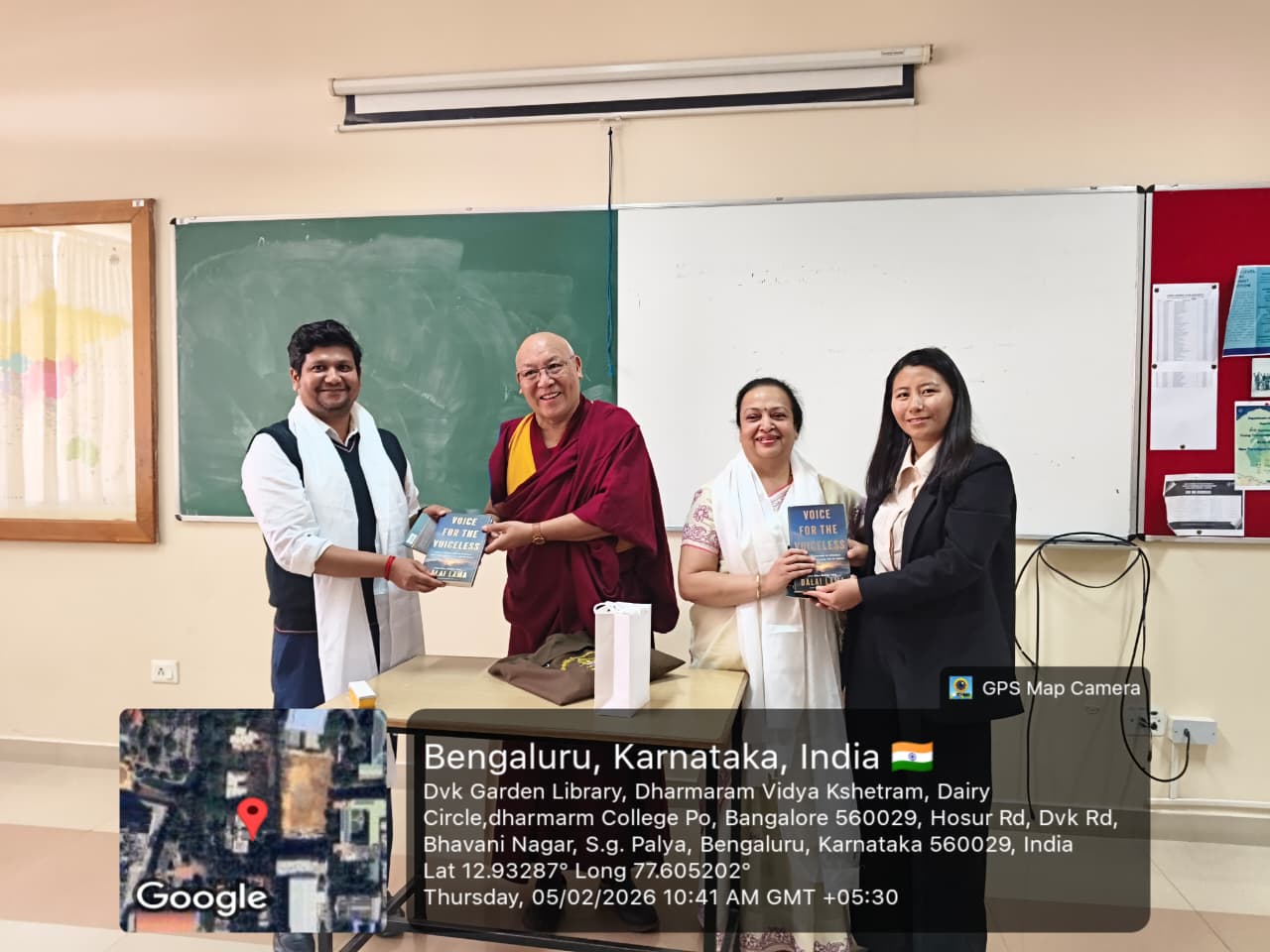
February 5, 2026: The 108 Peace Institute, in collaboration with Dept of International Studies, Political Science, and History, Christ University, organized a lecture session titled “The Reincarnation of the Dalai Lama: Spiritual Legacy and Geopolitical Stakes.” The session featured Venerable Geshe Lhakdor, a distinguished Tibetan Buddhist scholar and Director of the Library of Tibetan Works and Archives.
Geshe Lhakdor began his lecture by explaining the nature of the mind in Buddhist philosophy. He described the mind as a subtle energy that is both luminous and cognitive. According to him, human beings often rely more on sense consciousness rather than mental consciousness. Emphasizing the importance of mental cultivation, he stated that individuals must take care of the mind, as it governs one’s life. He further noted that, in Buddhist understanding, the mind does not cease with death. Referring to scientific perspectives, he mentioned that the human body undergoes significant transformation approximately every seven years, replacing nearly all of its cells. In contrast, he explained, the continuity of mind is a concept deeply rooted in ancient Indian traditions as well.
Clarifying a commonly misunderstood distinction, Geshe Lhakdor explained the difference between rebirth and reincarnation. He noted that rebirth is a universal process experienced by all beings, regardless of personal preference. The nature of one’s future experiences, he explained, is shaped by present actions and intentions. Rebirth, in Buddhist thought, is largely influenced by contaminated actions and negative emotions, although individuals can refine their conduct to achieve a more favorable rebirth. Reincarnation, however, is different. It refers to the conscious return of highly realized spiritual beings who, despite not needing to remain within the cycle of samsara, choose to be reborn out of compassion in order to help others.
Highlighting the broader implications of the issue, he emphasized that the reincarnation of the Dalai Lama holds global significance due to the spiritual leader’s millions of followers, particularly across Buddhist-majority regions and the Himalayan belt. He also referred to the historical fact that the 6th Dalai Lama was born in Tawang, a region currently part of India’s Arunachal Pradesh but claimed by China. In this context, he urged India to remain vigilant regarding China’s expansionist policies.
He also provided historical context regarding Chinese involvement in the Tibetan reincarnation system. According to him, such involvement began during a dispute between the Gorkhas and the Tibetan government concerning coin circulation. At that time, the Manchu rulers of the Qing dynasty intervened in support of Tibet, partly to extend their influence and partly because many among them were Buddhists who maintained a priest–patron relationship with Tibetan religious authorities. The Manchus introduced the Golden Urn method, somewhat comparable to Tibetan divination methods such as the dough-ball technique to recognize reincarnation. However, he noted that the Golden Urn was reportedly used only once in the case of the 11th Dalai Lama. He contrasted this historical practice with the position of the modern Chinese government, which, despite being neither Manchu nor religious and officially atheist, has shown interest in controlling the Tibetan reincarnation system for political reasons.
Referring to the case of the 11 Panchen Lama, he said that the child was taken into custody by Chinese authorities at the age of six and that his whereabouts remain unknown to the international community. He warned that China now intends to play a role in selecting the next Dalai Lama. Gehse Lhakdor highlighted the United States support to the Tibetan system of recognizing reincarnations and passed several Acts opposing Chinese interference. He urged the international community to follow suit and stand against the authoritarian regime’s interference.
Referring to the Dalai Lama’s recent book Voice for the Voiceless, Geshe Lhakdor noted that His Holiness indicated that his next rebirth would occur in a free country, implying a location outside China’s political reach.
The lecture concluded with an interactive question-and-answer session. More than 70 students attended the event and actively engaged with questions on the Tibetan Buddhist system of reincarnation and its broader spiritual and geopolitical implications.